
Acceleration
One small step at a time. Ask for a clue whenever you need one.
Ask about your own question- Step 1
- Step 2
- Step 3
- New question
A skateboarder starts from rest and reaches 8 m/s in 4 seconds. What is the skateboard's acceleration (a)?
Common mix-up
In this example, a student wrote 8 m/s, because it is moving at 8 meters per second..
Acceleration is a change in velocity, not a high speed. Cruising steady and turning at constant speed still count; only steady straight-line motion does not.
Guided example. Your answers aren’t saved or sent.
See why this works
Is acceleration just going fast?
You said a car cruising at 55 mph has lots of acceleration because it is fast. Constant speed on a straight road is zero acceleration.
Acceleration measures how fast velocity changes, whether speeding up, slowing down or turning, in meters per second per second.
Speed tells you how fast an object moves; acceleration tells you how fast its velocity changes. Velocity is speed with a direction, so acceleration covers three events: speeding up, slowing down, and changing direction. A car braking hard and a car rounding a bend at steady speed are both accelerating, because their velocity is changing in both cases. Only steady motion in a straight line has zero acceleration.
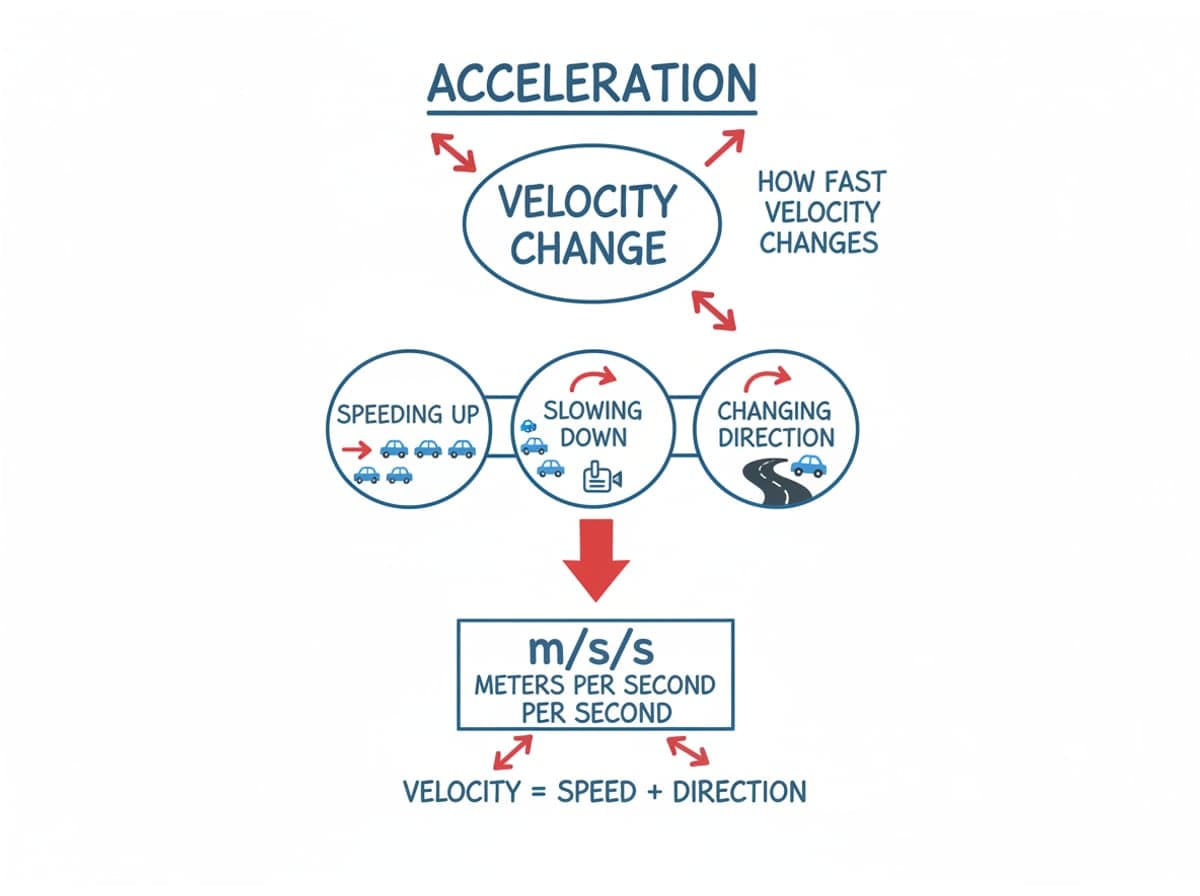
Slowing has its own everyday word, deceleration, but physicists call it negative acceleration, since the change in velocity points backward. Turning counts as acceleration even when the speedometer never moves, because the direction of the velocity has changed. Test any claim about acceleration with one question: is the velocity changing? If yes, the object is accelerating. If no, it is not.
The formula is small: acceleration equals the change in velocity divided by the time it took. A bike that goes from rest to 8 m/s in 4 seconds accelerates at 8 divided by 4, or 2 meters per second squared. Read it aloud: two meters per second, every second. Its speed climbs by two meters per second each second it keeps pushing. Always find the change in velocity first, then divide by the time.
And watch the sign. If a car goes from 20 m/s to 10 m/s in a few seconds, the change is negative, a back-pointing change, so the acceleration points backward too. Small accelerations build fast: 2 m/s^2 sounds gentle, but after 10 seconds a bicycle is moving at 20 m/s. Big accelerations, like a jet at takeoff, are what press you into the seat.
Keep this idea
Acceleration is any change in velocity per unit of time: a = (v2 - v1) / t, and it includes slowing down and turning, not just speeding up.
The practice checks apply only to the displayed examples. Follow your teacher’s guidance for your own assignments.
Get help with your own questionA practice lesson each week.
A short practice lesson for your inbox. Free, with a one-click unsubscribe.