
Kinetic and potential energy
One small step at a time. Ask for a clue whenever you need one.
Ask about your own question- Step 1
- Step 2
- Step 3
- New question
A roller coaster car is pulled to the top of the first hill and held still. Which kind of energy does it hold most of?
Common mix-up
In this example, a student wrote Kinetic energy, because gravity will soon pull it down..
A parked car at the top of a hill holds potential energy, not kinetic. Kinetic energy belongs to motion, and the car has none until it starts moving.
Guided example. Your answers aren’t saved or sent.
See why this works
Does a parked coaster car at the top of a hill have kinetic energy?
You said the coaster car at the top has kinetic energy because it is about to move. Stored height energy is potential; motion energy comes after the drop.
Potential energy is stored by position, kinetic energy is the energy of motion, and as an object moves, one converts into the other.
Energy comes in stored and moving forms. Potential energy is the stored kind, held by an object's position, shape or condition. A lifted book has gravitational potential energy: raising it took work, and it can give the energy back by falling. A stretched spring and a raised coaster car both hold potential energy, waiting to be spent. Height is savings; the savings are the potential energy.
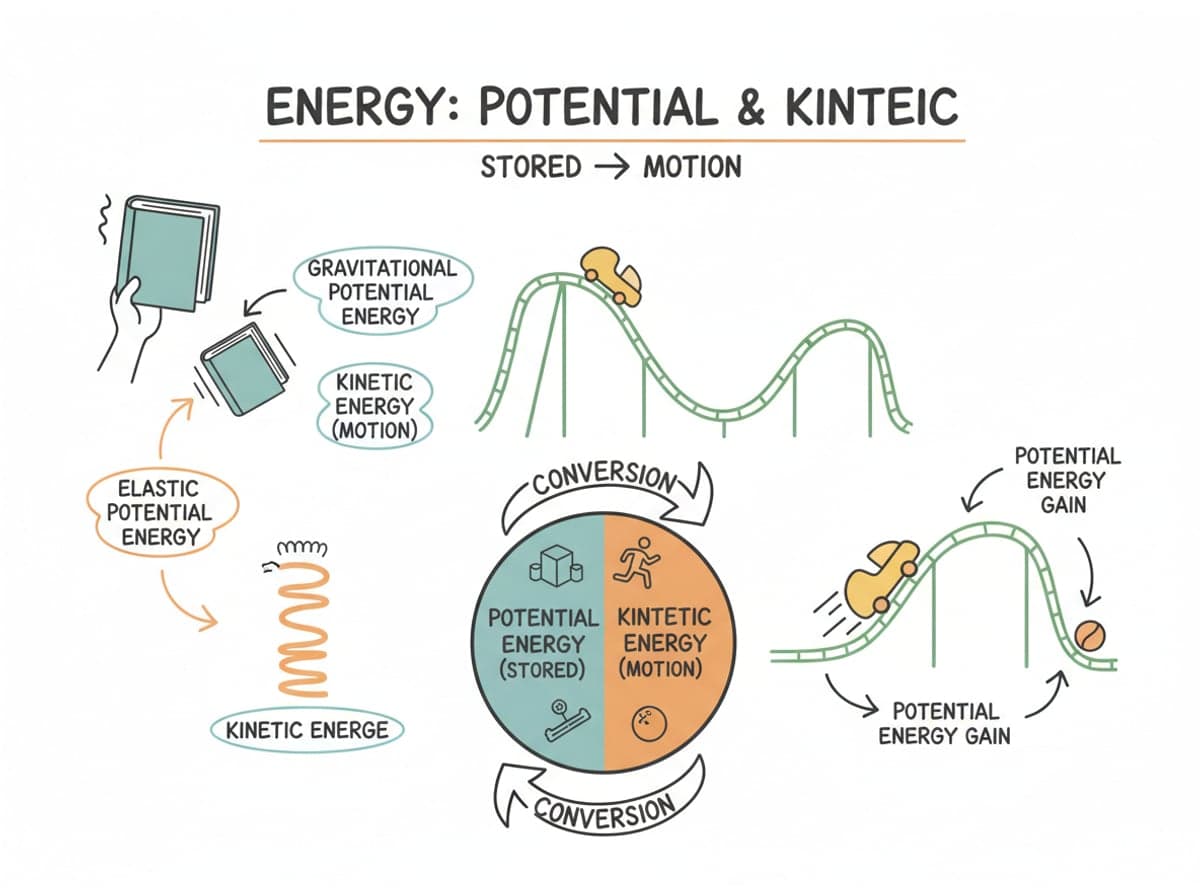
Kinetic energy is the energy of motion. Anything that moves has it: a rolling ball, a speeding car, or a molecule shaking. It depends on both mass and speed, and speed matters enormously because it is squared: a car at 60 mph carries four times the kinetic energy of the same car at 30 mph. When an object slows, its kinetic energy goes somewhere; when it speeds up, something paid for it.
The roller coaster is the classic demonstration. The engine hauls the car up the track; at the top, the car holds maximum potential energy and almost no kinetic energy if it is nearly stopped. Gravity pulls it down, height drops, and the potential energy converts into kinetic energy. At the bottom of the drop the car is fastest, with maximum kinetic energy and minimum potential. Height and speed trade places; the energy is conserved, only transformed.
Nothing in that ride was destroyed; energy only changes form. Friction steals some of it, turning motion energy into heat and sound along the track, which is why a real coaster never climbs as high as its first hill. The same conversion runs through everything: a falling apple, a swinging pendulum, a trampoline's stretch and bounce. Track where the energy sits and it is easy to say what happens next.
Keep this idea
A raised or stretched object stores potential energy, moving objects carry kinetic energy, and the two trade places as things fall, swing or roll.
The practice checks apply only to the displayed examples. Follow your teacher’s guidance for your own assignments.
Get help with your own questionA practice lesson each week.
A short practice lesson for your inbox. Free, with a one-click unsubscribe.
Search all 106 free lessons for “Kinetic and potential energy”