
Density
One small step at a time. Ask for a clue whenever you need one.
Ask about your own question- Step 1
- Step 2
- Step 3
- New question
A stone has mass 30 g and volume 15 mL. What is its density, and will it float in water?
Common mix-up
In this example, a student wrote It weighs 30 g, so it is heavy and will sink; its density is 30..
Weight alone does not decide floating; average density does. The steel ship floats because its air-filled hull has a density less than water's.
Guided example. Your answers aren’t saved or sent.
See why this works
Does heavy mean it sinks?
You said the steel ship is too heavy to ever float. The ship's average density, steel plus the air inside it, is less than water, so it floats.
Density equals mass divided by volume; an object floats if its average density is less than the liquid it sits in.
Density measures how tightly matter is packed: the mass stuffed into each unit of volume. Two objects can be the same size with very different masses, or the same mass with very different sizes. Compute density by dividing mass by volume. On the metric scale, water's density is about 1 g/mL, meaning each milliliter of water holds about one gram of it.
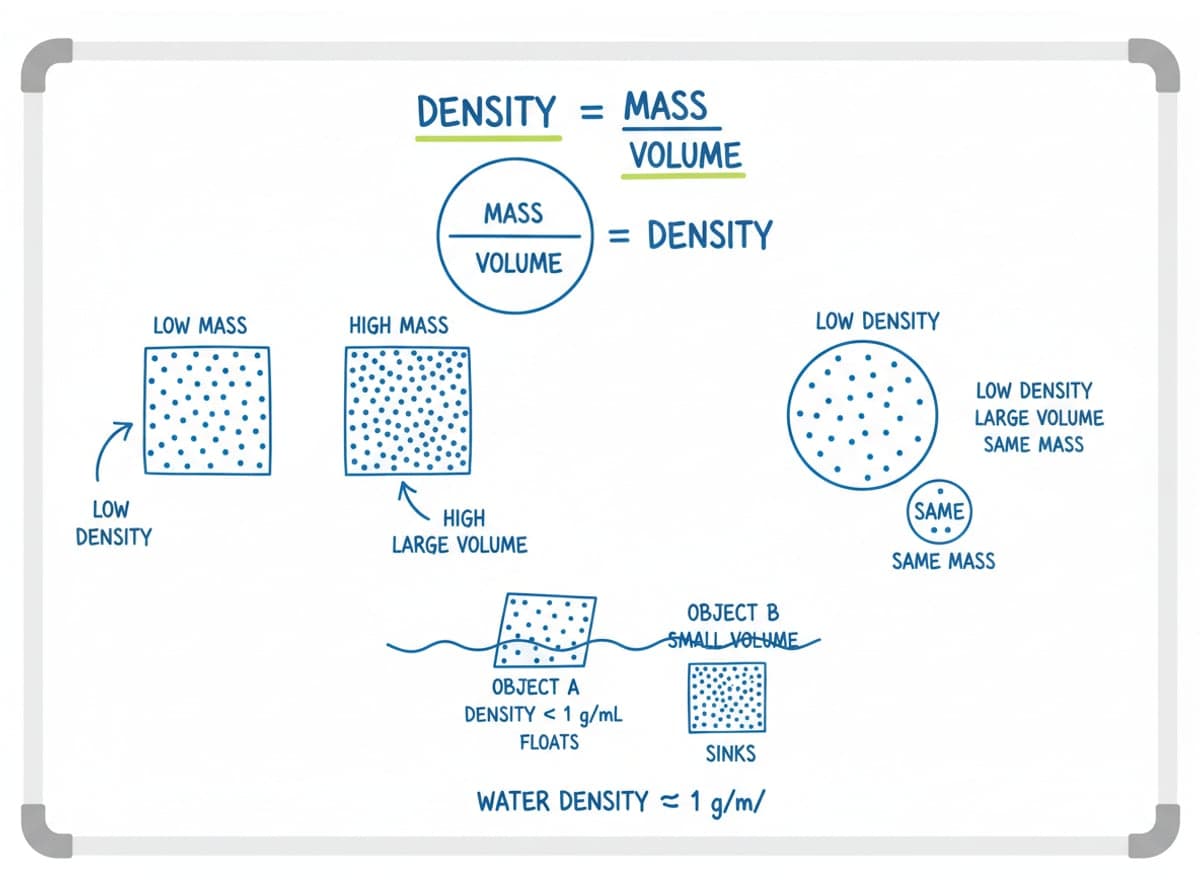
Now the ship puzzle. Steel is about 8 g/mL, far heavier than water, so an ordinary steel knife sinks. But a ship is not a steel block; it is a hollow shell. Its total mass spreads over a huge volume because most of that volume is air. The ship's average density, steel plus air, works out to less than 1 g/mL, so the water can support it. Shape can beat substance.
This is why the float test is a density test, not a weight test. An object floats when its average density is less than the liquid's, and sinks when it is greater. Ice is the famous exception: it is about 0.92 g/mL, slightly less than liquid water, so ice floats even though most substances get denser when they freeze. Lakes freeze from the top down, which keeps life below the ice alive.
Sneak a check into every density calculation: the units write the formula. Mass in grams divided by volume in milliliters gives grams per milliliter, the same number as grams per cubic centimeter. Then compare your answer with water's 1 g/mL: rocks and metals land well above, oils and woods below. The comparison is the point of the number: a density of 3 g/mL means three times as dense as water.
Keep this idea
Density is mass divided by volume; compare it with the surrounding liquid's density to decide whether something floats or sinks.
The practice checks apply only to the displayed examples. Follow your teacher’s guidance for your own assignments.
Get help with your own questionA practice lesson each week.
A short practice lesson for your inbox. Free, with a one-click unsubscribe.