
States of matter and phase changes
One small step at a time. Ask for a clue whenever you need one.
Ask about your own question- Step 1
- Step 2
- Step 3
- New question
An ice cube melts on a warm plate. What exactly changes about the water molecules in it?
Common mix-up
In this example, a student wrote The molecules in the ice were not moving at all..
Particles in a solid are moving, vibrating in place. Melting adds energy and lets them slide; it is a change of motion, not a change of material.
Guided example. Your answers aren’t saved or sent.
See why this works
Do molecules in a solid ever move?
You said the molecules in a solid are frozen still. They are never still: every particle vibrates, and heat changes how fast they shake.
States of matter differ in how the particles move and pack; adding or removing energy drives phase changes without making new substances.
Every state of matter is a different dance of the same particles. In a solid, particles are packed tightly and vibrate in place in a fixed arrangement, which is why solids hold their shape. In a liquid, the particles still touch but slide past each other, so a liquid takes the shape of its container. In a gas, particles fly free with wide space between them, filling the whole container.
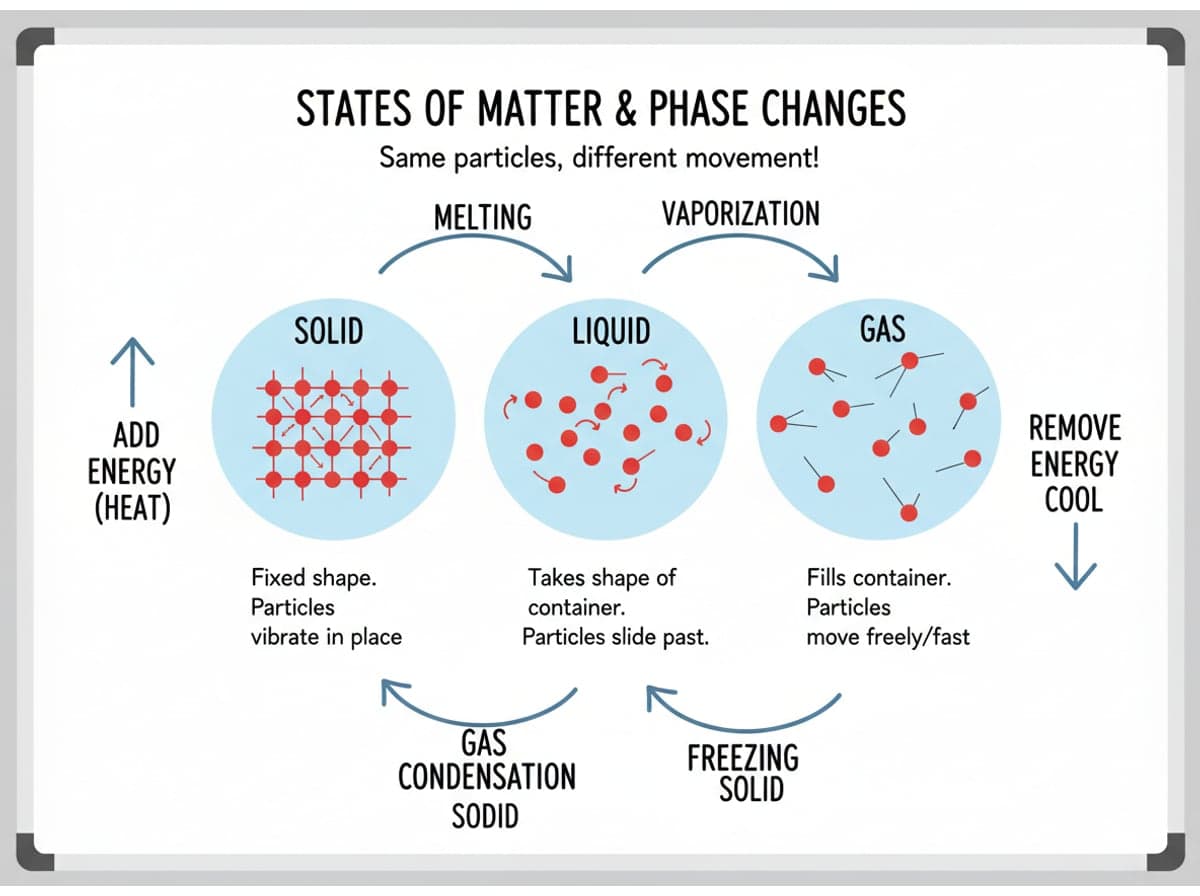
The deep idea is that the particles are never still. Even a block of ice at its coldest is a lattice of vibrating molecules. Heating gives the particles more energy: the vibrations grow until the crystal breaks apart, and the solid melts into a liquid. The particles do not get bigger, break apart or turn into something new. They simply move differently. Melting is a change of motion, not a change of material.
Phase changes are named by direction. Solid to liquid is melting; liquid to gas is evaporation or boiling; gas to liquid is condensation; liquid to solid is freezing; solid directly to gas is sublimation, like dry ice; and gas directly to solid is deposition, like frost. Each change is driven by energy entering or leaving the particles, and no new substance is created by any of them.
The steam above a kettle is an invisible gas; the white cloud you see is the tiny droplets formed as the vapor cools and condenses. Water boils at 100 degrees at sea level, but evaporation happens at any temperature: a puddle dries at 20 degrees because high-energy molecules escape from the liquid's surface. Boiling and evaporating both turn liquid to gas, one through the whole liquid and one at the surface, with the same particle story behind both.
Keep this idea
Particles vibrate in solids, slide in liquids and fly in gases, and adding or removing energy drives the phase changes between states without making new substances.
The practice checks apply only to the displayed examples. Follow your teacher’s guidance for your own assignments.
Get help with your own questionA practice lesson each week.
A short practice lesson for your inbox. Free, with a one-click unsubscribe.
Search all 106 free lessons for “States of matter and phase changes”