
Net force
One small step at a time. Ask for a clue whenever you need one.
Ask about your own question- Step 1
- Step 2
- Step 3
- New question
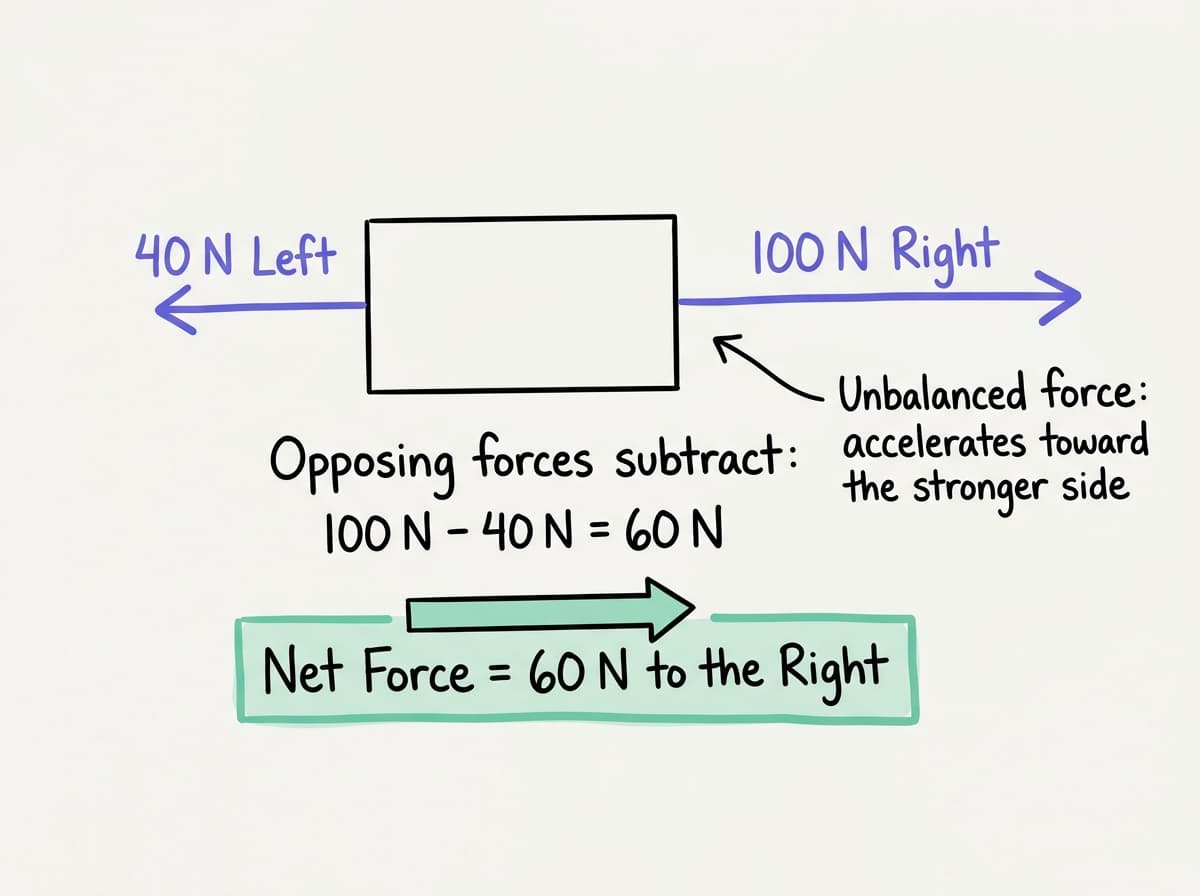
Two teams tug a rope. The right team pulls with F = 100 N east, and the left team pulls with 40 N west. What is the net force (F) on the rope?
Common mix-up
In this example, a student wrote 140 N, because both teams are pulling..
Opposing forces subtract. A 100 N pull right minus a 40 N pull left gives 60 N right, not 140 N.
Guided example. Your answers aren’t saved or sent.
See why this works
What is the net force when pulls go against each other?
You said a 100 N pull right and a 40 N pull left give 140 N. They fight: the net force is the difference, 60 N, and it points the stronger way.
Net force is the single effective force: pushes in the same direction add, opposing forces subtract, and equal opposite forces cancel to zero.
Every object usually feels more than one force at once. The net force is the single force that would do what all of them together do. Find it by treating the forces as pushes and pulls along a line: those acting the same way add up, and those acting against each other fight, so you subtract them. The direction of the net force is the direction of the stronger side.
Work an example. Two friends pull a sled the same way, one with 60 N and one with 40 N: the net force is 100 N toward the sled's front. Now one friend pulls back with 40 N while the other pulls forward with 100 N: the net force is 60 N forward. Ten students can tug against two and still lose; it is the difference that matters, not the count of tuggers.
Equal and opposite forces give a net force of zero. Balanced forces may hold an object still, but they can also let it keep moving at constant speed: a glider cruising steadily has thrust and drag matched. An unbalanced net force is the only thing that changes an object's speed or direction. Zero net force never means nothing is pulling; it means everything is pulling evenly.
Finding the net force is the first move in almost every physics problem. In middle-school problems the forces usually lie along one line, so the sum is simple. Draw the arrows head to tail and read the result. A net force of zero is the fingerprint of constant motion; any other net force is the fingerprint of an object whose motion is changing.
Keep this idea
Net force is the real push: same-direction forces add, opposing forces subtract, and equal opposite forces balance to zero and change no motion.
The practice checks apply only to the displayed examples. Follow your teacher’s guidance for your own assignments.
Get help with your own questionA practice lesson each week.
A short practice lesson for your inbox. Free, with a one-click unsubscribe.