
Adding fractions with unlike denominators
One small step at a time. Ask for a clue whenever you need one.
Ask about your own question- Step 1
- Step 2
- New question
What is 1/2 + 1/4?
Common mix-up
In this example, a student wrote 1/2 + 1/4 = 2/6.
Adding the denominators changes the size of the pieces. Rename the fractions before adding their numerators.
Guided example. Your answers aren’t saved or sent.
See why this works
Why can’t I add the denominators?
Before you add pieces, make sure they are the same size. The denominator names the pieces; the numerator counts how many you have.
Rename fractions as equal-size pieces, then add the counts.
Picture two identical whole bars. Divide one into halves and the other into quarters. A half is a larger piece than a quarter, so counting one of each does not tell you how many pieces of one size you have. First choose a shared piece size.
For 1/2 + 1/4, quarters work. Split each half into two equal pieces. The same half now covers two of the four pieces in a whole bar, so 1/2 = 2/4. Multiplying both the numerator and denominator by 2 renames the amount; it does not double the amount.
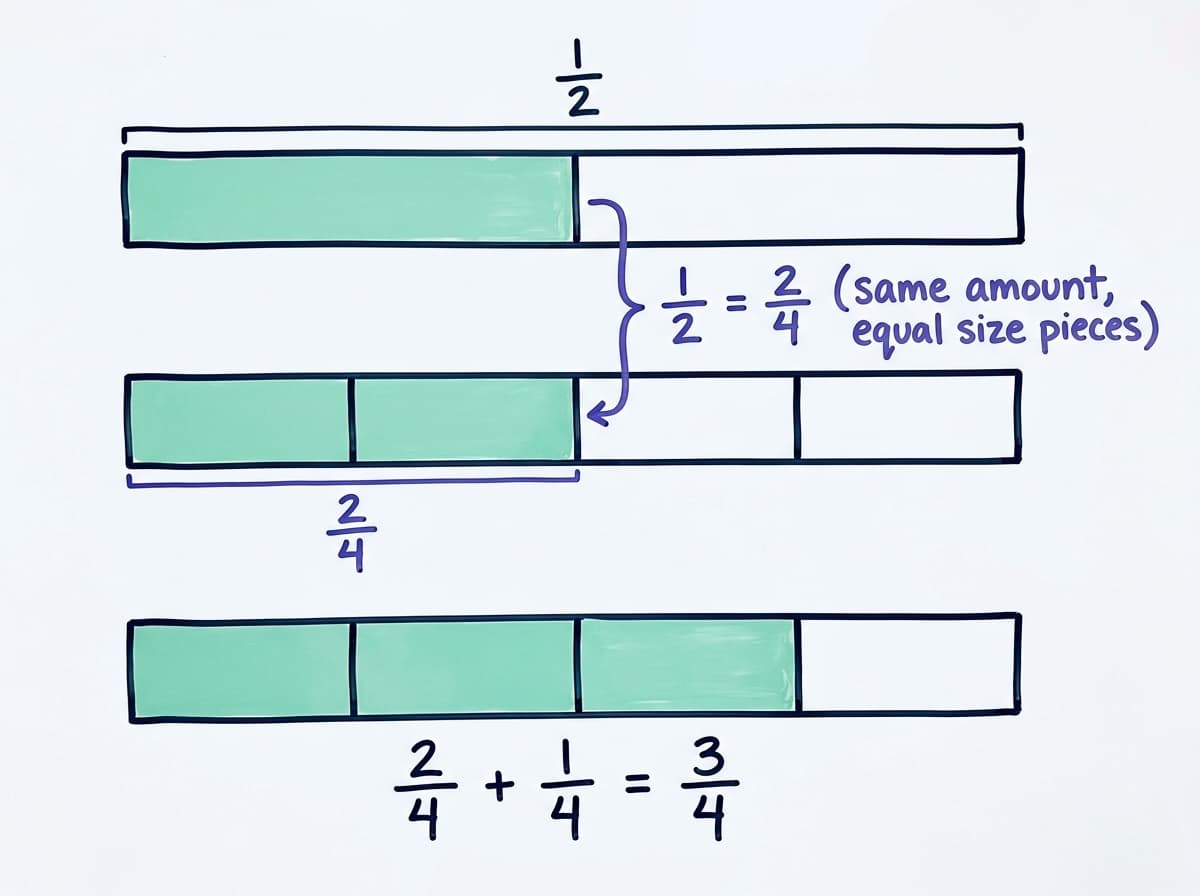
Now add 2/4 + 1/4. Two quarters plus one quarter is three quarters: 3/4. The denominator stays 4 because the pieces are still quarters. Writing 2/6 would change the piece size to sixths without preserving the original amounts. In fact, 2/6 is only 1/3, smaller than the 1/2 you started with.
That gives you a useful reasonableness check: adding a positive quarter to a half must produce more than a half. The result should also be less than one whole. For other fractions, look for a denominator both can be renamed with. You can simplify the result afterward, but preserving the amount comes first.
Keep this idea
The denominator names the piece size. Use a shared denominator, add the numerators, and check whether the total is a reasonable size.
The practice checks apply only to the displayed examples. Follow your teacher’s guidance for your own assignments.
Get help with your own questionA practice lesson each week.
A short practice lesson for your inbox. Free, with a one-click unsubscribe.
Search all 106 free lessons for “Adding fractions with unlike denominators”