
Subtracting fractions
One small step at a time. Ask for a clue whenever you need one.
Ask about your own question- Step 1
- Step 2
- Step 3
- New question
What is 3/4 - 1/3?
Common mix-up
In this example, a student wrote 2/7.
Leo did 3 - 1 = 2 on top and 4 + 3 = 7 on the bottom, writing 2/7. He subtracted pieces that were not the same size.
Guided example. Your answers aren’t saved or sent.
See why this works
Why can't I subtract straight across?
Leo worked out 3/4 - 1/3 by subtracting the tops and adding the bottoms, writing 2/7. The pieces were different sizes.
Before subtracting, rename each fraction with a common denominator, then subtract only the numerators.
A fraction names pieces of a whole, and the denominator tells how big those pieces are. Three fourths are pieces of size 1/4, while one third is a piece of size 1/3. You cannot subtract 1/4-sized pieces from 1/3-sized pieces directly, any more than you can subtract cars from bikes and get a meaningful count. The sizes have to match first.
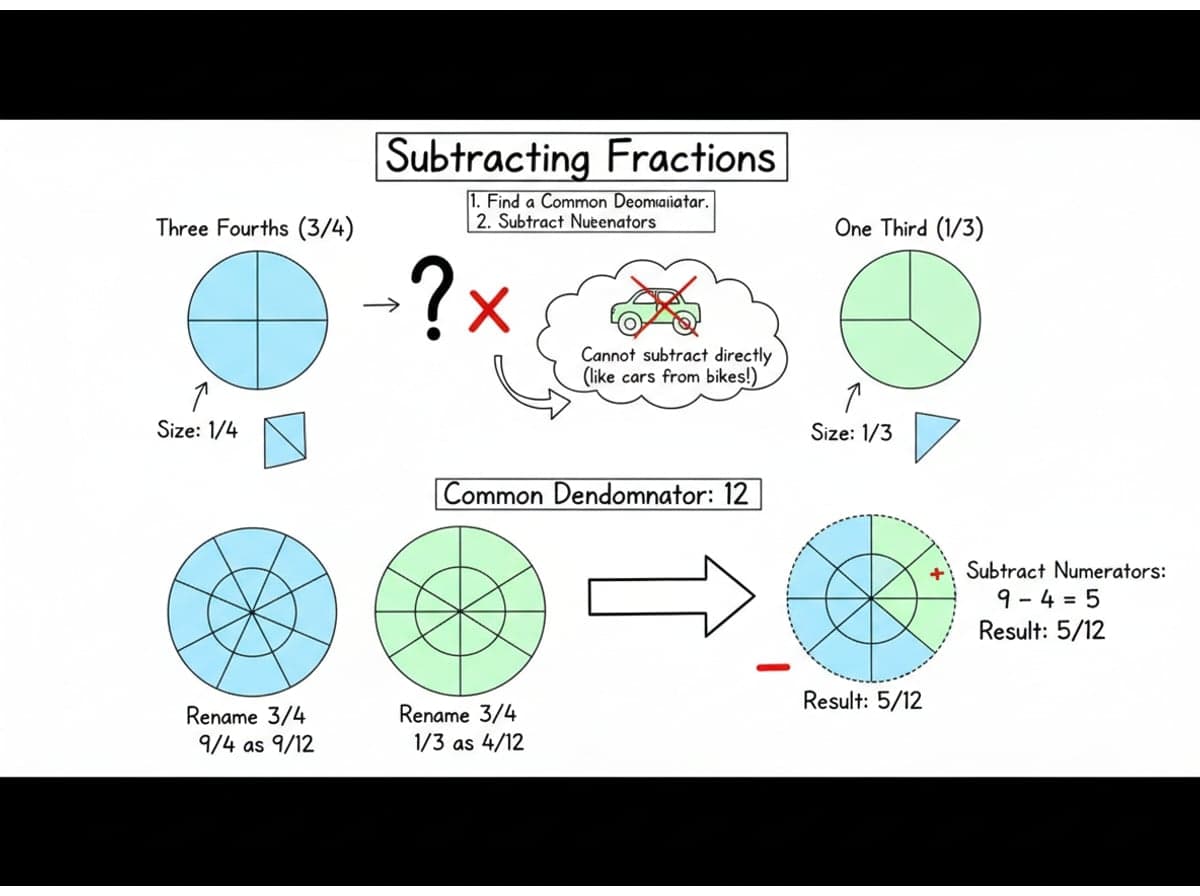
Leo's mistake was to subtract the tops (3 - 1 = 2) and add the bottoms (4 + 3 = 7), writing 2/7. He treated the fractions as if their pieces already matched. The operation never got a fair start because the pieces were different sizes, and mixing the two directions doubles the error: the top subtracts one way while the bottom adds the other way, so the answer means nothing at all.
The fix is renaming: cut every piece so the wholes use the same size. Fourths and thirds both divide into twelfths, so 3/4 becomes 9/12 (top and bottom times 3) and 1/3 becomes 4/12 (top and bottom times 4). Now the pieces are identical in size, and the two fractions describe the same two bars with the same grid lines.
With matching pieces, subtraction is simple: 9 twelfths minus 4 twelfths leaves 5 twelfths, or 5/12. The denominator stays 12 because the piece size did not change. Check the answer by adding back: 5/12 + 4/12 = 9/12 = 3/4, which is where you started, so the subtraction undoes perfectly. Addition is the reverse gear for subtraction, and it checks every time.
Keep this idea
Rename both fractions with a common denominator first; only then can you subtract the numerators.
The practice checks apply only to the displayed examples. Follow your teacher’s guidance for your own assignments.
Get help with your own questionA practice lesson each week.
A short practice lesson for your inbox. Free, with a one-click unsubscribe.