
Dividing fractions
One small step at a time. Ask for a clue whenever you need one.
Ask about your own question- Step 1
- Step 2
- New question
What is 1/2 / (2/3)?
Common mix-up
In this example, a student wrote 1/3.
Amara multiplied 1/2 by 2/3, getting 1/3. She kept the divisor instead of flipping it; in division the divisor gets flipped, not kept.
Guided example. Your answers aren’t saved or sent.
See why this works
Why do I flip the second fraction?
Amara shared 1/2 of a sandwich into 2/3-sized portions and wrote 1/3. She multiplied by 2/3 instead of flipping it first.
Dividing by a fraction means multiplying by its reciprocal: 1/2 / (2/3) = 1/2 * 3/2.
Division asks how many of a size fit into a total. One half divided by two thirds asks: how many two-third portions fit into one half? There are more than one, because the portion is smaller than the half, so the answer should come out bigger than the amount you started with. The answer, 3/4, makes sense this way: one portion plus a quarter of another.
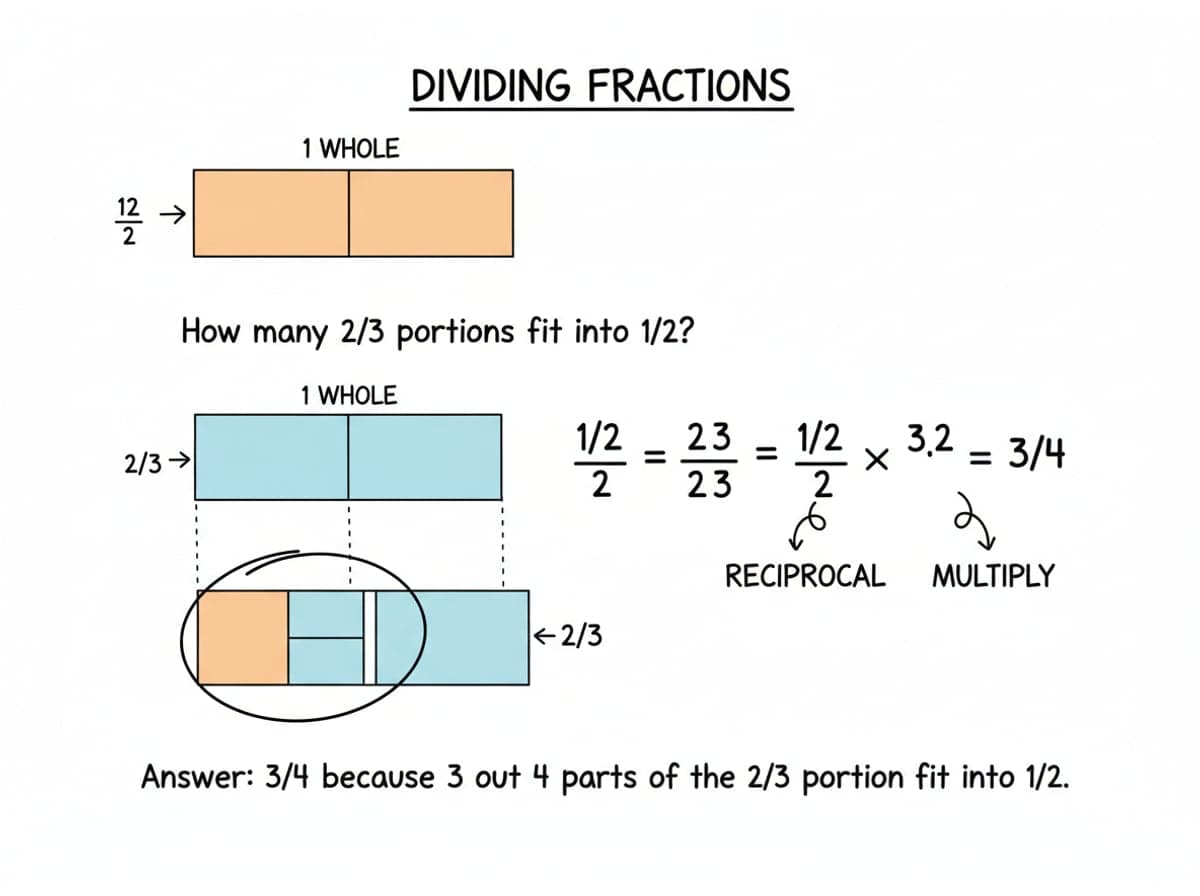
Amara's mistake was multiplying by 2/3, as if division were just multiplication. The numbers 1/2 * 2/3 give 1/3, which is smaller than the amount she started with, and you cannot fit the portions into less space than the portions themselves take. A quotient should be at least the size of one portion, and hers was not even that. A quotient that shrinks the amount is a warning sign that the divisor was not flipped.
The fix is the reciprocal. To divide by a fraction, keep the first number, turn division into multiplication, and flip the second fraction: 2/3 becomes 3/2. So 1/2 / (2/3) becomes 1/2 * 3/2. Flipping the divisor is what changes division into counting portions instead of shrinking the amount. Keep, change, flip is the whole method: nothing else about the problem moves.
Now multiply straight across: 1 * 3 = 3 on top and 2 * 2 = 4 on the bottom, giving 3/4. The flip is what makes the pieces get counted correctly, and you can always check division by multiplying the answer by the divisor to get back to the start: 3/4 of 2/3 should return to 1/2, and it does.
Keep this idea
Keep the first fraction, change division to multiplication, and multiply by the reciprocal of the divisor.
The practice checks apply only to the displayed examples. Follow your teacher’s guidance for your own assignments.
Get help with your own questionA practice lesson each week.
A short practice lesson for your inbox. Free, with a one-click unsubscribe.