
Equivalent and simplified fractions
One small step at a time. Ask for a clue whenever you need one.
Ask about your own question- Step 1
- Step 2
- Step 3
- New question
Simplify 18/24.
Common mix-up
In this example, a student wrote 18/24 = 9/12.
Sofia divided 18 and 24 by 2 and wrote 9/12. That is a true statement, and it is not the simplest form, so the answer was marked as unfinished rather than wrong.
Guided example. Your answers aren’t saved or sent.
See why this works
Why does 18/24 turn into 3/4?
The fraction looks different and describes the same amount. The rule that allows this is the same rule that makes adding fractions possible at all.
Multiply or divide the top and the bottom by the same number and the fraction keeps its value.
A fraction is a division, and dividing by one never changes a number. If you do 18 ÷ 24, you can also write it as (18 ÷ 6) ÷ (24 ÷ 6), because dividing both parts of a division by the same amount gives the same result. Now the top and bottom are 3 and 4, so the answer can be written as 3/4. Same value, simpler name.
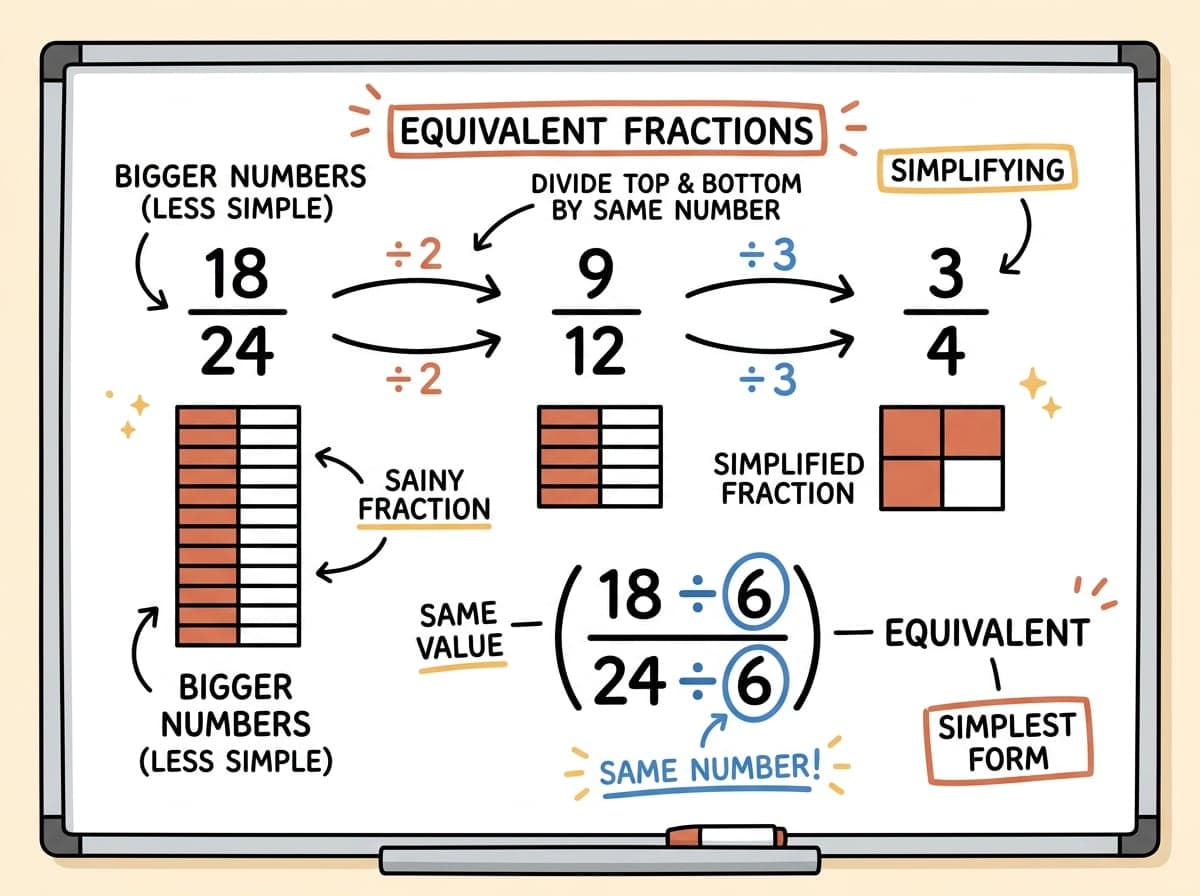
The picture makes it obvious. Cut a cake into 24 small pieces and take 18: you have taken most of it, but not all. Cut the same cake into 4 slices and take 3: you have taken exactly the same amount of cake. Only the size of each piece changed. This is why equivalent fractions are sometimes called the same fraction wearing a different costume.
Simplifying means dividing repeatedly until nothing divides both numbers except 1. Doing it in one step means finding the biggest number that divides both, which is the greatest common factor. For 18 and 24 that is 6. Dividing in two steps works too — 18/24 becomes 9/12 by dividing by 2, then 3/4 by dividing by 3 — but stopping at 9/12 leaves the job unfinished, which is the mistake teachers mark most often.
You can always check your own work by cross-multiplying. Two fractions are equal exactly when the products crosswise are equal: 3 × 24 = 72 and 4 × 18 = 72, so 3/4 and 18/24 are the same. That check works even when you cannot see the common factor, and it is worth habit, because it turns a rule you might misremember into an answer you can prove.
Keep this idea
Dividing the top and the bottom by the same number keeps a fraction's value. Divide by the greatest common factor to reach the simplest form in one step, and check the result by cross-multiplying.
The practice checks apply only to the displayed examples. Follow your teacher’s guidance for your own assignments.
Get help with your own questionA practice lesson each week.
A short practice lesson for your inbox. Free, with a one-click unsubscribe.
Search all 106 free lessons for “Equivalent and simplified fractions”