
Multiplying fractions
One small step at a time. Ask for a clue whenever you need one.
Ask about your own question- Step 1
- Step 2
- Step 3
- New question
What is 1/2 * 2/3?
Common mix-up
In this example, a student wrote 3/5.
Sam added across: 1 + 2 = 3 on top and 2 + 3 = 5 on the bottom, getting 3/5. He applied the addition pattern to a multiplication problem.
Guided example. Your answers aren’t saved or sent.
See why this works
Why do I multiply straight across?
Sam computed 1/2 * 2/3 and wrote 3/5. He added the top numbers and the bottom numbers, which is how you combine, not how you multiply.
To multiply fractions, multiply the numerators and multiply the denominators. No common denominator is needed.
Fractions are ways of writing a counted amount: the numerator counts pieces, and the denominator names how many pieces make a whole. Multiplying 1/2 by 2/3 means taking 1/2 of the amount 2/3. Two thirds is 2 pieces out of a 3-piece whole, and half of that is 1 piece out of the same whole, so the product lives inside the same 3-piece bar.
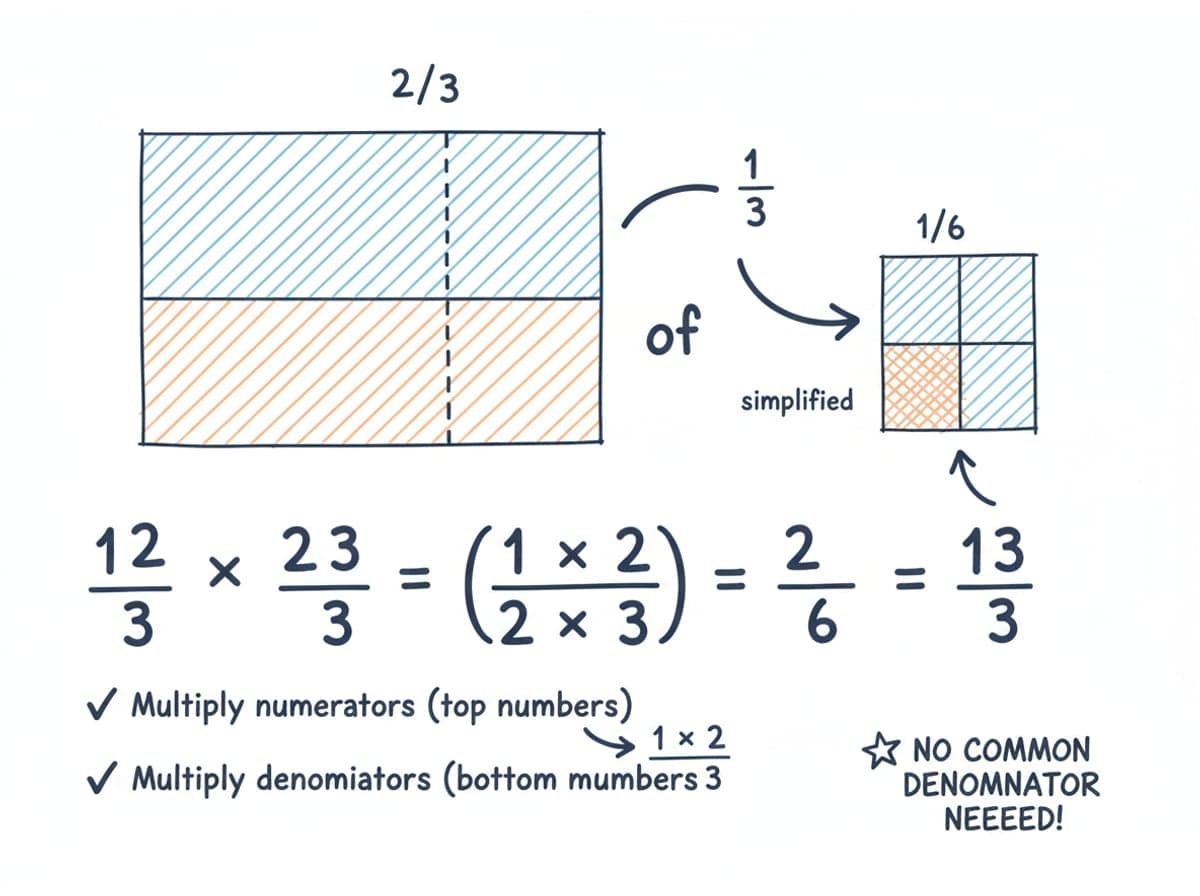
Sam's mistake was to add the tops and add the bottoms, writing 3/5. Adding is for when you put two separate amounts together. Multiplying is for when you take a piece of an amount, so the pieces themselves get combined in a different way: 1 * 2 = 2 pieces on top, and 2 * 3 = 6 pieces in the whole, giving 2/6.
Notice that no common denominator was needed. Common denominators help with adding and subtracting, because you need same-size pieces to combine. Multiplication just counts what happens to the pieces, so you multiply straight across. The tops multiply because the counted pieces multiply, and the bottoms multiply because the whole is split two ways at once. Two fractions in a product split the whole twice, and the denominator totals up all the parts.
The last step is simplifying: 2/6 has a top and bottom that both divide by 2, so it reduces to 1/3. Check with a picture: half of two thirds is one third, which matches, and 1/2 * 2/3 = 1/3 is the same amount written in lowest terms. A fraction bar split into 6 with 2 shaded looks exactly like 1 of 3 shaded.
Keep this idea
Multiply the tops together and the bottoms together, then simplify; adding a common denominator is only for adding and subtracting.
The practice checks apply only to the displayed examples. Follow your teacher’s guidance for your own assignments.
Get help with your own questionA practice lesson each week.
A short practice lesson for your inbox. Free, with a one-click unsubscribe.