Atoms, ions and isotopes
One small step at a time. Ask for a clue whenever you need one.
Ask about your own question- Step 1
- Step 2
- Step 3
- New question
A chlorine atom has 17 protons, 17 electrons, and 18 neutrons. Find its mass number. Then find its charge. Finally, find the charge if this atom had 18 electrons instead.
Common mix-up
In this example, a student wrote mass number = 18, charge = -1.
The student used the neutron count as the mass number and subtracted neutrons from protons to get a charge of -1.
Guided example. Your answers aren’t saved or sent.
See why this works
Why isn't the mass number just the neutrons?
An atom with 17 protons and 18 neutrons: is its mass number 35 or 18? And what is its charge? Work through the counting rules one blank at a time.
Mass number counts protons plus neutrons. Charge depends only on protons minus electrons.
Every atom of an element has the same number of protons. That number is the atomic number and it decides what element you have. Chlorine always has 17 protons. But atoms of chlorine are not identical: the count of neutrons can differ, and these versions are called isotopes. Chlorine-35 has 18 neutrons, while chlorine-37 has 20, and both are still chlorine because both hold 17 protons.
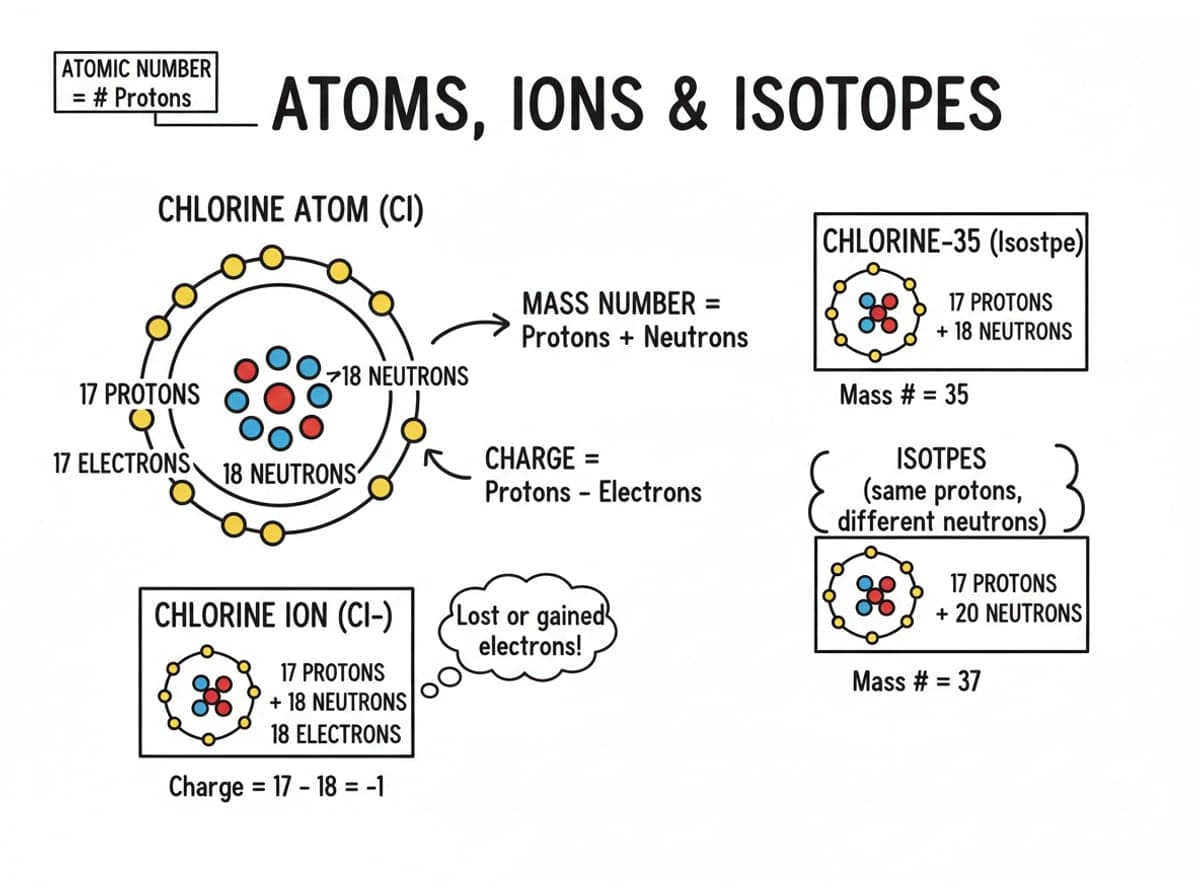
The mass number is the total of particles in the nucleus: protons plus neutrons. Electrons are not counted because each one weighs almost nothing next to a proton. Writing mass number = protons + neutrons keeps that straight. If you know an atom has 17 protons and 18 neutrons, the mass number is 35, never 18. The neutrons alone never tell the whole story.
Charge is a separate question from mass number. A neutral atom has exactly as many electrons as protons, so the positives and negatives cancel and the charge is 0. The common mistake is bringing neutrons into the charge, or guessing the charge from the mass number. Neutrons are neutral particles: they add mass, but they add no charge at all. To predict an ion's charge, count the electrons, count the protons, and take the difference.
Ions form when electrons are gained or lost. If this chlorine atom picks up one electron, it has 17 protons and 18 electrons, giving a net charge of -1. The nucleus never changed, and the element did not change either: it is still chlorine. Check protons for identity, protons plus neutrons for mass, and the difference between protons and electrons for charge.
Keep this idea
Protons fix the identity of an element, protons plus neutrons fix the mass number, and the difference between protons and electrons fixes the charge.
The practice checks apply only to the displayed examples. Follow your teacher’s guidance for your own assignments.
Get help with your own questionA practice lesson each week.
A short practice lesson for your inbox. Free, with a one-click unsubscribe.