
Covalent bonds
One small step at a time. Ask for a clue whenever you need one.
Ask about your own question- Step 1
- Step 2
- Step 3
- New question
Two hydrogen atoms form an H2 molecule. How are they held together, and what type of bond forms in O2 and N2?
Common mix-up
In this example, a student wrote Hydrogen transfers its electron to the other hydrogen, forming an ionic bond..
The student said hydrogen transfers its electron to the other hydrogen, forming an ionic bond.
Guided example. Your answers aren’t saved or sent.
See why this works
When two nonmetals meet, do they share or transfer?
Hydrogen cannot pull an electron away from hydrogen, so the two atoms do something smarter: they share. Count the pairs.
Covalent bonding is the sharing of electron pairs between nonmetals; one, two, or three shared pairs make single, double, or triple bonds.
Covalent bonds form between nonmetals, where neither atom wants to fully give away an electron. Hydrogen has one electron and needs two for a full shell. That is exactly half of the need, so one hydrogen atom cannot be satisfied unless a second atom shares its electron. Neither hydrogen can win the electron, so both must cooperate. The result is a molecule held together by a bond that neither atom would grant the other.
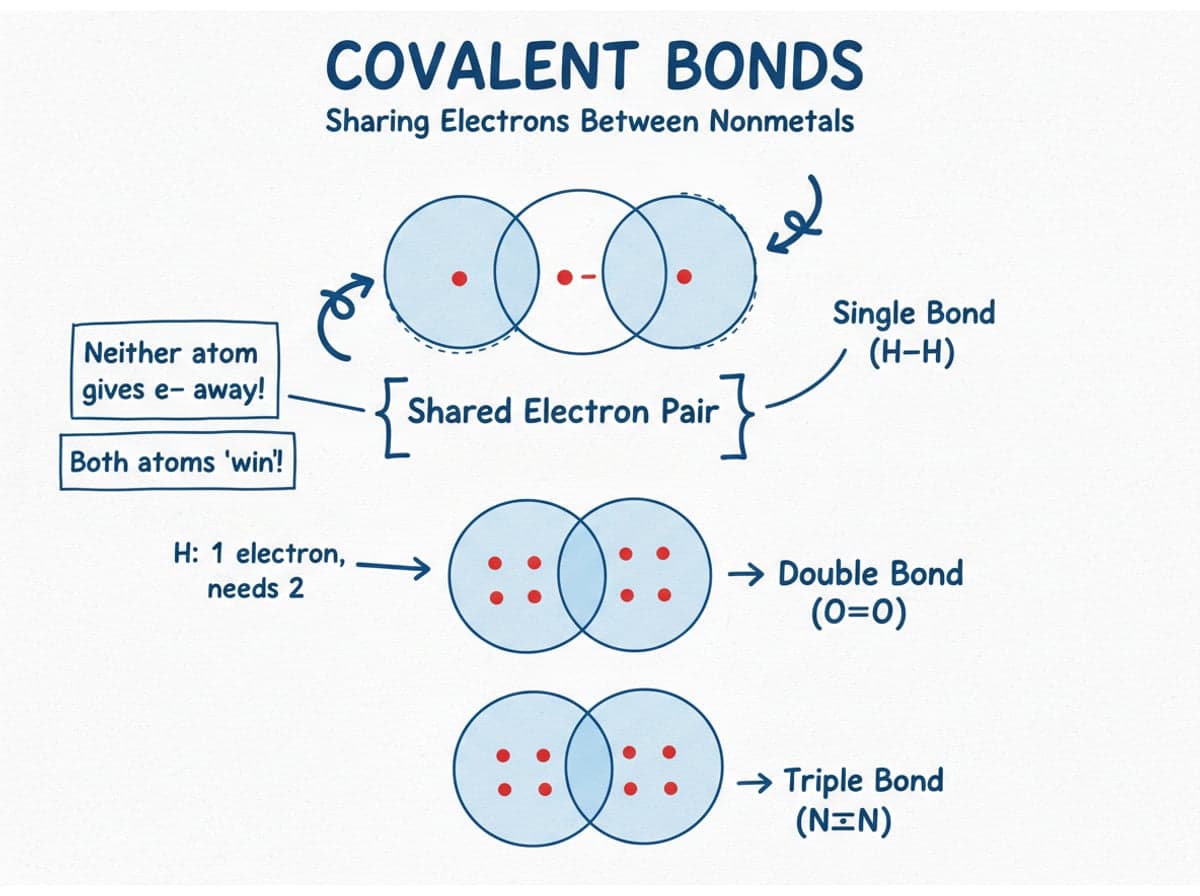
The two electrons travel around both atoms, which is called a shared pair. Each hydrogen counts the pair as its own outer shell. That sharing is the covalent bond. It is the opposite of ionic bonding, where an electron jumps from one atom to another instead of staying with both at once. Counting the shared pair is the whole skill of covalent bonding, and a lone pair would not hold anything together.
Bonds are named by how many pairs are shared. One pair is a single bond, like H-H. Two pairs are a double bond, like O=O, where each oxygen brings two of the four shared electrons. Three pairs are a triple bond, like N=N. Each extra pair pulls the atoms a little closer and makes the bond stronger. The common error is forgetting to count pairs.
Two hydrogen atoms make the simplest possible molecule, but the counting rule is the one that builds water: each oxygen shares one pair with each of two hydrogens. Covalent chemistry is pair-counting, and everything from simple gases to the molecules in your body follows the same arithmetic. Water, carbon dioxide, and methane all fall out of the same pair-counting rules.
Keep this idea
Covalent bonds are shared electron pairs between nonmetals; one, two, or three pairs name the bond single, double, or triple.
The practice checks apply only to the displayed examples. Follow your teacher’s guidance for your own assignments.
Get help with your own questionA practice lesson each week.
A short practice lesson for your inbox. Free, with a one-click unsubscribe.