
Naming covalent compounds
One small step at a time. Ask for a clue whenever you need one.
Ask about your own question- Step 1
- Step 2
- New question
Name CO2. Then name N2O.
Common mix-up
In this example, a student wrote carbon oxide and nitrogen oxide.
The student wrote carbon oxide instead of carbon dioxide, treating the covalent compound like an ionic name.
Guided example. Your answers aren’t saved or sent.
See why this works
Which prefix: mono, di, or tri?
Carbon dioxide and carbon monoxide both start with carbon. The prefixes are the only thing telling them apart, so get them right.
Covalent names use Greek prefixes for both elements, dropping mono on the first element and ending the second in -ide.
Covalent compounds are made of nonmetals only, and their names count atoms. Each element gets a prefix: mono (1), di (2), tri (3), tetra (4), penta (5), hexa (6). The first element gets a prefix too, but mono is dropped when it has just one atom, so CO2 is carbon dioxide and never monocarbon dioxide. The second element never drops mono, because symmetry matters.
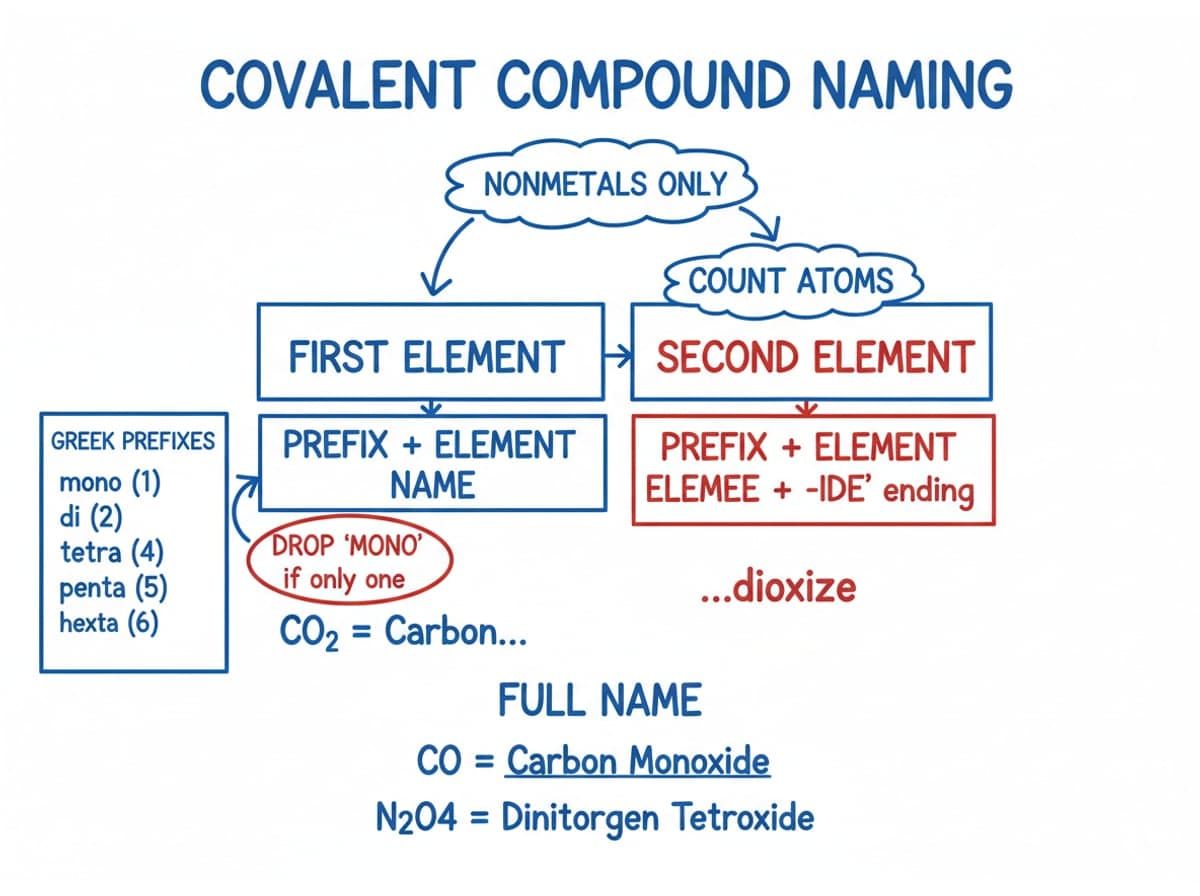
The second element also takes the -ide ending: oxygen becomes oxide, chlorine becomes chloride. The prefix di is doing real work: it names the pair of oxygen atoms that makes carbon dioxide a different gas from carbon monoxide. One fewer oxygen changes the poison entirely, so the name has to say how many. The subscript and the prefix always match.
N2O shows both rules. Two nitrogens give the prefix di, so dinitrogen appears first. One oxygen gives mono, and the mono is kept because oxygen is the second element: dinitrogen monoxide. Dropping that mono would blur the distinction between NO and N2O, two very different gases. Carbon monoxide is a different story only because its name keeps a mono in front of the oxide.
The common mistake is treating covalent names like ionic names and dropping the prefixes, or using prefixes on ionic compounds such as sodium chloride. If both elements are nonmetals, count and prefix; if a metal is present, name the ions. The metal rule and the prefix rule never mix. A single glance at the periodic table tells you which rule applies.
Keep this idea
Both elements get prefixes by atom count; mono is dropped on the first element only, and the second ends in -ide.
The practice checks apply only to the displayed examples. Follow your teacher’s guidance for your own assignments.
Get help with your own questionA practice lesson each week.
A short practice lesson for your inbox. Free, with a one-click unsubscribe.