Ionic bonds
One small step at a time. Ask for a clue whenever you need one.
Ask about your own question- Step 1
- Step 2
- Step 3
- New question
Sodium (group 1) reacts with chlorine (group 17). What happens to the electrons, and what holds the resulting ions together?
Common mix-up
In this example, a student wrote Sodium and chlorine share one pair of electrons, forming a covalent bond that holds them together..
The student thought sodium and chlorine share a pair of electrons, so the bond was treated like a covalent bond.
Guided example. Your answers aren’t saved or sent.
See why this works
Does sodium share its electron with chlorine?
NaCl is table salt, but is it held together by sharing or by moving an electron? Trace the transfer and the attraction.
Ionic bonding is the transfer of electrons to form oppositely charged ions, which then attract electrostatically.
Ionic bonding happens between a metal and a nonmetal. In NaCl, sodium is the metal and chlorine is the nonmetal. Sodium has one valence electron and chlorine has seven. Neither atom is trying to share here: the electron that sodium finds easiest to give is exactly the one chlorine is missing. The two atoms fit together like the two pieces of a puzzle, and the size difference is part of what makes the transfer so easy.
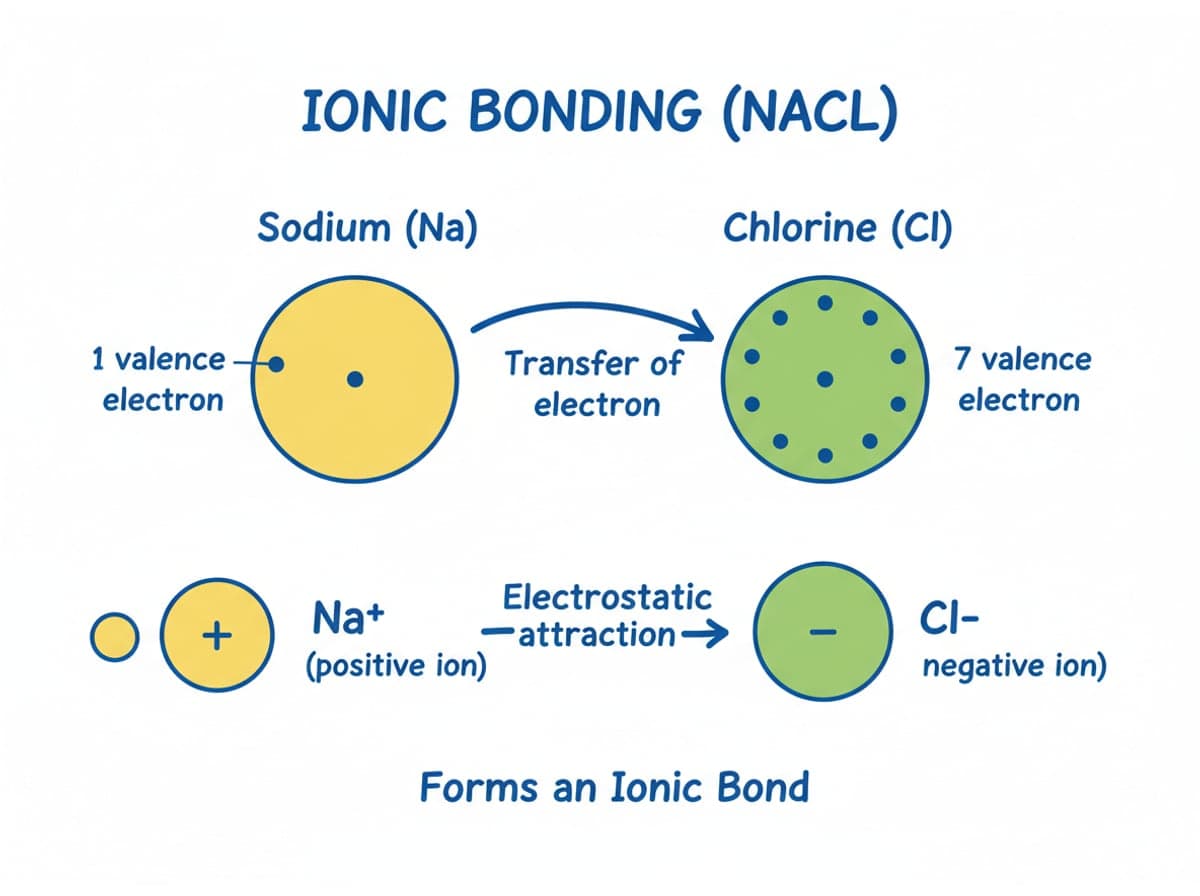
One electron moves from sodium to chlorine. Sodium becomes Na+, a cation with 11 protons and 10 electrons. Chlorine becomes Cl-, an anion with 17 protons and 18 electrons. Both ions now have a full outer shell, which is the stable state they were after. The electron did not vanish or split; it simply changed homes, and the charge signs in the two ion names are the bookkeeping for that one moving electron.
The bond is not a shared pair. It is the electrostatic attraction between opposite charges: the positive sodium ion and the negative chloride ion pull toward each other. Millions of these ions stack into a crystal lattice, which is why NaCl is a solid with a high melting point. The common mistake is calling ionic bonding sharing. Every grain of salt is the same pattern repeated millions of times.
Ions keep their identity. Counting protons still identifies the element, and charge shows up only in the electron count. Transfer, then attract, is the whole picture for a simple ionic compound, and the same picture repeats in every direction of the crystal. Nothing about the sodium changes except the loss of one electron, and no atom was destroyed or created. That is why balancing the charge, not the atoms, is the point of writing the formula.
Keep this idea
A metal transfers its valence electrons to a nonmetal, and the resulting ions are held together by electrostatic attraction.
The practice checks apply only to the displayed examples. Follow your teacher’s guidance for your own assignments.
Get help with your own questionA practice lesson each week.
A short practice lesson for your inbox. Free, with a one-click unsubscribe.