
Naming ionic compounds
One small step at a time. Ask for a clue whenever you need one.
Ask about your own question- Step 1
- Step 2
- New question
Name NaCl. Then write the formula for the compound formed from Ca2+ and F-.
Common mix-up
In this example, a student wrote sodium chlorine and CaF.
The student said the name was sodium chlorine and wrote CaF instead of CaF2, leaving the charges unbalanced.
Guided example. Your answers aren’t saved or sent.
See why this works
Is it sodium chloride or sodium chlorine?
Two words and two numbers stand between you and a correct ionic name or formula. Learn the rule, then balance the charges.
Ionic names put the metal name first and the nonmetal root with -ide second; formulas must have zero net charge.
Naming a two-element ionic compound is a two-step job: say the metal first with its element name, then the nonmetal with its ending changed to -ide. Sodium with chlorine gives sodium chloride. Potassium with oxygen gives potassium oxide. No prefixes are used; ionic compounds are not counted that way in their names. The order matters: the metal is named before the nonmetal every time.
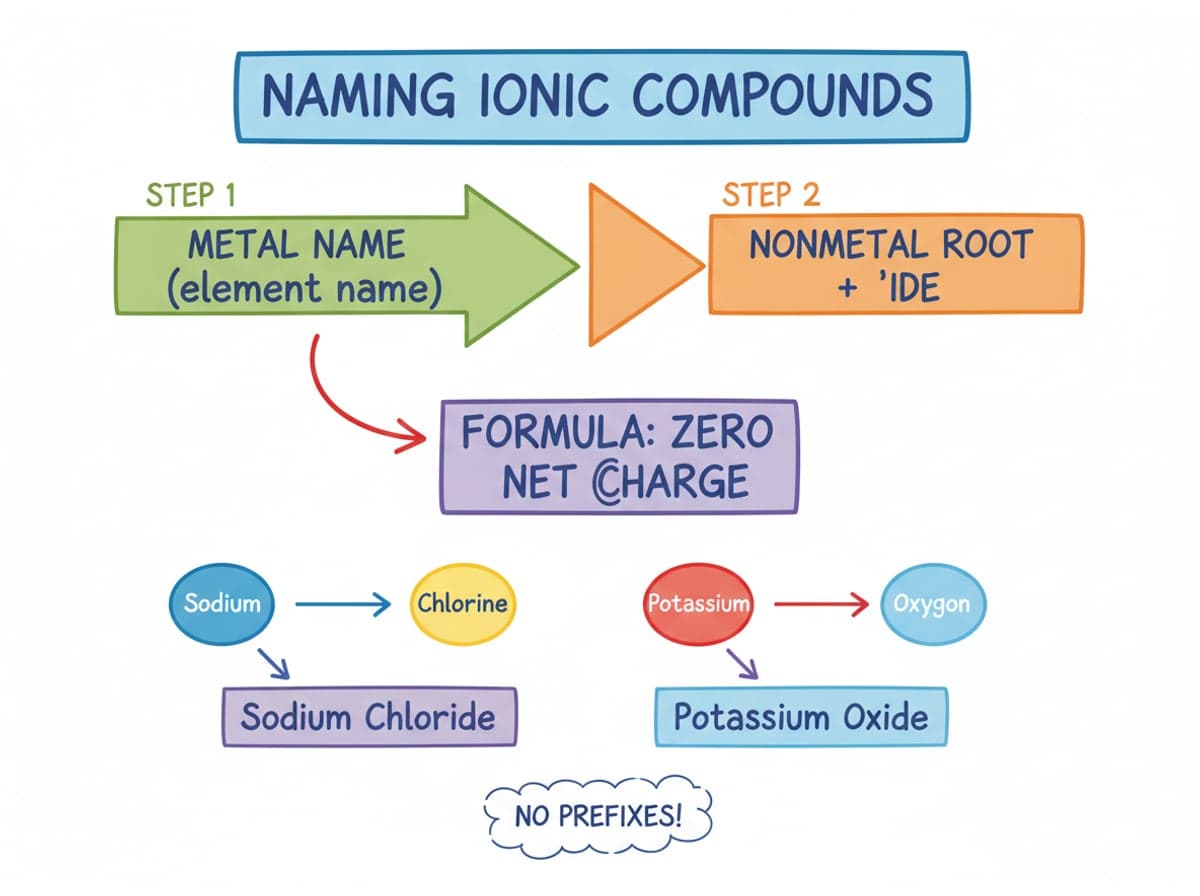
The common mistake is leaving the nonmetal's own name, or inventing a suffix like -ate. Chlorine becomes chloride, never chlorate. The -ate ending belongs to polyatomic ions such as carbonate or sulfate, which are named as whole groups, not to a plain nonmetal. The -ide ending is the signal that two elements make the compound. If you see -ate, you are naming a group, not a single element.
To write a formula, the charges must cancel. Ca2+ and F-: one Ca2+ needs two F- ions, so the formula is CaF2. Think of it as a tug of war the compound must win with zero net charge. The subscript 2 attaches to the second element in the written formula. Writing CaF would leave a net +1 charge, which cannot be a neutral formula.
Check your work at the end: the total positive charge must equal the total negative charge, and each ion keeps the charge written on it. Ionic compounds are neutral formulas, no exceptions. A quick charge balance at the start and at the end catches the subscript mistakes most often made, and it takes only seconds. Once the charges cancel, the formula you wrote is the formula of the compound.
Keep this idea
Metal name first, nonmetal root with -ide second; the formula subscripts must make the total charge zero.
The practice checks apply only to the displayed examples. Follow your teacher’s guidance for your own assignments.
Get help with your own questionA practice lesson each week.
A short practice lesson for your inbox. Free, with a one-click unsubscribe.