
Avogadro's number and the mole
One small step at a time. Ask for a clue whenever you need one.
Ask about your own question- Step 1
- Step 2
- New question
A sample holds 3.01 x 10^23 helium atoms. How many moles is that? Then: how many moles are in 12.04 x 10^23 helium atoms?
Common mix-up
In this example, a student wrote 0.5 mol by weight, since it is half of 6.02 x 10^23 grams..
The student said 3.01 x 10^23 atoms is half a mole by weight, treating the mole as a mass unit.
Guided example. Your answers aren’t saved or sent.
See why this works
Why is a mole not a weight?
A dozen is 12. A mole is 6.02 x 10^23. Practice dividing particle counts by Avogadro's number, and learn why the mole is not a weight.
1 mole of anything contains 6.02 x 10^23 particles; the mole is a counting unit, not a mass.
Atoms are far too small to count individually, so chemists count by the mole. One mole is exactly 6.02 x 10^23 particles: atoms, molecules, ions, whatever you are counting. It is a counting unit just like a dozen, except a dozen is 12 things and a mole is Avogadro's number of things. The name of the unit is the only tricky part of the idea.
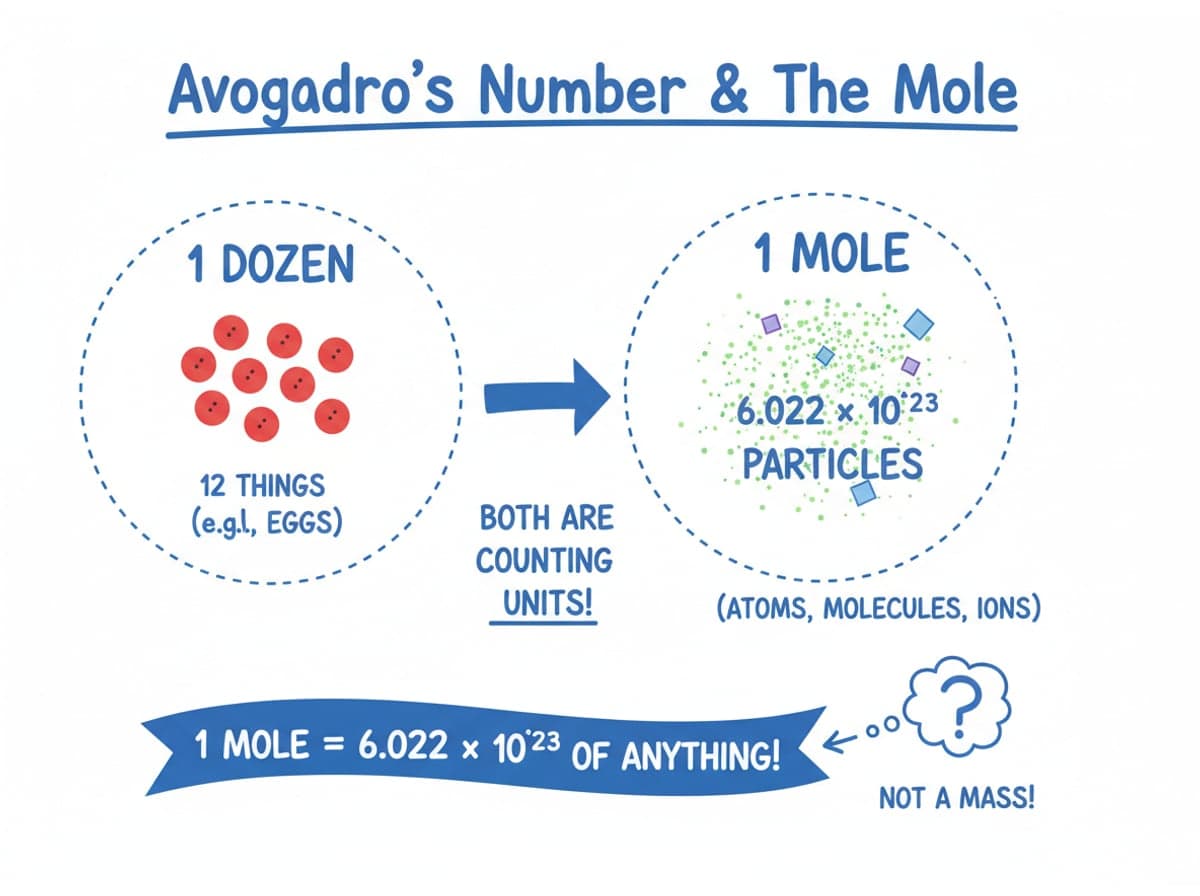
The common mistake is treating the mole as a weight compared with grams. One mole of helium and one mole of carbon contain the same number of atoms, yet they have different masses because each atom weighs differently. The mole tells you how many; molar mass tells you how much. If a partner asks for a mass, use grams per mole, not moles.
Converting is straight division. If you hold 3.01 x 10^23 helium atoms, compare it with Avogadro's number: 3.01 x 10^23 divided by 6.02 x 10^23 is 0.50, so you have half a mole. With 12.04 x 10^23 atoms, the same division gives 2.0 mol. The coefficients compare as 3.01 to 6.02, or 12.04 to 6.02. Getting the exponent right is just moving the decimal point; comparing the coefficients does the real work.
Name what you are counting. A mole of NaCl is a mole of formula units, not separate atoms, and a mole of O2 is a mole of molecules. The number is always Avogadro's number; only the label changes. That one habit keeps every conversion factor honest. Counting formula units by the mole keeps the math exact no matter how tiny the particles are.
Keep this idea
One mole is 6.02 x 10^23 particles. Count by dividing particles by Avogadro's number; mass is a separate question for molar mass.
The practice checks apply only to the displayed examples. Follow your teacher’s guidance for your own assignments.
Get help with your own questionA practice lesson each week.
A short practice lesson for your inbox. Free, with a one-click unsubscribe.
Search all 106 free lessons for “Avogadro's number and the mole”