
Percent yield
One small step at a time. Ask for a clue whenever you need one.
Ask about your own question- Step 1
- Step 2
- New question
A reaction was predicted to make 60 g of product, and the lab recovered 45 g. What is the percent yield?
Common mix-up
In this example, a student wrote 60/45 x 100 = 133%.
The student calculated 60/45 x 100 = 133%, putting the theoretical yield on top.
Guided example. Your answers aren’t saved or sent.
See why this works
Is it 60 over 45 or 45 over 60?
If 60 g was expected and 45 g appeared, is that 75% or 133%? The order of the fraction is the whole lesson.
Percent yield = (actual yield / theoretical yield) x 100. The actual amount is always the part, never the whole.
Chemists calculate how much product a reaction should make, the theoretical yield, then measure what actually forms, the actual yield. Reactions rarely give back everything: spills, side reactions, and losses in transfer all reduce the actual. Percent yield measures how close the run came to the expectation that the calculation set. The prediction usually comes from stoichiometry, and the measurement comes from the balance.
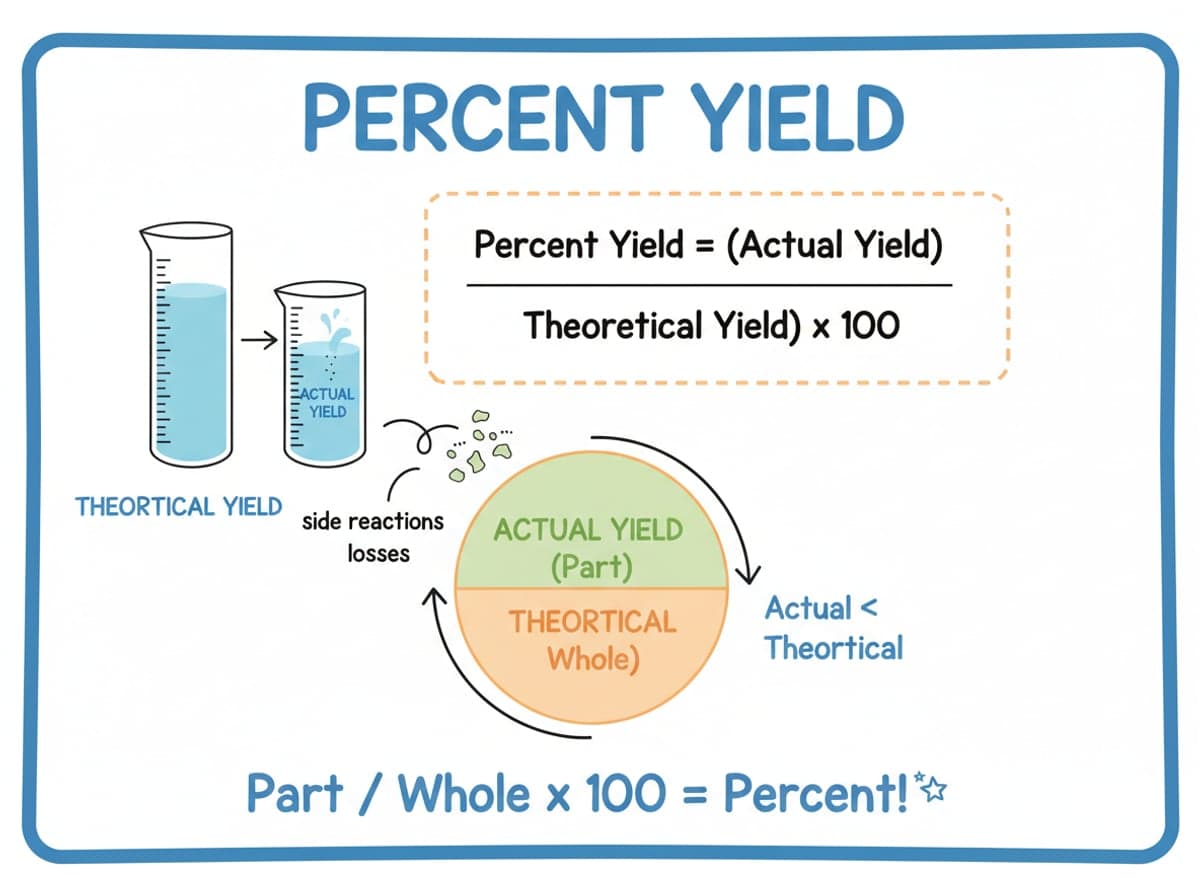
The formula is percent yield = (actual / theoretical) x 100. The recovered amount is the part, the predicted amount is the whole. With 45 g recovered and 60 g expected: 45/60 = 0.75, so 75%. The common mistake is flipping it and writing 60/45 = 133%, which would claim more product than the reaction could possibly make. Set it up part over whole and the direction is always the same.
Check percent yield for sanity. A value above 100% usually means the product was not dry or was contaminated, or the theoretical yield was wrong. A value near 0% means the reaction never happened or the product was lost. In a clean example, the answer stays at or below 100%. A yield close to the theoretical means the method worked well; a low one means searching for the loss.
The units cancel in the ratio, grams over grams, so the answer is a pure percentage. Set the comparison up as part over whole, and the division is one small step. The direction of the fraction is the only thing that can go wrong. Grams over grams, both measured the same way, give a clean percentage with no conversion needed.
Keep this idea
Percent yield = actual over theoretical, times 100. The actual yield is always the part, never the whole.
The practice checks apply only to the displayed examples. Follow your teacher’s guidance for your own assignments.
Get help with your own questionA practice lesson each week.
A short practice lesson for your inbox. Free, with a one-click unsubscribe.