
Mole conversions (grams ↔ moles ↔ particles)
One small step at a time. Ask for a clue whenever you need one.
Ask about your own question- Step 1
- Step 2
- Step 3
- New question
How many moles are in 36.0 g of H2O (M = 18.0 g/mol)? Then: how many grams are in 2.00 mol of CO2 (M = 44.0 g/mol)? Then: how many moles are in 6.02 x 10^23 water molecules?
Common mix-up
In this example, a student wrote 0.5 mol of water, because I divided 18.0 by 36.0..
The student divided 18.0 by 36.0, swapping the numbers and getting 0.5 mol for the water.
Guided example. Your answers aren’t saved or sent.
See why this works
36 g of water: 2 moles or half a mole?
36.0 g of water is 2.00 mol, and 2.00 mol of CO2 is 88.0 g. Practice reading the units to choose divide or multiply.
n = m / M. Divide by molar mass to go grams to moles, multiply to go moles to grams, and divide by 6.02 x 10^23 for particles.
The mole is the bridge between the invisible world of molecules and the readable gram readings of a lab. Molar mass is the exchange rate: 18.0 g per mole for water. To go from grams to moles, divide. There are 36.0 g of water, so 36.0 divided by 18.0 is 2.00 mol. The division is small; deciding to divide is the actual skill.
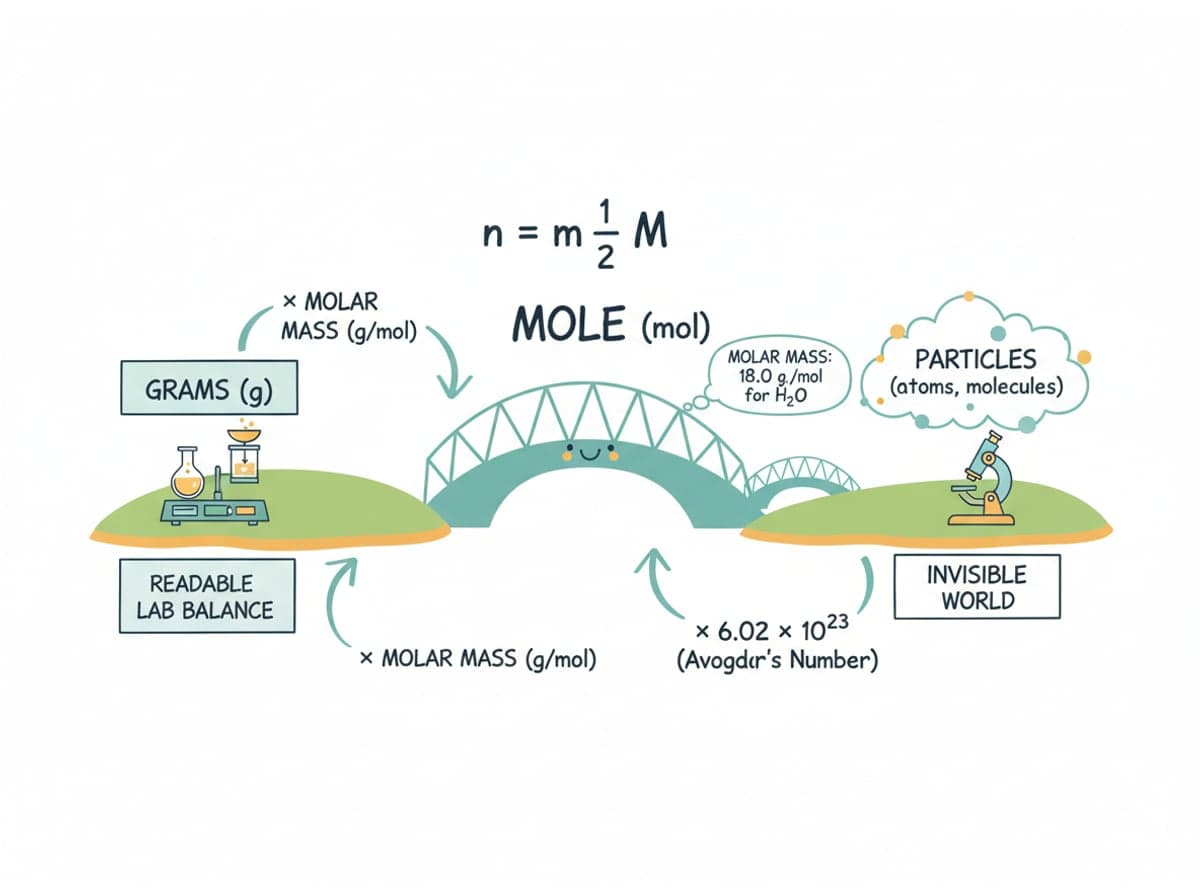
The common mistake is flipping the operation. 18.0 divided by 36.0 gives 0.5, and some call that the answer. Check yourself with units: grams divided by grams per mole leaves moles, and that is the direction this question wants. The operation is chosen by which unit must cancel, so write the units next to the numbers. Writing the units is the fastest way to catch a flipped ratio.
To go the other way, from moles to grams, multiply. Two moles of CO2: 2.00 x 44.0 = 88.0 g. Moles times grams per mole gives grams. The same thinking handles particles: divide a particle count by 6.02 x 10^23 per mole to get moles, and work in groups of Avogadro's number. Each direction uses one conversion factor, and the factor is chosen by the units you need to cancel.
Draw the path before you calculate. Grams to moles uses molar mass; moles to particles uses Avogadro's number. Every route between grams, moles, and particles passes through the mole, which is why the mole sits at the center of the conversion map and why one checked answer protects the whole path. You never go straight from grams to particles without passing through the mole.
Keep this idea
Grams to moles: divide by M. Moles to grams: multiply by M. Particles to moles: divide by 6.02 x 10^23.
The practice checks apply only to the displayed examples. Follow your teacher’s guidance for your own assignments.
Get help with your own questionA practice lesson each week.
A short practice lesson for your inbox. Free, with a one-click unsubscribe.
Search all 106 free lessons for “Mole conversions (grams ↔ moles ↔ particles)”