
Limiting reactants
One small step at a time. Ask for a clue whenever you need one.
Ask about your own question- Step 1
- Step 2
- New question
In 2H2 + O2 → 2H2O, you start with 4.0 mol H2 and 3.0 mol O2. Which is the limiting reactant?
Common mix-up
In this example, a student wrote Oxygen, because there is less of it (3.0 mol vs 4.0 mol)..
The student chose O2 because 3.0 mol is less than 4.0 mol, without checking the 2:1 ratio.
Guided example. Your answers aren’t saved or sent.
See why this works
Which reactant runs out first?
3.0 mol of O2 and 4.0 mol of H2: which runs out first? The ratio decides, not the smaller number.
The limiting reactant is the one that runs out first when you compare against the mole ratio, never by raw starting amounts.
In a reaction with two reactants, one usually runs out before the other. The limiting reactant is used up completely, and it decides how much product forms. The other reactant, left over, is in excess. Which one limits is decided by the reaction's ratios, not by the raw starting amounts on the balance. The product calculation always starts from the limiting reactant, never from the leftover one.
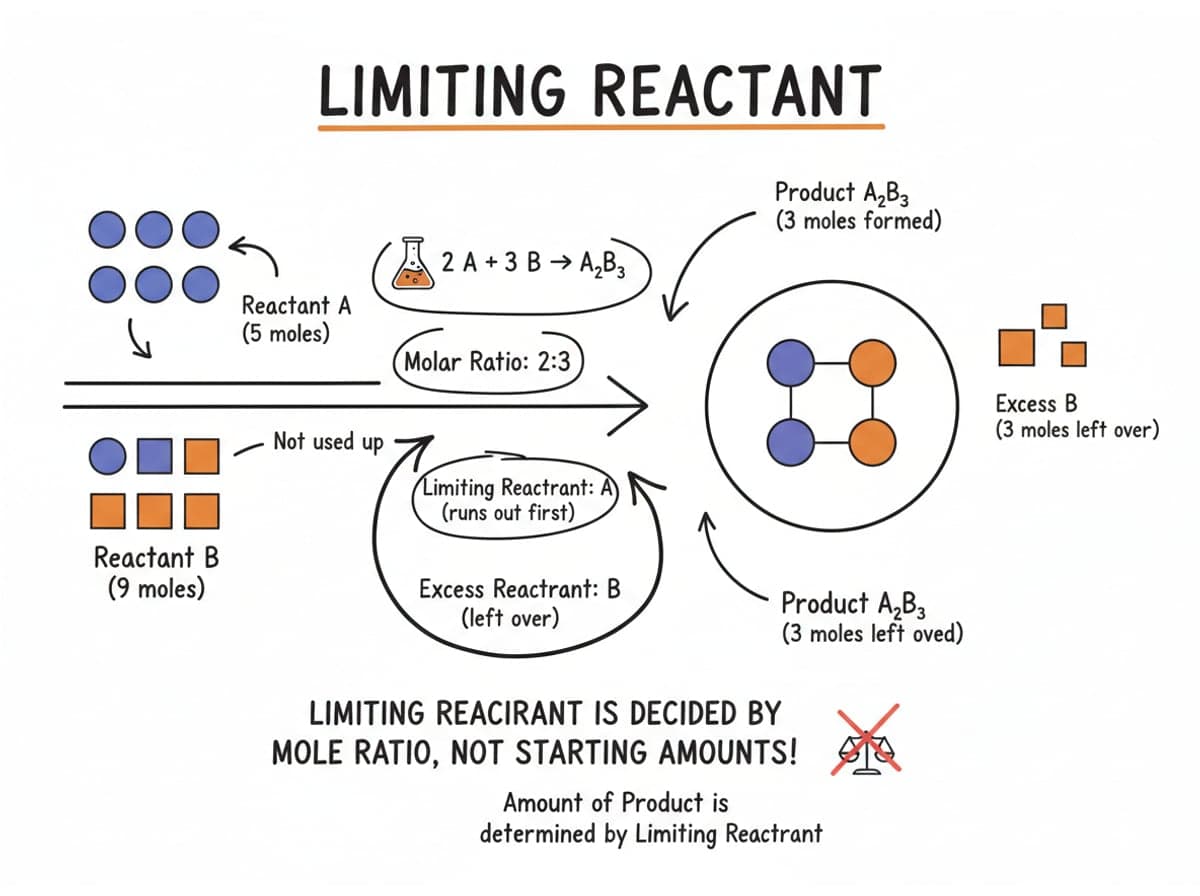
The common mistake is picking oxygen simply because 3.0 mol is less than 4.0 mol. The ratio says otherwise: 4.0 mol of H2 needs only 2.0 mol of O2. You hold 3.0 mol, so oxygen is not the scarce partner. Hydrogen is used up first and is the limiting reactant, even though it started with the larger amount. Mathematics does not care which number is larger; the ratio decides scarcity.
The method is a two-step test. Pick one reactant, count how much of the other it needs, then compare that requirement with what you have. If you have more than needed, that reactant is in excess, and the other one runs out first. If you have exactly the required amount, neither is left over. You can check by testing the other reactant the same way.
In the transfer, N2 + 3H2 → 2NH3, 2.0 mol of N2 needs 6.0 mol of H2. With 7.0 mol on hand, hydrogen is in excess, so N2 limits. Comparing in moles with the ratio is the only reliable way; gram amounts never decide it alone. Writing out the required amount is the step that makes the choice obvious, and the other reactant sits unused.
Keep this idea
Convert both amounts to moles, check how much one reactant needs of the other, and the one that runs out first is limiting.
The practice checks apply only to the displayed examples. Follow your teacher’s guidance for your own assignments.
Get help with your own questionA practice lesson each week.
A short practice lesson for your inbox. Free, with a one-click unsubscribe.