
Stoichiometry with mole ratios
One small step at a time. Ask for a clue whenever you need one.
Ask about your own question- Step 1
- Step 2
- New question
In 2H2 + O2 → 2H2O, how many moles of water form from 3.0 mol of O2? Then how many moles of water form from 4.0 mol of H2?
Common mix-up
In this example, a student wrote 1.5 mol of water, because 3.0 divided by 2 equals 1.5..
The student divided 3.0 by 2, using the coefficient of O2 against the amount of O2 instead of the ratio to water.
Guided example. Your answers aren’t saved or sent.
See why this works
Which coefficient becomes your ratio?
Coefficients are ratios. Three moles of O2 in the hydrogen reaction make twice as much water. Learn to read the recipe.
Mole ratios come from coefficients: 3.0 mol O2 times (2 mol H2O / 1 mol O2) gives 6.0 mol H2O.
A balanced equation is a recipe in moles. In 2H2 + O2 → 2H2O, the coefficients say that 2 mol of hydrogen react with 1 mol of oxygen to give 2 mol of water. Those numbers form the mole ratio that converts one substance into another. The recipe gives the ratio in whole numbers, so no arithmetic beyond multiplying and dividing is needed.
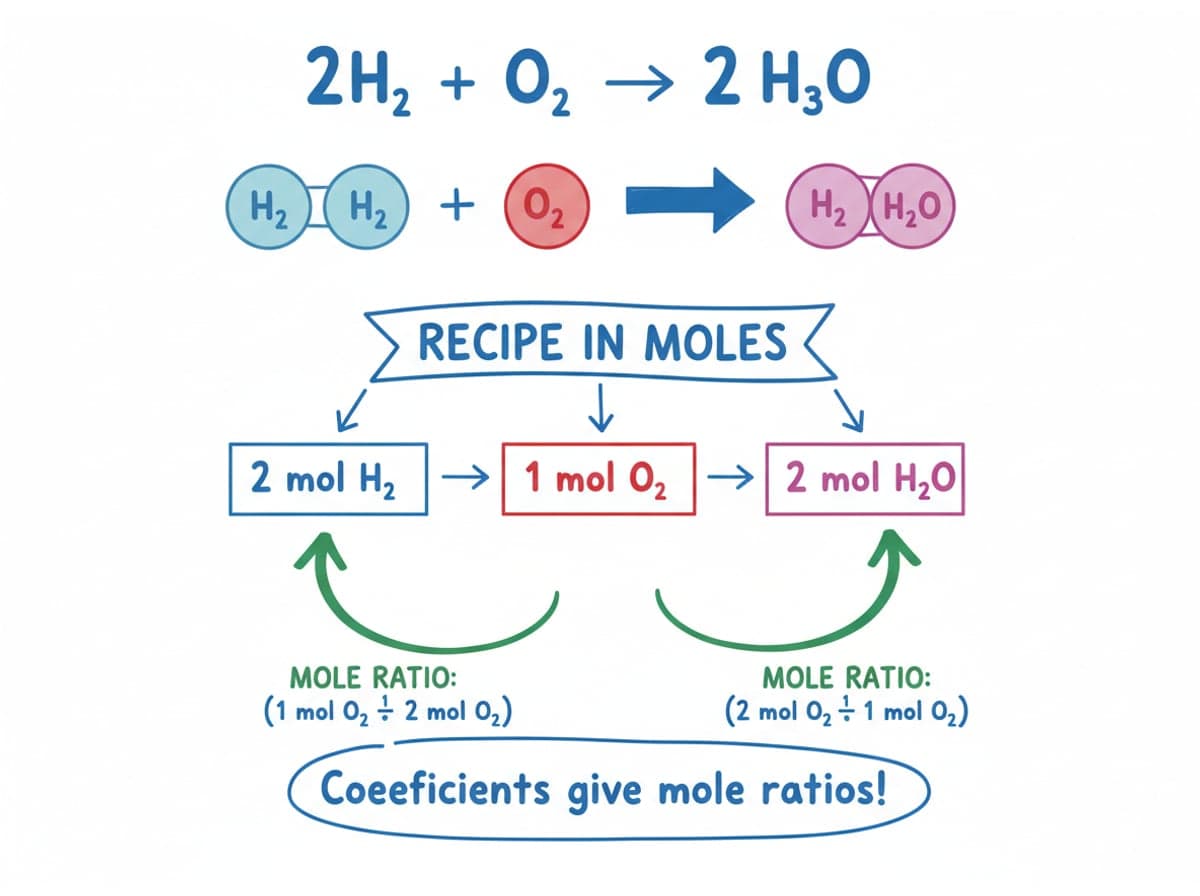
The common mistake is dividing by whatever coefficient looks small, or ignoring the coefficients and assuming a 1 to 1 ratio. Starting from 3.0 mol of O2, the ratio of water to oxygen is 2/1, so water = 3.0 x 2 = 6.0 mol. Starting from 4.0 mol of H2, the ratio is 2/2, or 1 to 1, so water is 4.0 mol.
The recipe always answers the same question: for every coefficient A of the starting substance, the reaction involves coefficient B of the target. Write the ratio with the target on top so the units cancel toward the answer. The substance you are given should be on the bottom. Saw a coefficient, write a fraction, and let the units agree with your choice. If the units do not cancel, the ratio is upside down.
Always start from a balanced equation before touching numbers. If the equation is not balanced, no ratio exists. The transfer problem uses the same move: N2 + 3H2 → 2NH3, and 6.0 mol of H2 times 2/3 gives 4.0 mol of NH3. Same recipe method, new equation. The coefficient numbers you read off the balanced equation are the only ones that matter.
Keep this idea
Multiply the given moles by the coefficient ratio from the balanced equation, with the target substance on top.
The practice checks apply only to the displayed examples. Follow your teacher’s guidance for your own assignments.
Get help with your own questionA practice lesson each week.
A short practice lesson for your inbox. Free, with a one-click unsubscribe.
Search all 106 free lessons for “Stoichiometry with mole ratios”