
Molar mass
One small step at a time. Ask for a clue whenever you need one.
Ask about your own question- Step 1
- Step 2
- New question
What is the molar mass of H2O? Then what is the molar mass of NaCl? Use H = 1.0, O = 16.0, Na = 23.0, Cl = 35.5.
Common mix-up
In this example, a student wrote 17 g/mol, because you add 1 + 16..
The student added 1.0 + 16.0 = 17.0 g/mol, leaving out one hydrogen atom.
Guided example. Your answers aren’t saved or sent.
See why this works
Is water's molar mass 17 or 18 g/mol?
The subscript 2 in H2O is easy to miss in a molar mass. Count it once, and every conversion after stays right.
Molar mass is the sum of atomic masses scaled by subscripts: H2O = 18.0 g/mol, CO2 = 44.0 g/mol, NaCl = 58.5 g/mol.
Molar mass is the mass of one mole of a substance, measured in grams per mole. It comes from the periodic table: each element's atomic mass in grams is the mass of one mole of that element. The skill is applying the subscripts. H2O means two hydrogens and one oxygen inside every molecule, and each of those two hydrogens counts its full atomic mass.
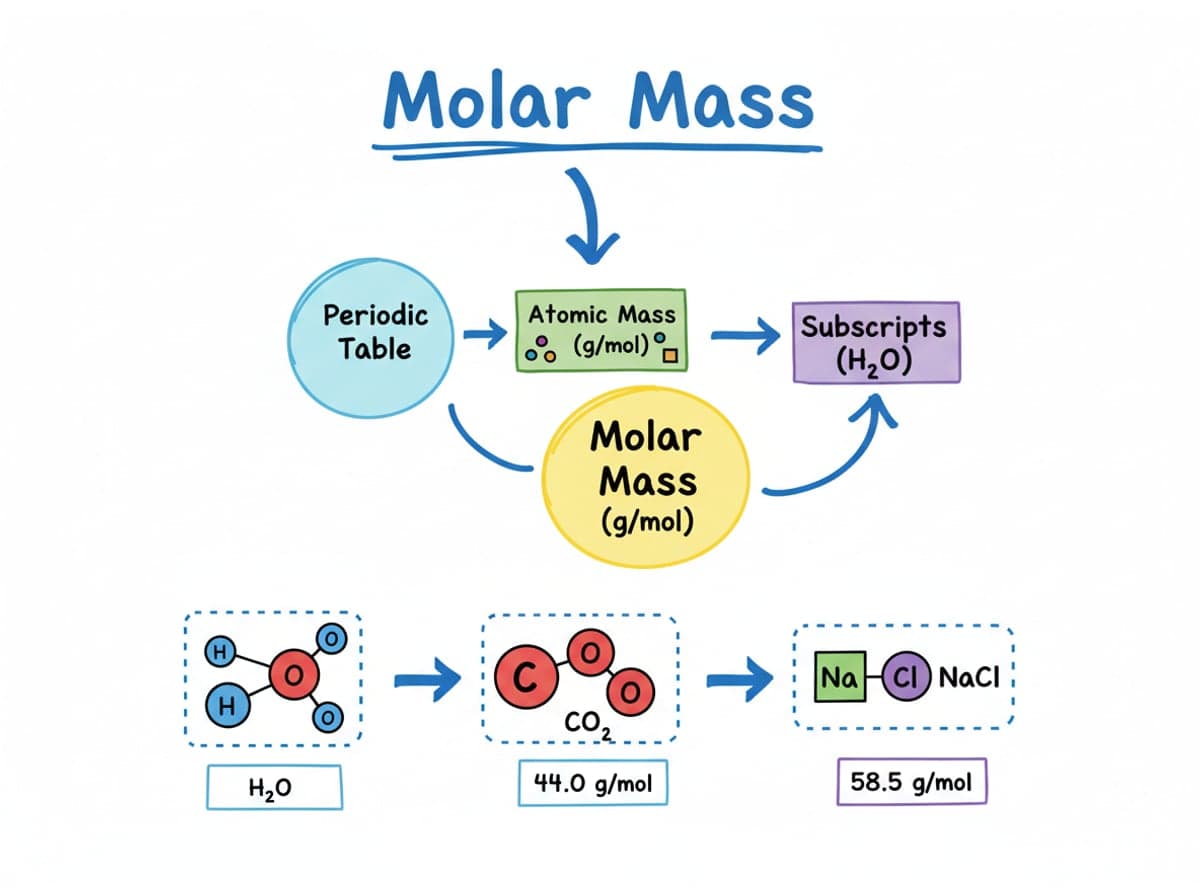
For water: 2 x 1.0 plus 1 x 16.0 equals 18.0 g/mol. The common mistake is 1 + 16 = 17, which forgets that the subscript 2 multiplies the hydrogen mass. Subscripts are multipliers, in molar mass just like everywhere else. Read the formula as a short shopping list of atoms and add the prices. The periodic table gives you the per-atom masses; only the subscripts multiply them.
For a formula with every subscript 1, like NaCl, you simply add once each: 23.0 plus 35.5 is 58.5 g/mol. For CO2, the two oxygens each count: 12.0 + 2 x 16.0 = 44.0 g/mol. The subscript rule works the same whether the number is written or understood. Nothing about the method changes when you switch from one compound to the next.
Three-term sums work the same way. For CaCO3: 40.1 + 12.0 + 3 x 16.0 = 100.1 g/mol. Carry the same rounding through the sum, and a checked molar mass makes every conversion after it reliable. One wrong subscript would change every mole conversion that follows. Choose the rounded values you will use and stick with them throughout the problem.
Keep this idea
Molar mass is the sum of atomic masses, each multiplied by its subscript: H2O is 18.0, CO2 is 44.0, NaCl is 58.5 g/mol.
The practice checks apply only to the displayed examples. Follow your teacher’s guidance for your own assignments.
Get help with your own questionA practice lesson each week.
A short practice lesson for your inbox. Free, with a one-click unsubscribe.