
The carbon cycle
One small step at a time. Ask for a clue whenever you need one.
Ask about your own question- Step 1
- Step 2
- Step 3
- New question
A leaf falls, rots, and its carbon returns to the atmosphere. In what form does the carbon rejoin the air?
Common mix-up
In this example, a student wrote As new carbon the soil made after the leaf died..
Carbon is not created or destroyed; burning just releases stored carbon atoms back into the air.
Guided example. Your answers aren’t saved or sent.
See why this works
Is carbon ever created or destroyed?
You said burning makes new carbon. The atoms were already here; burning just moves stored carbon back into the air.
Carbon atoms cycle among air, organisms, oceans and rocks: photosynthesis removes CO2, and respiration, decomposition and burning return it.
Carbon is the atom that builds the backbones of life's molecules: sugars, fats, proteins and DNA. It is never created or destroyed on Earth; the same atoms keep moving around. The carbon cycle is the road map of those travels, between the air, living things, the oceans, rocks and soil. Follow the carbon and you are following the planet's whole chemistry.
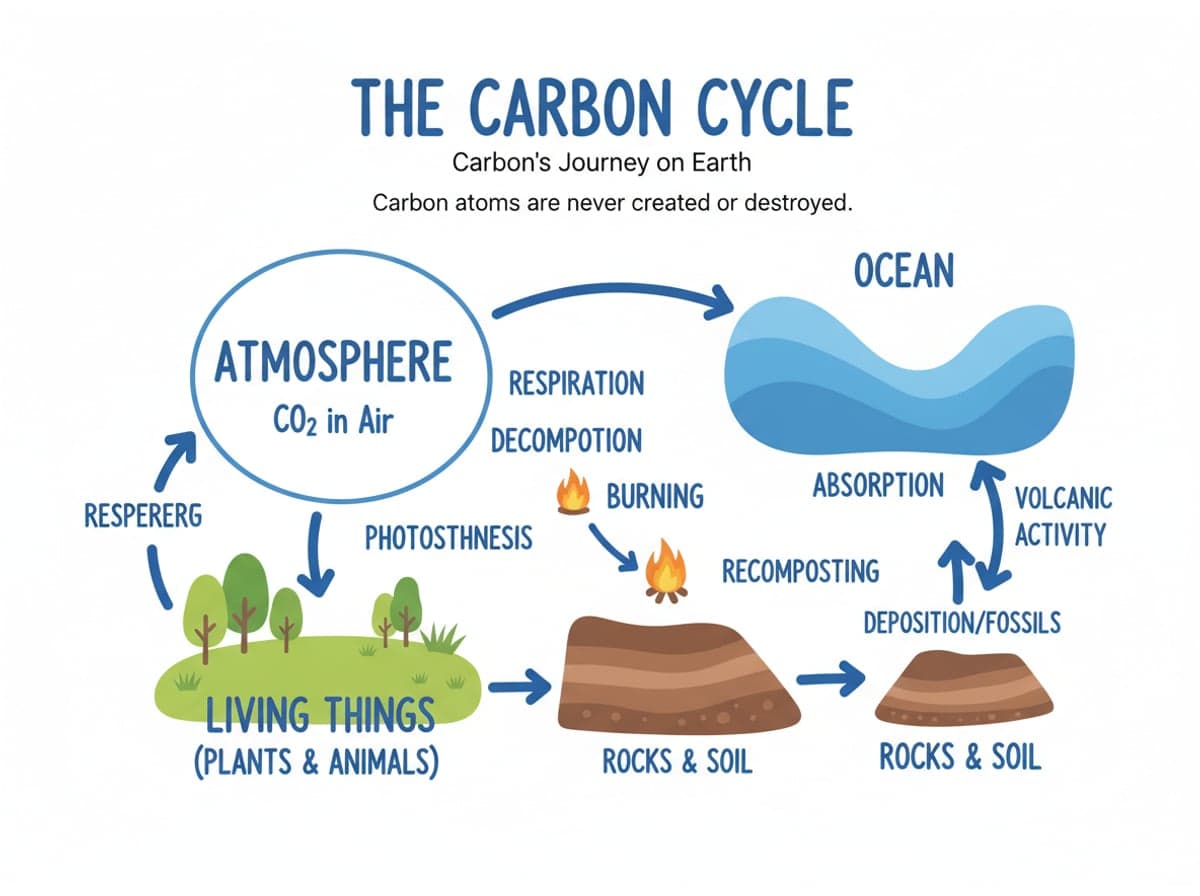
The air holds carbon as carbon dioxide gas, a tiny share of the atmosphere. Photosynthesis takes it in: plants and algae use the carbon to build glucose and everything made from it. That carbon climbs the food web as animals eat plants. Growing forests, seaweed meadows and plankton blooms are all pulling carbon out of the air and storing it in living matter.
Carbon returns to the air through several doors. Cellular respiration in every living cell breaks carbon molecules down and releases carbon dioxide. Decomposers do the same work on dead plants and animals. And burning wood, coal, oil or gas joins stored carbon quickly with oxygen, releasing carbon dioxide all at once. All three paths send the same atoms back to the atmosphere.
Some carbon takes the slow road. Shells and tiny plankton skeletons sink and become limestone, and the remains of ancient forests and plankton became coal and petroleum. Over millions of years these rocks and fuels lock huge amounts of carbon away from the air. Volcanoes release the carbon of old sea floor, and burning fossil fuels releases the carbon of ancient plants, returning it to the sky in seconds.
Keep this idea
Carbon cycles: photosynthesis locks CO2 into living matter, while respiration, decomposition and burning release it back as CO2.
The practice checks apply only to the displayed examples. Follow your teacher’s guidance for your own assignments.
Get help with your own questionA practice lesson each week.
A short practice lesson for your inbox. Free, with a one-click unsubscribe.