
The rock cycle
One small step at a time. Ask for a clue whenever you need one.
Ask about your own question- Step 1
- Step 2
- Step 3
- New question
Granite is buried deep, squeezed by heat and pressure, but never melts. What kind of rock does it become?
Common mix-up
In this example, a student wrote Nothing changes; granite is granite forever..
No rock type is permanent or final. Melting, heat and pressure, and weathering can change any rock into any other.
Guided example. Your answers aren’t saved or sent.
See why this works
Can one kind of rock become another?
You said granite stays granite forever. Given enough time, granite can become sediment, or metamorphic rock, or magma, and back again.
The rock cycle lets any rock type change into any other through melting, heat and pressure, weathering and erosion.
Rocks look permanent, but they are made over deep time and they keep changing. The rock cycle is the web of those changes. It is not a fixed order, and no rock type is a final product; every rock can be recycled in several ways. The full journey can take millions of years, so the processes are easy to miss in a human lifetime. Geologists read the changes in the minerals and patterns left behind.
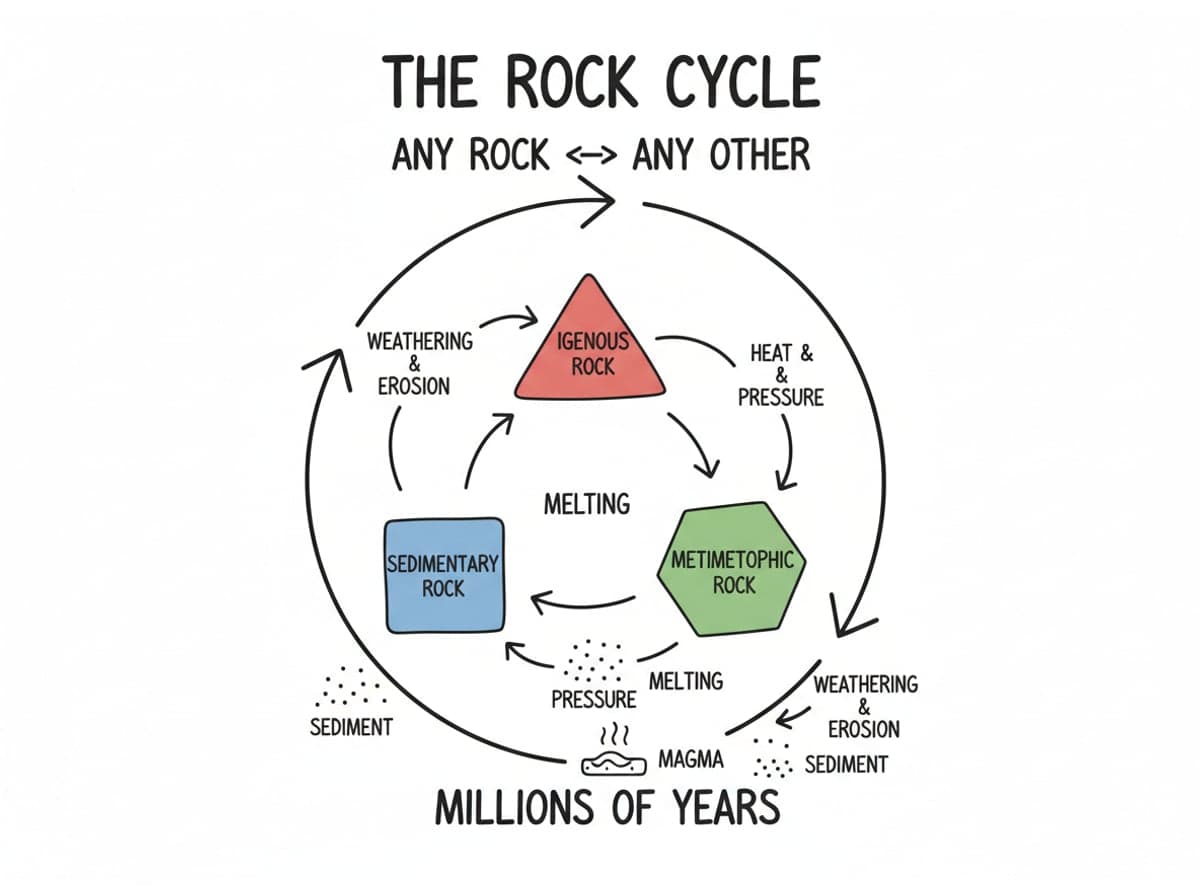
Molten rock is magma underground and lava at the surface. When it cools, crystals form and the result is igneous rock. Granite is a slow-cooled igneous rock with large crystals; basalt is a fast-cooled one with small crystals. The cooling rate is a clue to history: a deep, slow chill makes fat crystals, while a sudden surface chill makes fine ones.
Two more makers exist. Weathering and erosion break any rock into sediment: sand, pebbles and mud. Buried and squeezed into layers, sediment compacts and cements into sedimentary rock, the type that holds most fossils. And great heat and pressure deep underground can recrystallize any rock without melting it, producing metamorphic rock, such as marble from limestone. Metamorphic means changed in form.
Now connect the pieces. Take igneous granite, bury it and squash it: it becomes metamorphic rock. Melt that metamorphic rock and new magma forms, then new igneous rock. Take a sandstone and weather it: it becomes sediment again. Because every path is open in both directions, the cycle is a tangle of roads, not a line, and each rock's recent location shows in the changes it carries.
Keep this idea
Any rock can become any other: magma cools to igneous, heat and pressure make metamorphic, and weathering, compaction and cementation make sedimentary.
The practice checks apply only to the displayed examples. Follow your teacher’s guidance for your own assignments.
Get help with your own questionA practice lesson each week.
A short practice lesson for your inbox. Free, with a one-click unsubscribe.