
The water cycle
One small step at a time. Ask for a clue whenever you need one.
Ask about your own question- Step 1
- Step 2
- Step 3
- New question
A lake evaporates under the Sun, and rain later falls on a town downwind. Where did the lake's water go in between?
Common mix-up
In this example, a student wrote It became clouds, which are made of water vapor..
Clouds are liquid droplets, not water vapor. Vapor is invisible, and it becomes droplets when it cools and condenses.
Guided example. Your answers aren’t saved or sent.
See why this works
Where does rain come from, and where do puddles go?
You said clouds are water vapor. Vapor is an invisible gas; clouds are made of tiny liquid droplets that vapor turned into.
The Sun powers the cycle: evaporation makes invisible vapor, condensation makes droplets and clouds, precipitation returns water to Earth.
The same water has been cycling around Earth for billions of years. The Sun warms the surface, and molecules of water gain energy and escape into the air. Liquid becoming gas is evaporation: a puddle vanishing on a warm sidewalk, sweat drying from your skin, or a lake slowly shrinking in the Sun. The water does not disappear; it joins the air as vapor.
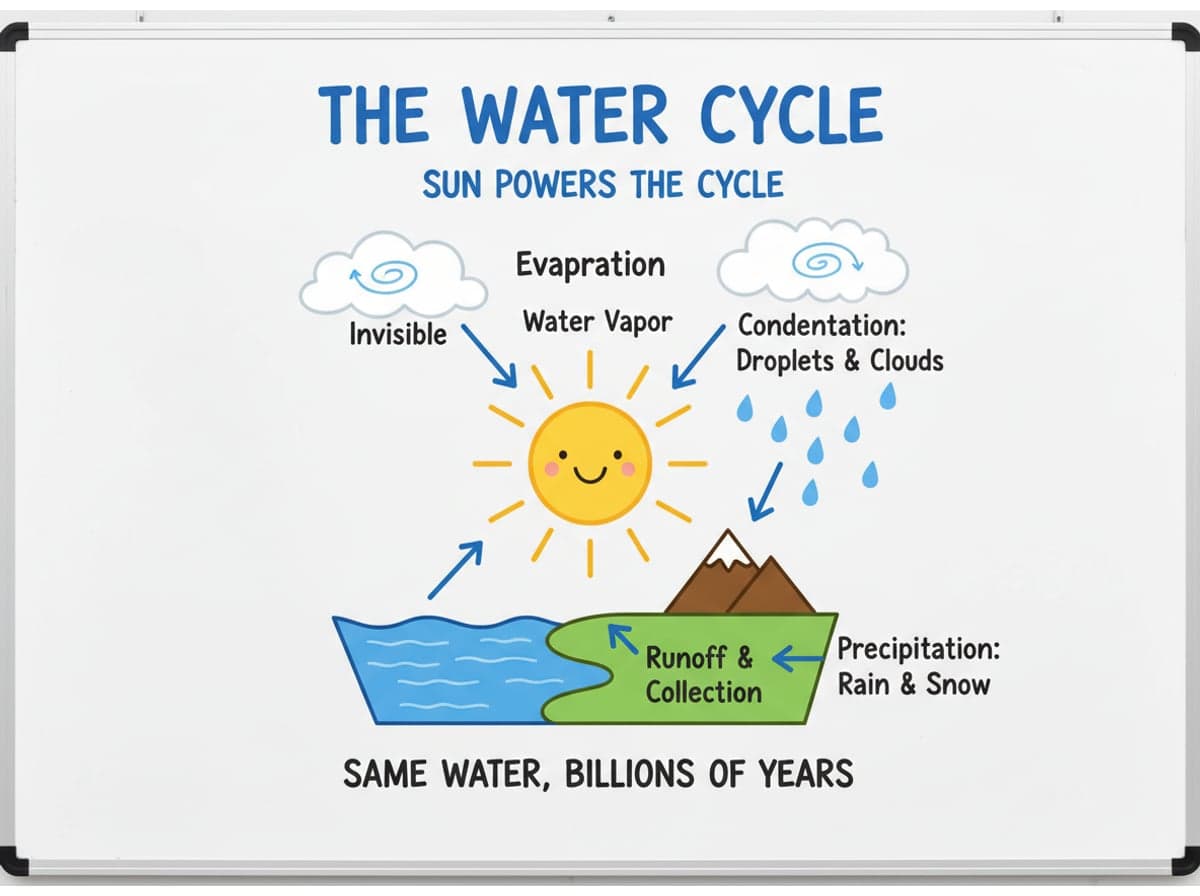
Water vapor is an invisible gas. You cannot see it even on a humid day, when the air holds plenty of it. Clouds, fog, and the puff above a kettle are made of liquid droplets, not vapor. When vapor cools, its molecules slow down and stick together on tiny particles in the air, forming droplets. Gas turning into liquid this way is condensation, the same change that fogs a cold drink glass.
A cloud is a floating collection of countless tiny droplets or ice crystals, so small that rising air holds them up. The droplets meet, merge and grow. When the drops get too heavy for the rising air to support, gravity wins and they fall. Everything that falls out of a cloud, rain, snow, sleet or hail, is called precipitation, and each of those is a different form of the same falling water.
Plants add a second path: they pull water from the soil and release it through their leaves, a process called transpiration. Evaporation and transpiration feed the same bank of vapor. Winds carry it inland, high above the mountains it cools and condenses, and the rain feeds streams that run back to the sea. The water you drink today was likely in a dinosaur's puddle.
Keep this idea
The Sun powers the cycle: evaporation makes invisible vapor, condensation forms droplets, clouds grow, and precipitation returns the water to Earth.
The practice checks apply only to the displayed examples. Follow your teacher’s guidance for your own assignments.
Get help with your own questionA practice lesson each week.
A short practice lesson for your inbox. Free, with a one-click unsubscribe.