
Plate tectonics
One small step at a time. Ask for a clue whenever you need one.
Ask about your own question- Step 1
- Step 2
- Step 3
- New question
The Atlantic Ocean widens about 2 cm every year. What is actually carrying the Americas and Africa apart?
Common mix-up
In this example, a student wrote The crust cracked while Earth cooled, so the pieces are still drifting..
The plates ride slow convection currents in the mantle; they are not drifting on a cracking, cooling shell.
Guided example. Your answers aren’t saved or sent.
See why this works
Why do the continents drift?
You said the continents drift because Earth is cracking as it cools. The plates ride slow currents of heated rock in the mantle.
Earth's rigid plates move on convection currents in the mantle; divergent, convergent and transform boundaries shape the planet.
Earth's outer shell is not one solid skin. It is broken into a handful of giant rigid plates that include the crust and the top of the mantle, together called the lithosphere. The plates sit on the asthenosphere, part of the mantle that flows like very slow, thick material. They move a few centimeters a year, about the speed a fingernail grows, which is why the motion is invisible in a lifetime.
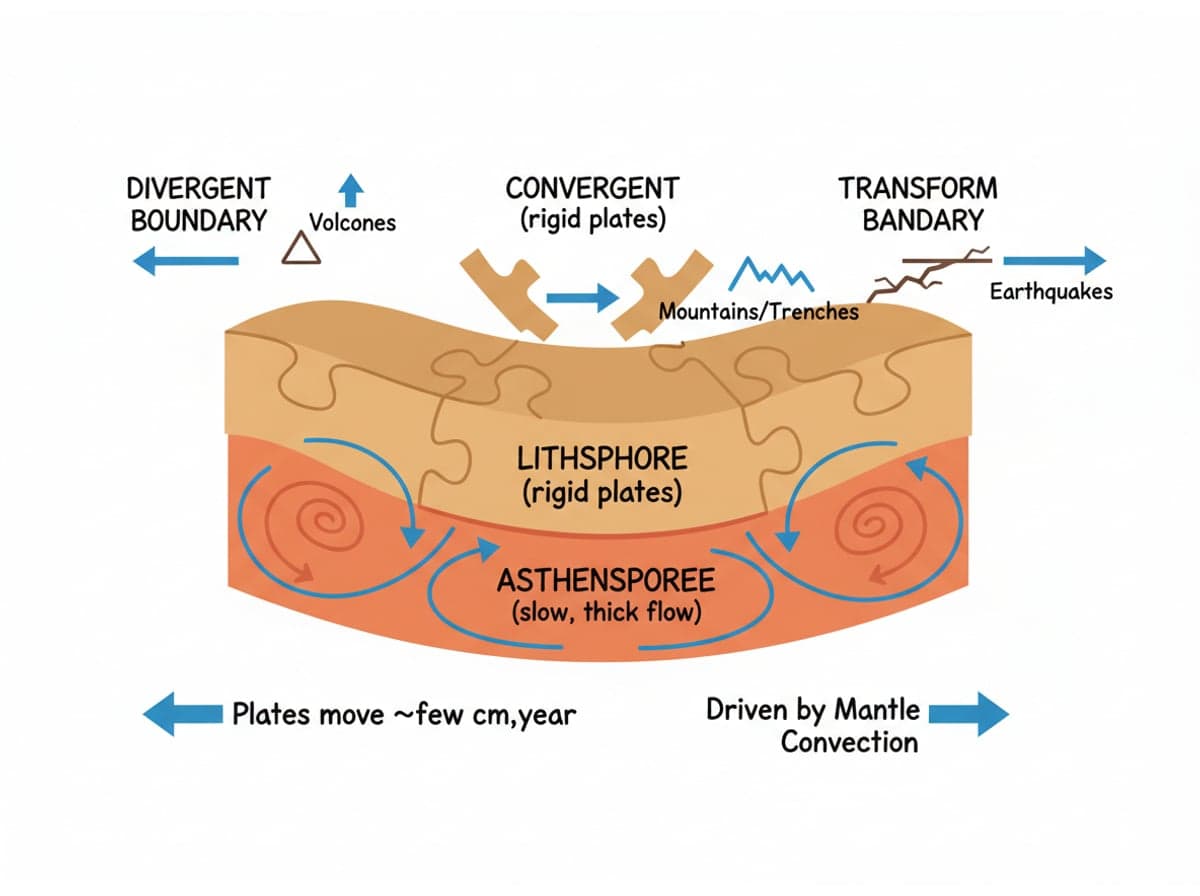
What drives them? Heat from the deep interior makes convection currents in the mantle. Warm material rises, spreads, cools and sinks, the same pattern you see in a heated pot of soup, only far slower and in rock that looks solid. The slowly flowing asthenosphere drags the plates along with it. No crack from a cooling Earth is needed; the same currents are still running today.
At divergent boundaries, plates pull apart. Magma rises into the gap, cools into new sea floor, and the ridges stay young and volcanic. At convergent boundaries, plates collide. Where a dense oceanic plate slides into the mantle, it melts and feeds arc volcanoes, and deep trenches mark the sinking edge. Where two continents collide, crust crumples upward into mountain ranges like the Himalayas.
At transform boundaries, plates slide sideways past each other, so earthquakes break loose along the fault. The plate map explains a lot of planet history: the Atlantic is widening because a divergent ridge splits its floor, and the Americans are riding west with their plates. India still pushes into Asia, so the Himalayas still rise, and most big volcanoes and quakes cluster on plate edges.
Keep this idea
Convection currents in the mantle carry Earth's plates; divergent, convergent and transform boundaries build oceans, mountains, volcanoes and earthquakes.
The practice checks apply only to the displayed examples. Follow your teacher’s guidance for your own assignments.
Get help with your own questionA practice lesson each week.
A short practice lesson for your inbox. Free, with a one-click unsubscribe.