
Photosynthesis
One small step at a time. Ask for a clue whenever you need one.
Ask about your own question- Step 1
- Step 2
- Step 3
- New question
A sunflower gains 50 kg of new stems and seeds in one season. Where does most of that new matter come from?
Common mix-up
In this example, a student wrote From the soil, through the roots..
Soil provides water and minerals, but nearly all of a plant's body mass comes from carbon dioxide taken from the air.
Guided example. Your answers aren’t saved or sent.
See why this works
Where does a growing plant's mass come from?
You said the soil feeds the plant. Soil holds water and minerals, but most of the tree's wood is built from carbon in the air.
Photosynthesis uses light, water and carbon dioxide to make glucose and oxygen, and that glucose's carbon builds the plant.
A plant needs three main inputs to make food: light, water, and carbon dioxide. Nearly all of the work happens in the leaves, inside organelles called chloroplasts that hold the green pigment chlorophyll. Chlorophyll captures light energy. That energy drives the reaction that builds glucose from water and carbon dioxide, releasing oxygen as a by-product. Plants release far more oxygen than they use, which is why forests are called the planet's lungs.
Write the recipe as carbon dioxide plus water plus light, making glucose plus oxygen. One important detail: the carbon in the glucose comes from carbon dioxide, not from the water. The leaf is not a mouth; it is a factory. It takes simple molecules from air and water and builds the rich carbon compounds that make up stems, leaves, seeds and roots. Every plant cell then uses that glucose as its fuel and its building material.
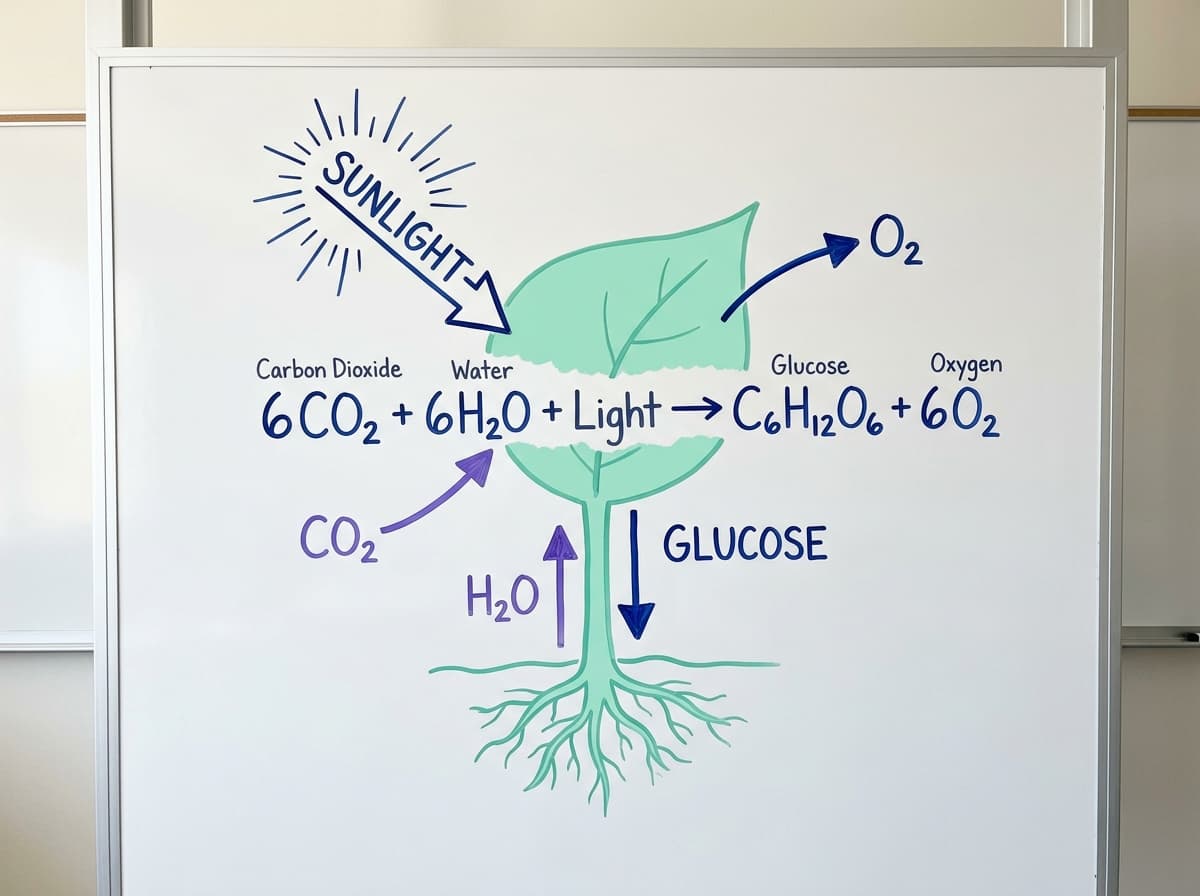
Here is the surprising part: most of a plant's dry matter is carbon. Roots do bring in water and dissolved minerals, but those are only a small part of a tree's mass. The wood, the leaves and the fruit are mostly carbon and water built from carbon dioxide pulled out of the air. Plant growth is really atmospheric carbon being packed into solid form, season after season.
The soil's real jobs are anchorage, water, and a few mineral nutrients. If the soil supplied most of a plant's matter, a growing field would slowly sink. Weighed-tree experiments show the soil barely loses mass while the tree gains plenty. The missing mass comes from carbon dioxide. Feed a bean sprout sunlight and air, and it grows heavy from what it took out of the sky, not from what it took out of the pot.
Keep this idea
Photosynthesis builds glucose from water and carbon dioxide using light energy, and that carbon builds the plant. Most plant mass comes from the air, not the soil.
The practice checks apply only to the displayed examples. Follow your teacher’s guidance for your own assignments.
Get help with your own questionA practice lesson each week.
A short practice lesson for your inbox. Free, with a one-click unsubscribe.