
Cellular respiration
One small step at a time. Ask for a clue whenever you need one.
Ask about your own question- Step 1
- Step 2
- Step 3
- New question
You inhale air and your body uses food to release energy. Where in your body do the cells actually release that energy?
Common mix-up
In this example, a student wrote In the lungs, when the air gets in..
Breathing moves air; cellular respiration releases energy from glucose and oxygen inside every cell.
Guided example. Your answers aren’t saved or sent.
See why this works
Is breathing the same as cellular respiration?
You said respiration happens in the lungs. The lungs move air in and out; the useful energy release happens inside every one of your cells.
Cellular respiration uses oxygen and glucose to release energy, water and carbon dioxide inside every cell.
The word respiration confuses two different things. Breathing moves air into and out of your lungs. Cellular respiration is a set of chemical reactions that releases energy from food, and it happens in every living cell of your body, not only in your lungs. Breathing exists partly to supply the oxygen those reactions need and to carry away the carbon dioxide they make. One is air going back and forth; the other is chemistry going on inside cells.
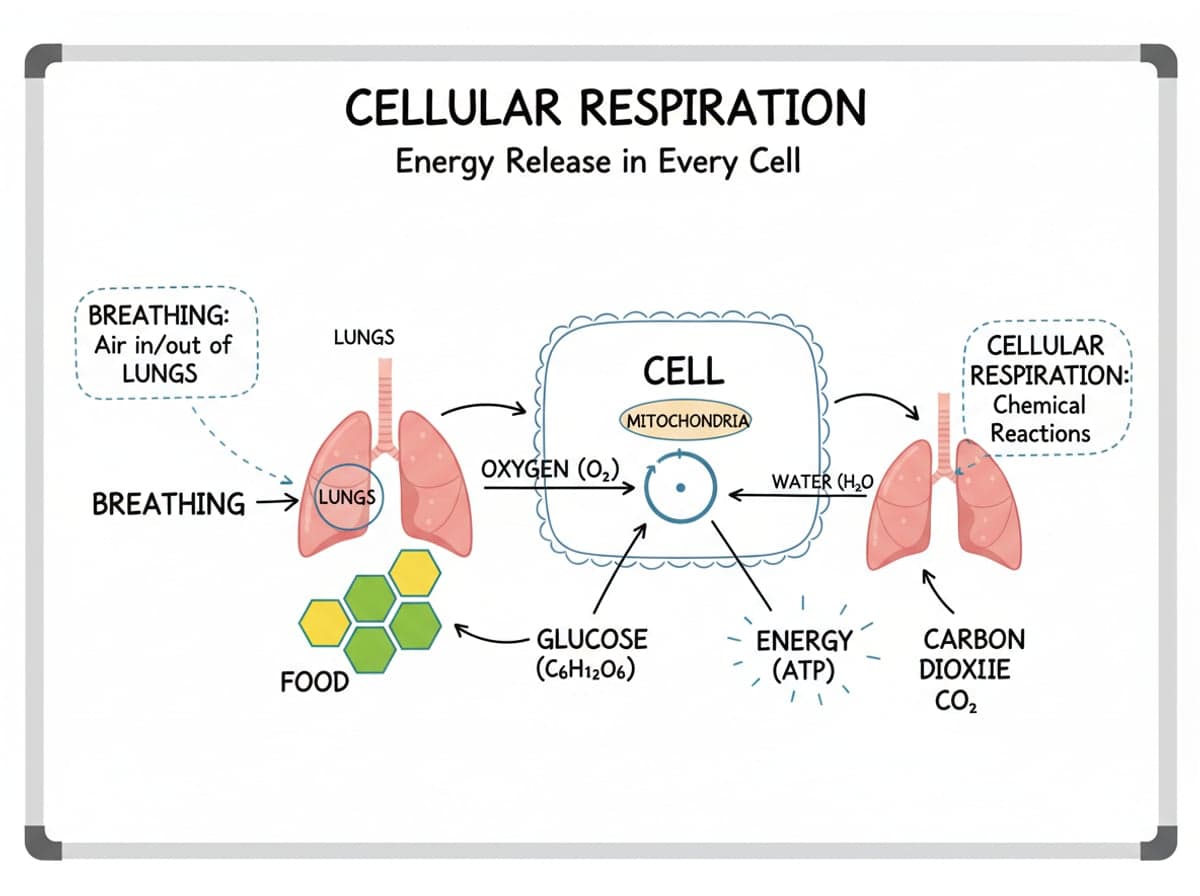
The recipe for cellular respiration is glucose plus oxygen, reacting to release energy, plus carbon dioxide and water. The energy emerges in a form cells can use directly, a molecule called ATP. Cells spend that ATP on everything: building proteins, moving, and keeping the cell running. Respiration is the cell's way of turning food into usable energy, and it never stops while the cell is alive.
Most of the energy-releasing reactions run inside the mitochondria, the same power plants we meet when studying organelles. Glucose is partly broken down outside the mitochondria, then the fragments enter them for the oxygen-using stage. This is why muscle cells are crowded with mitochondria and why you breathe faster when you run: working muscles demand more oxygen to keep releasing energy.
The wastes of cellular respiration are carbon dioxide and water. When you breathe out, you release carbon dioxide that your cells just made. Plants use that same carbon dioxide for photosynthesis, and the oxygen they release feeds your cells. Respiration and photosynthesis are two halves of one recycling loop between living things and the air. Neither process creates energy; both move the same energy captured from sunlight through life.
Keep this idea
Cellular respiration releases energy from glucose and oxygen in every cell and returns carbon dioxide and water to the air. Breathing only delivers the gas.
The practice checks apply only to the displayed examples. Follow your teacher’s guidance for your own assignments.
Get help with your own questionA practice lesson each week.
A short practice lesson for your inbox. Free, with a one-click unsubscribe.