
Cell organelles
One small step at a time. Ask for a clue whenever you need one.
Ask about your own question- Step 1
- Step 2
- Step 3
- New question
A muscle cell works hard and needs plenty of energy. Which organelle releases that energy from food?
Common mix-up
In this example, a student wrote The nucleus releases the energy for the muscle cell..
The nucleus stores the cell's instructions. Making energy from food is the mitochondria's job.
Guided example. Your answers aren’t saved or sent.
See why this works
Which organelle makes the cell's energy?
You said the nucleus makes the cell's energy. The instructions live in the nucleus, but the energy-making has a different address.
Each organelle has its own job: mitochondria release energy, the nucleus keeps instructions, chloroplasts make food.
A cell is like a small factory with many tiny machines inside. Each machine, called an organelle, has one main job. Two organelles are easy to mix up because both sit in every animal cell: the nucleus and the mitochondria. If you remember one job for each, the cell stops being a jumble of important-sounding names. The nucleus stores instructions, and the mitochondria release usable energy.
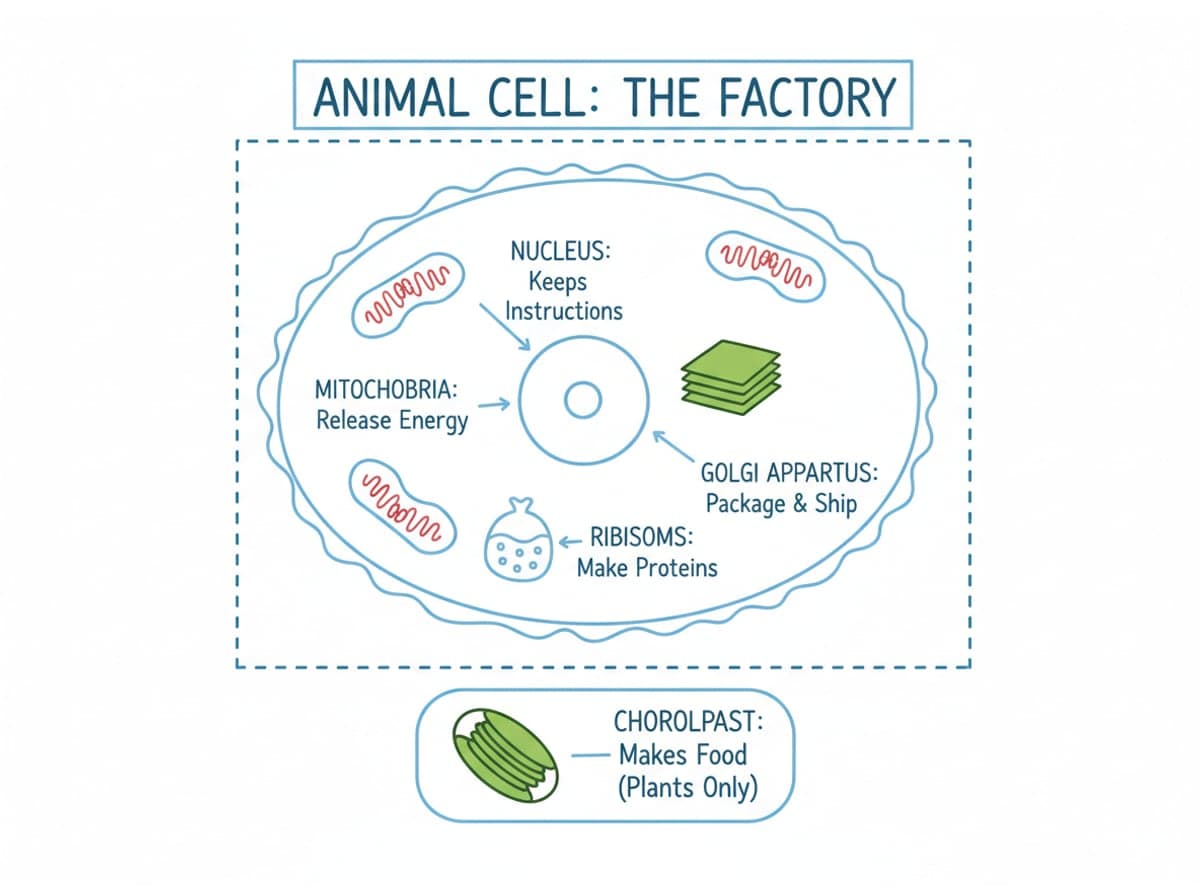
Mitochondria release energy from glucose using oxygen. The cell spends that energy on building, moving, and repairing itself. Because of this, mitochondria are often called the cell's power plants. Most of the energy-releasing work in a cell happens inside them. The number of mitochondria matches a cell's needs, so a cell that works hard builds extra copies to keep up.
The nucleus is the cell's instruction keeper. It holds the DNA that carries the code for making proteins and running the cell. Compare it to a reference library: the information stays stored safely inside, and the cell reads it as needed. The nucleus directs what the cell does, but it does not make energy from food. When a cell divides, the nucleus makes sure the DNA is copied first.
Plant cells add one more piece: chloroplasts. These green organelles hold chlorophyll, which captures sunlight. With that light, chloroplasts build glucose from water and carbon dioxide. Plant cells also have mitochondria, so a plant makes its food with chloroplasts and then releases its energy with mitochondria. The soil supplies water and minerals, but the green food factory inside a leaf is the chloroplast.
Keep this idea
Mitochondria release energy, the nucleus stores instructions, and chloroplasts make food in plant cells. Match each organelle to its one job and the cell makes sense.
The practice checks apply only to the displayed examples. Follow your teacher’s guidance for your own assignments.
Get help with your own questionA practice lesson each week.
A short practice lesson for your inbox. Free, with a one-click unsubscribe.