
Cell division (mitosis)
One small step at a time. Ask for a clue whenever you need one.
Ask about your own question- Step 1
- Step 2
- Step 3
- New question
A skin cell divides to heal a scrape. How many new cells does one parent cell make, and what do they carry?
Common mix-up
In this example, a student wrote Two new cells, each with half of the parent's DNA..
The DNA is not split in half. The cell copies its DNA first, and each daughter cell receives a complete set.
Guided example. Your answers aren’t saved or sent.
See why this works
What happens to the DNA when a cell divides?
You said the DNA splits in half so two cells can share it. The DNA is copied first, and both new cells end up with a complete set.
Mitosis: a parent cell copies its DNA, splits once, and produces two daughter cells with identical DNA.
Your body makes new cells all the time. When you scrape a knee, skin cells multiply to repair it; when you grow, cells multiply to add tissue. The process that makes two cells from one is mitosis. Before it begins, the parent cell has one nucleus and one full set of DNA. Because all of that DNA matters, the cell manages it very carefully through the division.
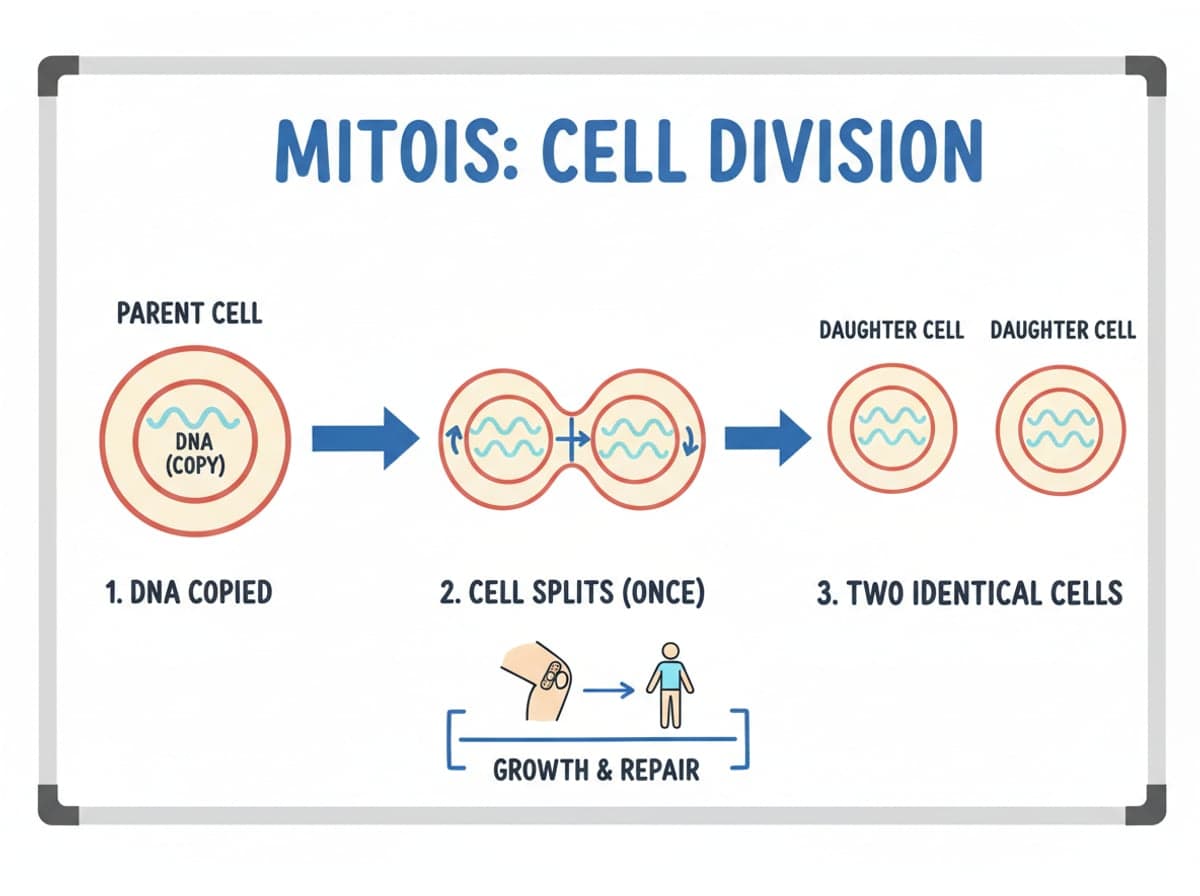
The first step is copying. Every chromosome is duplicated, so the cell now holds two identical copies of its whole set of instructions. If the DNA were cut in half instead, each daughter cell would permanently lose information. Copying first is why both new cells can carry the full set: nothing is missing on either side when the cell finally splits.
In mitosis, the copies line up, and then the cell divides once. The nucleus divides so each daughter cell receives one complete set of chromosomes. The result is two daughter cells that are genetically identical to the parent and to each other. This is what makes healing and growth reliable: the new cells match the old ones exactly, with the same enzymes and the same instructions for every job.
One way to picture it is a book. A cell about to divide photocopies its manual, and each new cell receives a whole manual, not half of one. Mitosis in body cells is for growth and repair, and it runs constantly. A different process, called meiosis, makes eggs and sperm, and it halves the chromosome number on purpose. That special division is for inheritance, not for healing a scrape.
Keep this idea
In mitosis a cell copies its DNA, splits once, and makes two identical daughter cells. Copying first is why nothing is lost.
The practice checks apply only to the displayed examples. Follow your teacher’s guidance for your own assignments.
Get help with your own questionA practice lesson each week.
A short practice lesson for your inbox. Free, with a one-click unsubscribe.