
Comparing and ordering fractions
One small step at a time. Ask for a clue whenever you need one.
Ask about your own question- Step 1
- Step 2
- Step 3
- New question
Which is larger, 5/8 or 2/3?
Common mix-up
In this example, a student wrote 5/8, because 5 > 2 and 8 > 3.
Leo compared the tops and then the bottoms and decided 5/8 was larger because 5 beats 2 and 8 beats 3. He was comparing the labels on the pieces instead of the amount of cake.
Guided example. Your answers aren’t saved or sent.
See why this works
Why is 5/8 smaller than 2/3?
Five is a bigger number than two and eight is a bigger number than three, yet five eighths is the smaller amount. Bigger numbers on the page are smaller pieces of the whole.
Compare fractions by rewriting them with the same denominator, or by cross-multiplying.
The digits in a fraction are not amounts, they are instructions. The bottom number says how many equal pieces the whole was cut into, and the top says how many you took. Cutting into 8 pieces makes each piece smaller than cutting into 3 pieces, so 5 small pieces can easily be less than 2 bigger ones. That is the whole reason 5/8 is smaller than 2/3, and it is why comparing tops and bottoms separately gives the wrong answer.
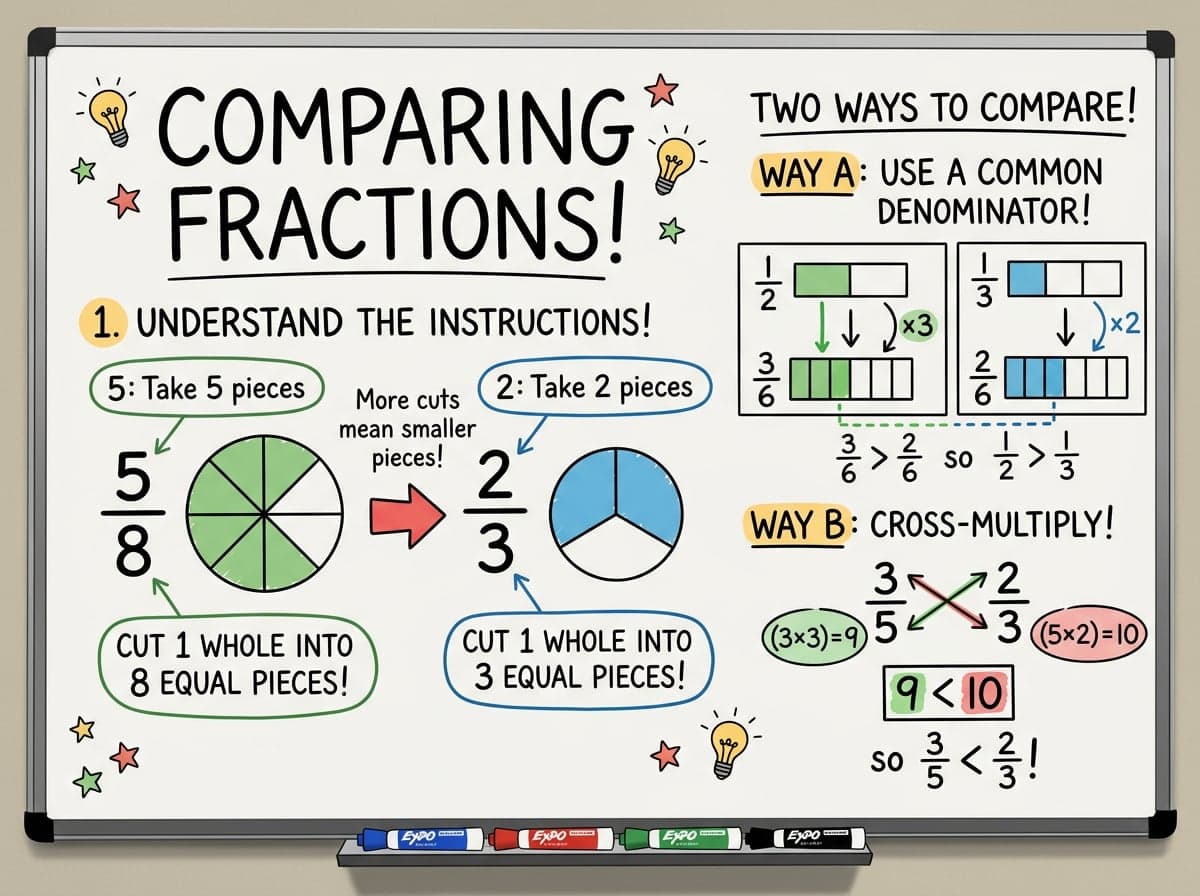
The reliable method is to give both fractions the same denominator, because then the pieces are the same size and the numerators can be compared directly. Rewrite 5/8 as 15/24 and 2/3 as 16/24. Now both are counted in twenty-fourths, and 15 is less than 16. The method is exactly the equivalence rule you already use when simplifying, run in the other direction.
Cross-multiplying is the same comparison done faster, and it is worth learning because it costs no writing. Multiply 5 by 3 and 2 by 8. The two products are 15 and 16, and the fraction on the side of the bigger product is the bigger fraction. This works because both products are the numerators of the same common denominator — 24 in this case — so you compared 15 and 16 without ever writing the denominator down.
Two quick checks save time when the fractions are far apart. Compare each to a half: anything with a top less than half the bottom is under a half, anything with a top more than half the bottom is over. And remember that a fraction is also a division, so a calculator check of 5 ÷ 8 against 2 ÷ 3 will settle any argument — the methods above are for when you want to be sure without one.
Keep this idea
Compare fractions by size of piece, not size of digit. Rewrite both with a common denominator, or cross-multiply and compare the two products — the bigger product sits under the bigger fraction.
The practice checks apply only to the displayed examples. Follow your teacher’s guidance for your own assignments.
Get help with your own questionA practice lesson each week.
A short practice lesson for your inbox. Free, with a one-click unsubscribe.
Search all 106 free lessons for “Comparing and ordering fractions”