
Decimal operations
One small step at a time. Ask for a clue whenever you need one.
Ask about your own question- Step 1
- Step 2
- Step 3
- New question
Work out 0.4 × 0.3.
Common mix-up
In this example, a student wrote 0.4 × 0.3 = 1.2.
Kai multiplied 4 by 3 to get 12, then decided the answer looked too small and wrote 1.2. The digits were right and the point was one place too far to the right.
Guided example. Your answers aren’t saved or sent.
See why this works
Why is 0.4 × 0.3 smaller than both?
Multiplying is supposed to make things bigger, and here it made something smaller. That is not a trick, it is what happens when both numbers are less than one.
Each decimal place counts, so the answer takes as many decimal places as the two numbers had between them.
A decimal below one is a fraction in disguise: 0.4 means four tenths. Multiplying four tenths by three tenths is the same as multiplying two fractions smaller than one, and multiplying two fractions smaller than one always gives a smaller result. You are taking a part of a part, which is why 0.4 × 0.3 cannot be 1.2.
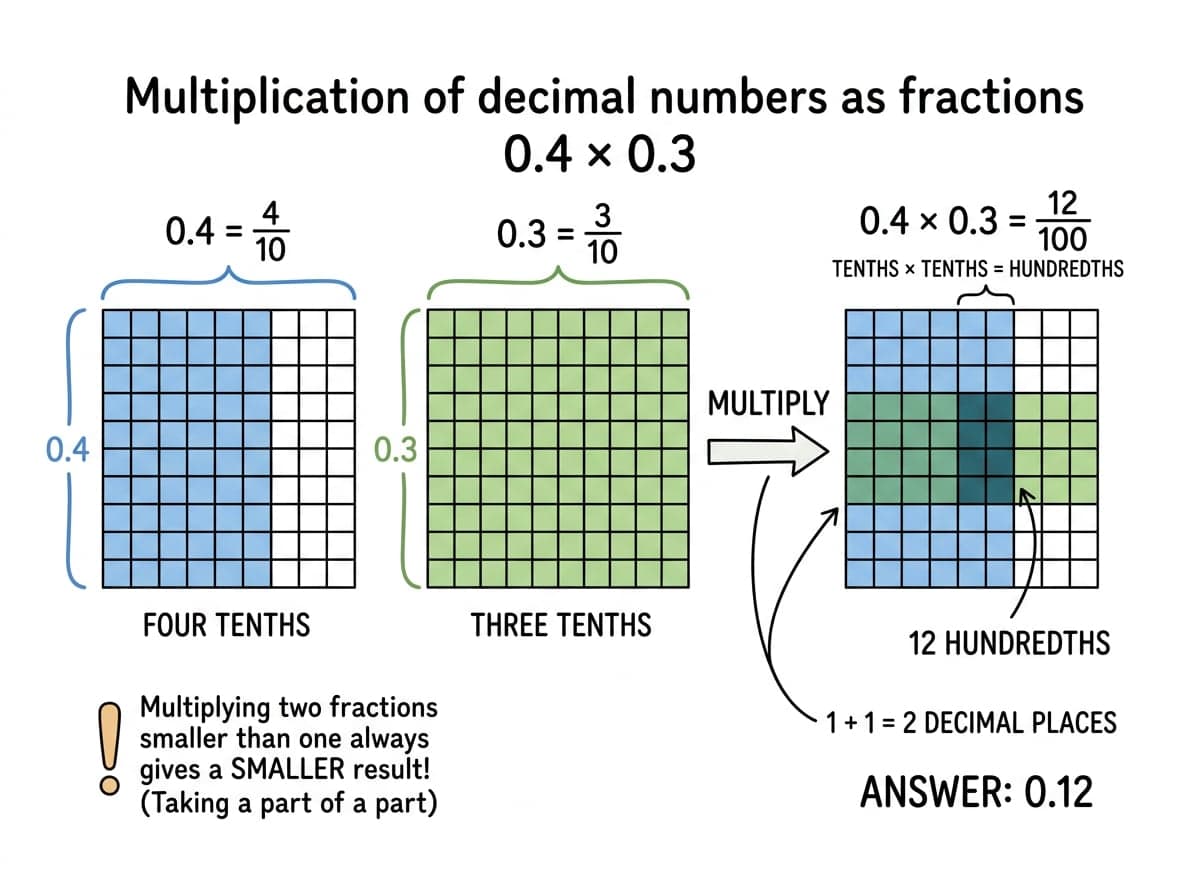
The method for placing the point is to count. Multiply as though the points were not there: 4 × 3 = 12. Then count the decimal places in the question — one in 0.4 and one in 0.3, so two altogether — and give the answer the same number. Two places on 12 gives 0.12. This rule works because the tenths and tenths together create hundredths.
Estimating is the check that catches a misplaced point, and it is quicker than re-doing the sum. The answer to 0.4 × 0.3 must be smaller than 0.4, so anything near 1 or larger is wrong; roughly a third of four tenths is about 0.1, which confirms 0.12 and rules out both 1.2 and 0.012. Estimates cannot prove an answer, but they reliably catch the error that costs the most marks.
Adding decimals is a different job with a different rule: line up the points, then add. Writing 0.7 + 0.25 as 0.70 + 0.25 shows why — the 7 is tenths and the 5 is hundredths, so they are not the same size and cannot simply be added across. Fill the gaps with zeros until both numbers have the same number of places, and the addition becomes ordinary. Dividing by a decimal uses the same idea in reverse: multiply both numbers by ten until the number you are dividing by is a whole number, and the answer is unchanged.
Keep this idea
Multiply the digits as whole numbers, then give the answer as many decimal places as the question had altogether, and check it with an estimate. When adding, line up the points and fill the gaps with zeros.
The practice checks apply only to the displayed examples. Follow your teacher’s guidance for your own assignments.
Get help with your own questionA practice lesson each week.
A short practice lesson for your inbox. Free, with a one-click unsubscribe.