
Domain and range
One small step at a time. Ask for a clue whenever you need one.
Ask about your own question- Step 1
- Step 2
- New question
What is the domain of f(x) = 1/(x - 2)?
Common mix-up
In this example, a student wrote The domain is all real numbers..
The student wrote the domain as all real numbers, forgetting that the denominator x - 2 becomes zero at x = 2.
Guided example. Your answers aren’t saved or sent.
See why this works
Which x values are allowed in f(x) = 1/(x - 2)?
A function's domain is the list of numbers you may feed it. A zero denominator is one number that is never allowed.
The domain excludes every x that makes a denominator zero.
The domain of a function is the set of allowable inputs. Most functions accept every real number, but a fraction adds one restriction: the denominator cannot be zero, because division by zero is undefined. For f(x) = 1/(x - 2), the allowed x values are all real numbers that keep the denominator alive.
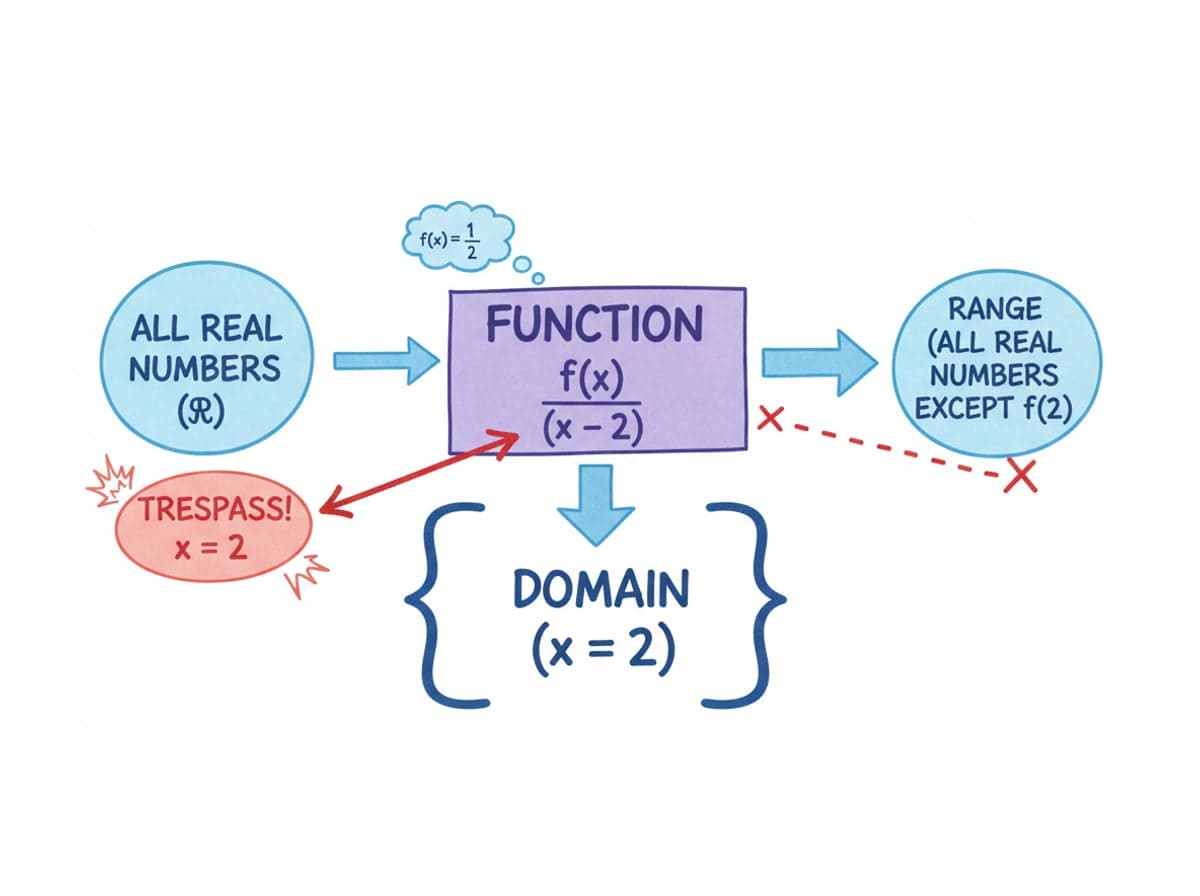
Find the trespasser by solving the denominator equation. Set x - 2 = 0 and the outlaw value appears immediately: x = 2. At that input, the function would try to compute 1/0, which has no value. Every other real number is fine, including negative numbers, fractions, and numbers far off the usual list.
Write the domain as a union of intervals. The real number line is split by the gap at 2 into (-infinity, 2) and (2, infinity). Joined with the union symbol, the domain is (-infinity, 2) U (2, infinity). The parentheses mean open intervals: 2 itself is not included, and the infinities are never included.
Notice what the domain does not say. It does not depend on the numerator at all, and it does not restrict x to positive values. The range is a separate story: for this function it is also all real numbers except 0. Ask which values are forbidden, and the domain follows.
Keep this idea
Ask what the function cannot accept. For fractions, that is where the denominator is zero, and the domain is the number line missing that point.
The practice checks apply only to the displayed examples. Follow your teacher’s guidance for your own assignments.
Get help with your own questionA practice lesson each week.
A short practice lesson for your inbox. Free, with a one-click unsubscribe.