
Function notation
One small step at a time. Ask for a clue whenever you need one.
Ask about your own question- Step 1
- Step 2
- New question
Given f(x) = x^2 - 4x, find f(-2).
Common mix-up
In this example, a student wrote f(-2) = -4 + 8 = 4.
The student computed (-2)^2 as -4, then wrote f(-2) = -4 + 8 = 4.
Guided example. Your answers aren’t saved or sent.
See why this works
What is f(-2) when f(x) = x^2 - 4x?
f(x) is a rule with a name, not multiplication. f(-2) means: feed -2 into the rule and see what comes out.
Replace every x in the rule with the number in the parentheses, then follow the order of operations.
Function notation is a substitution recipe. The rule f(x) = x^2 - 4x describes what to do with x: square it, then subtract four times the original. When the input is written inside the parentheses, as in f(-2), every x in the rule gets replaced by that input, and the parentheses keep the negative numbers together.
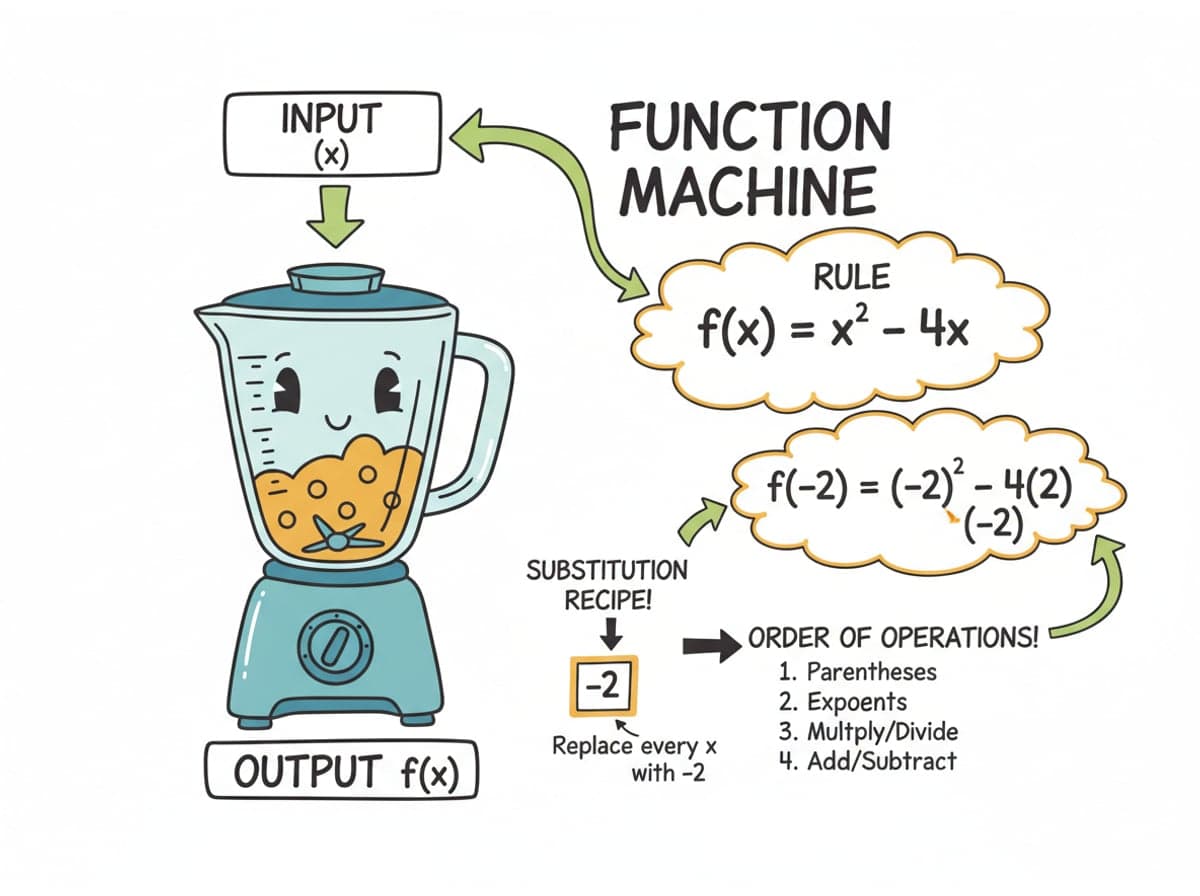
The dangerous moment is (-2)^2. The square applies to the whole quantity -2, not to just the 2, because of the parentheses. (-2)(-2) is positive 4. A student who writes -4 has squared the 2 and kept the negative sign hanging outside, and every later step inherits that wrong sign.
Continue through the rule. The second term of the rule is -4x, which becomes -4(-2) with the input inside parentheses. That is positive 8, because a negative times a negative is positive. The rule now reads f(-2) = 4 + 8 = 12, and the answer is 12.
One habit protects the sign mistakes: put parentheses around every substituted number. Then evaluate in the standard order: powers, multiplication, addition and subtraction. The earlier line, if written as -4 + 8 = 4, shows exactly where the squared negative got lost.
Keep this idea
f(a) means substitute a for every x inside the rule. Wrap each negative input in parentheses before evaluating.
The practice checks apply only to the displayed examples. Follow your teacher’s guidance for your own assignments.
Get help with your own questionA practice lesson each week.
A short practice lesson for your inbox. Free, with a one-click unsubscribe.