
Parallel and perpendicular lines
One small step at a time. Ask for a clue whenever you need one.
Ask about your own question- Step 1
- Step 2
- New question
The line y = 2x + 7 has slope 2. What is the slope of a line perpendicular to it?
Common mix-up
In this example, a student wrote m = 1/2.
The student flipped 2 to 1/2 but kept the sign, so the perpendicular slope came out as 1/2 instead of -1/2.
Guided example. Your answers aren’t saved or sent.
See why this works
What slope makes a line perpendicular to y = 2x + 7?
Two lines can look very different and still be perfect partners. The slope alone tells you whether they are parallel or perpendicular.
Parallel lines share the same slope; perpendicular lines have slopes that multiply to -1.
The slope of a line in y = mx + b form is the number m. It measures the rise over the run, how far the line climbs for every step across. For y = 2x + 7, the slope is 2. Everything special about parallel and perpendicular lines is decided by this one number.
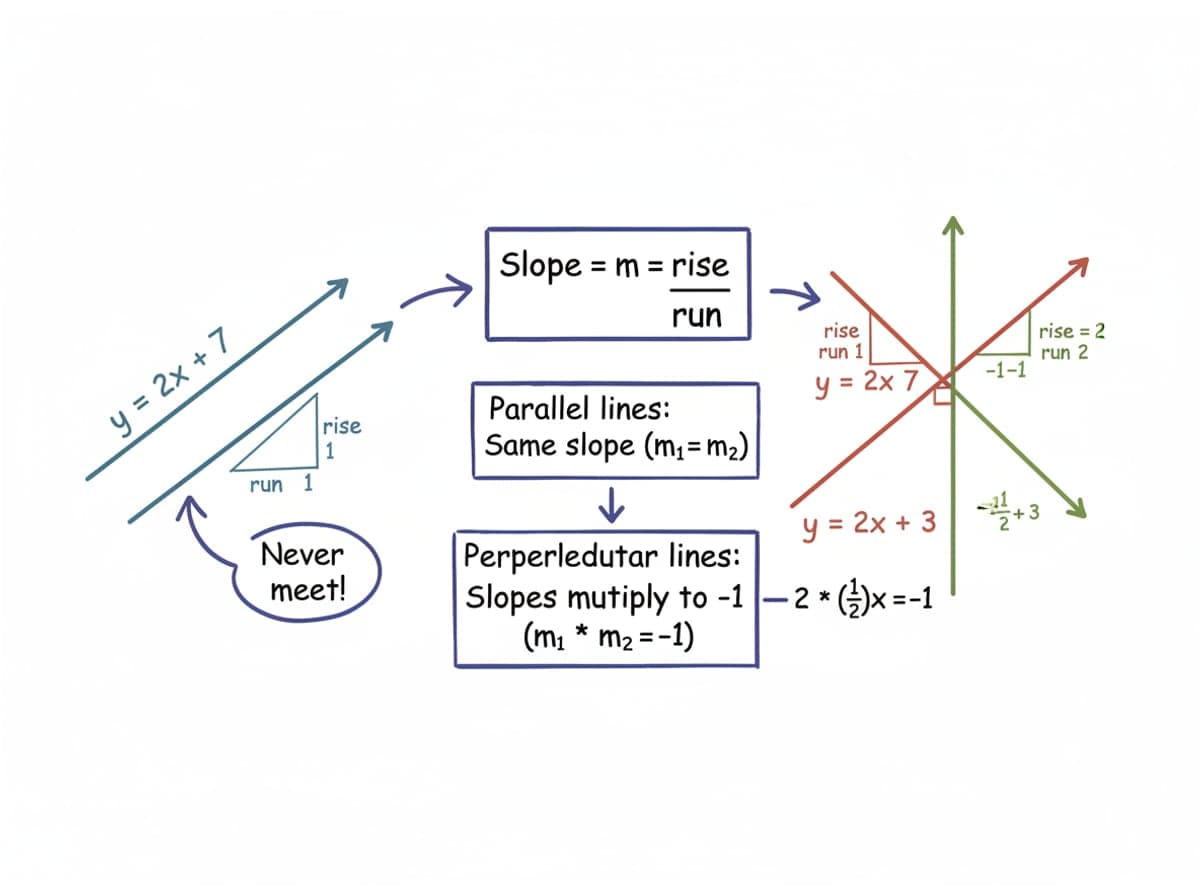
Parallel lines never meet because they climb at the same rate. What matters is the slope and only the slope: y = 2x + 7 is parallel to y = 2x - 4, even though they touch the y-axis at different points. Copy the slope, change the intercept freely.
Perpendicular lines meet at a right angle, and their slopes are negative reciprocals. For slope 2, flip the fraction, 2 over 1 becomes 1 over 2, then switch the sign: -1/2. The check is a multiplication: 2 * (-1/2) = -1. If the slopes multiply to -1, the lines are perpendicular. Flipping without switching the sign leaves perpendicular lines meeting with the wrong tilt.
The two tests handle every problem of this type: parallel means identical slope, perpendicular means negative reciprocal. Read the slope from y = mx + b, then apply whichever test the question asks for. Notice that both tests use the slope alone, never the intercept.
Keep this idea
Same slope for parallel lines; negative reciprocal for perpendicular lines: flip the fraction and switch the sign.
The practice checks apply only to the displayed examples. Follow your teacher’s guidance for your own assignments.
Get help with your own questionA practice lesson each week.
A short practice lesson for your inbox. Free, with a one-click unsubscribe.
Search all 106 free lessons for “Parallel and perpendicular lines”