
Logarithms
One small step at a time. Ask for a clue whenever you need one.
Ask about your own question- Step 1
- Step 2
- New question
Solve 2^x = 32 for x.
Common mix-up
In this example, a student wrote x = 16.
The student divided 32 by 2 and answered 16, treating log2(32) as if a log asked for a quotient.
Guided example. Your answers aren’t saved or sent.
See why this works
What power solves 2^x = 32?
A logarithm asks one question: what exponent do I need? log3(81) says: 3 to what power gives 81?
log base b of N is the exponent you raise b to in order to get N.
A logarithm is a question in disguise. log2(32) asks: 2 to what power equals 32? The answer is not a quotient. The log answers with an exponent, so dividing 32 by 2, as some do, finds a different number entirely and answers a question nobody asked.
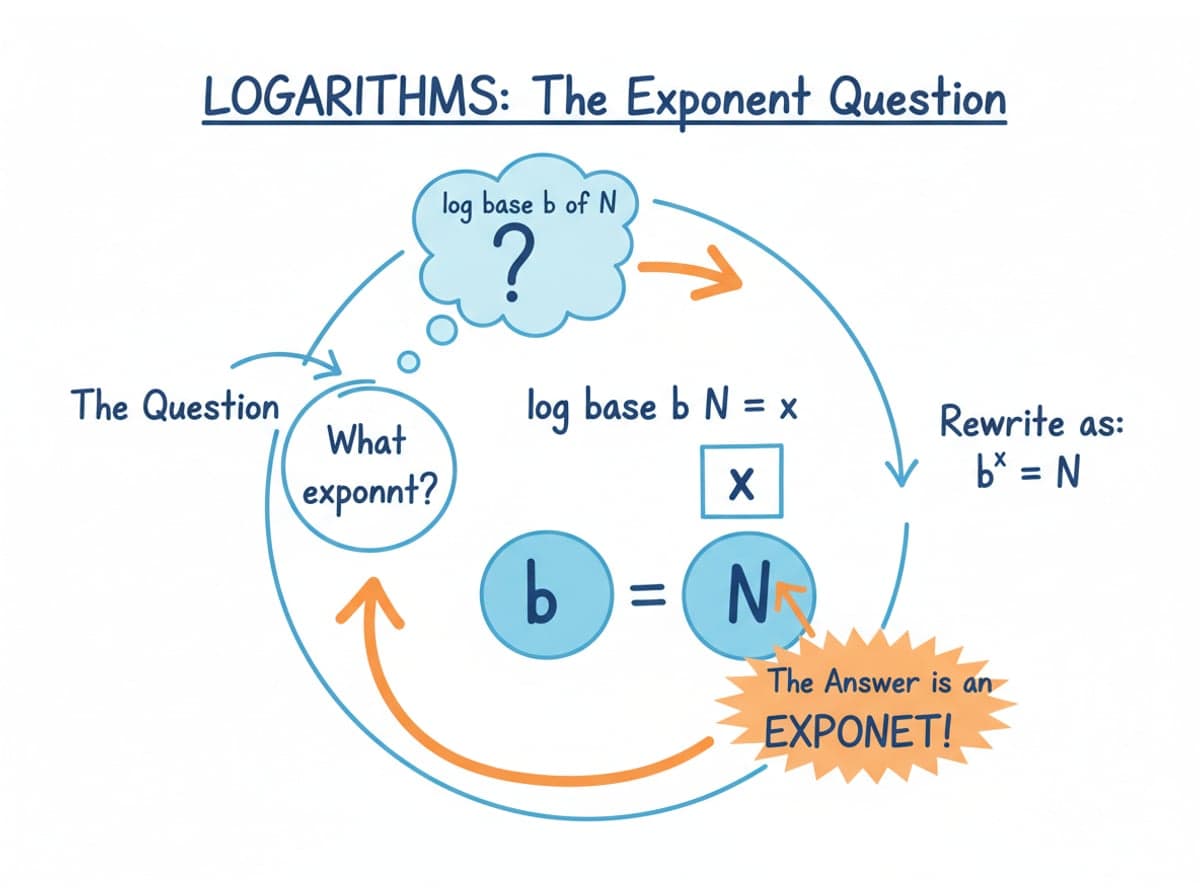
To answer, rewrite the log as an exponential. log2(32) = x means exactly 2^x = 32. Then ask: how many 2's multiply together to make 32? Doubling along the way, 2, 4, 8, 16, 32, the count of multiplications is five, so 2^5 = 32 and x = 5.
The logarithm of 32 in base 2 is therefore 5: log2(32) = 5. Two expressions, one statement. When you see a log, always translate into exponential form first if the answer is not obvious. The exponential form shows where the unknown lives: it is an exponent, missing, and waiting to be counted.
This works cleanly whenever a number is a small power of the base. log3(81) asks: 3 to what power gives 81? Walking up: 3, 9, 27, 81, that is four multiplications, so the answer is 4. In general the log asks for the exponent, and the exponential form gives you a path to find it.
Keep this idea
A logarithm is an exponent. Ask which power, or rewrite the log in exponential form and count.
The practice checks apply only to the displayed examples. Follow your teacher’s guidance for your own assignments.
Get help with your own questionA practice lesson each week.
A short practice lesson for your inbox. Free, with a one-click unsubscribe.