
Inverse functions
One small step at a time. Ask for a clue whenever you need one.
Ask about your own question- Step 1
- Step 2
- New question
Find the inverse of f(x) = 2x + 3.
Common mix-up
In this example, a student wrote f^-1(x) = (x + 3)/2.
The student swapped x and y correctly, then solved wrong: they added 3 instead of subtracting, writing y = (x + 3)/2.
Guided example. Your answers aren’t saved or sent.
See why this works
What equation undoes f(x) = 2x + 3?
An inverse function undoes whatever the original did. Here f multiplies by 2 and adds 3, so the inverse must unwind both in reverse.
Swap x and y, then solve for y; that y is f^-1(x).
Think of f(x) = 2x + 3 as a machine: a number comes in, gets doubled, gets 3 added, and a result comes out. The inverse machine should take that result and hand back the original number. If the machine doubled then added 3, the reverse machine must subtract 3 then halve.
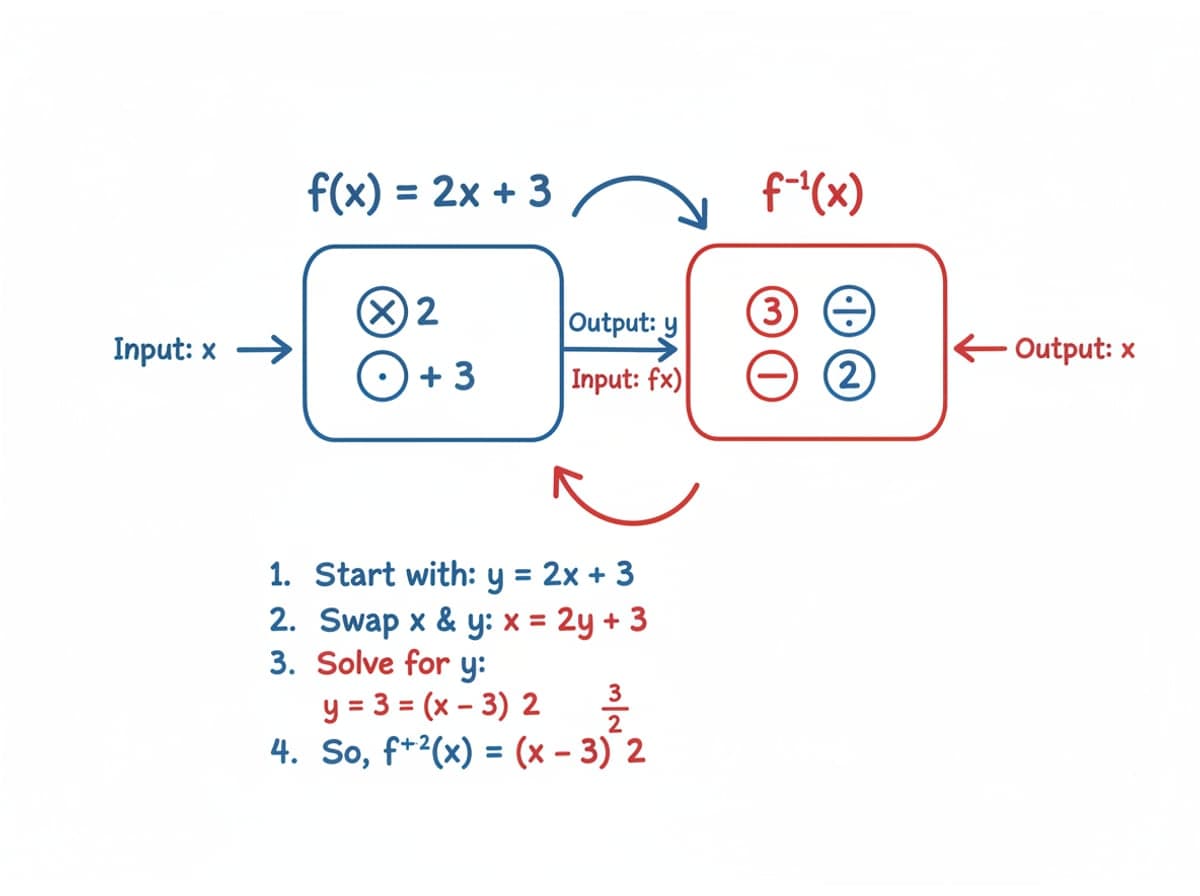
The recipe starts by renaming. Replace f(x) with y to get y = 2x + 3. Then swap the letters: x = 2y + 3. Swapping is the algebra bookkeeping for the idea of exchanging input and output. The result is a new equation, and it may look odd at first because y has moved to the other side.
Solve the swapped equation for y. Subtract 3 from both sides: x - 3 = 2y. Then divide by 2: y = (x - 3)/2. This expression is the inverse, written f^-1(x) = (x - 3)/2. One common error is rearranging instead of swapping, which produces the same function back again.
The check is a round trip. Feed 5 into f: 2 * 5 + 3 = 13. Feed 13 into the inverse: (13 - 3)/2 = 5, back where you started. If the round trip lands on the starting number for a few test inputs, the functions really undo each other.
Keep this idea
To invert a function: swap x and y, solve for y, then test the round trip with a number.
The practice checks apply only to the displayed examples. Follow your teacher’s guidance for your own assignments.
Get help with your own questionA practice lesson each week.
A short practice lesson for your inbox. Free, with a one-click unsubscribe.