
Exponential vs. linear growth
One small step at a time. Ask for a clue whenever you need one.
Ask about your own question- Step 1
- Step 2
- New question
A savings account starts with $100 and earns 10% interest each year. How much is in the account after 2 years?
Common mix-up
In this example, a student wrote 120.
The student added 10% of the original amount each year: 100 + 10 + 10 = 120, ignoring that the balance grows and so does its interest.
Guided example. Your answers aren’t saved or sent.
See why this works
Why does 10% growth beat adding 10 each year?
Adding the same amount each year is linear. Multiplying by the same number each year is exponential, and the difference grows fast.
A percent increase means multiplying by 1 + r each period, not adding r.
Growth can be described two ways. A linear rule adds a fixed amount every period: start with 100 and add 10 each year. An exponential rule multiplies by a fixed number every period: start with 100 and become 110% bigger each year. The two sound similar at first, but they behave very differently.
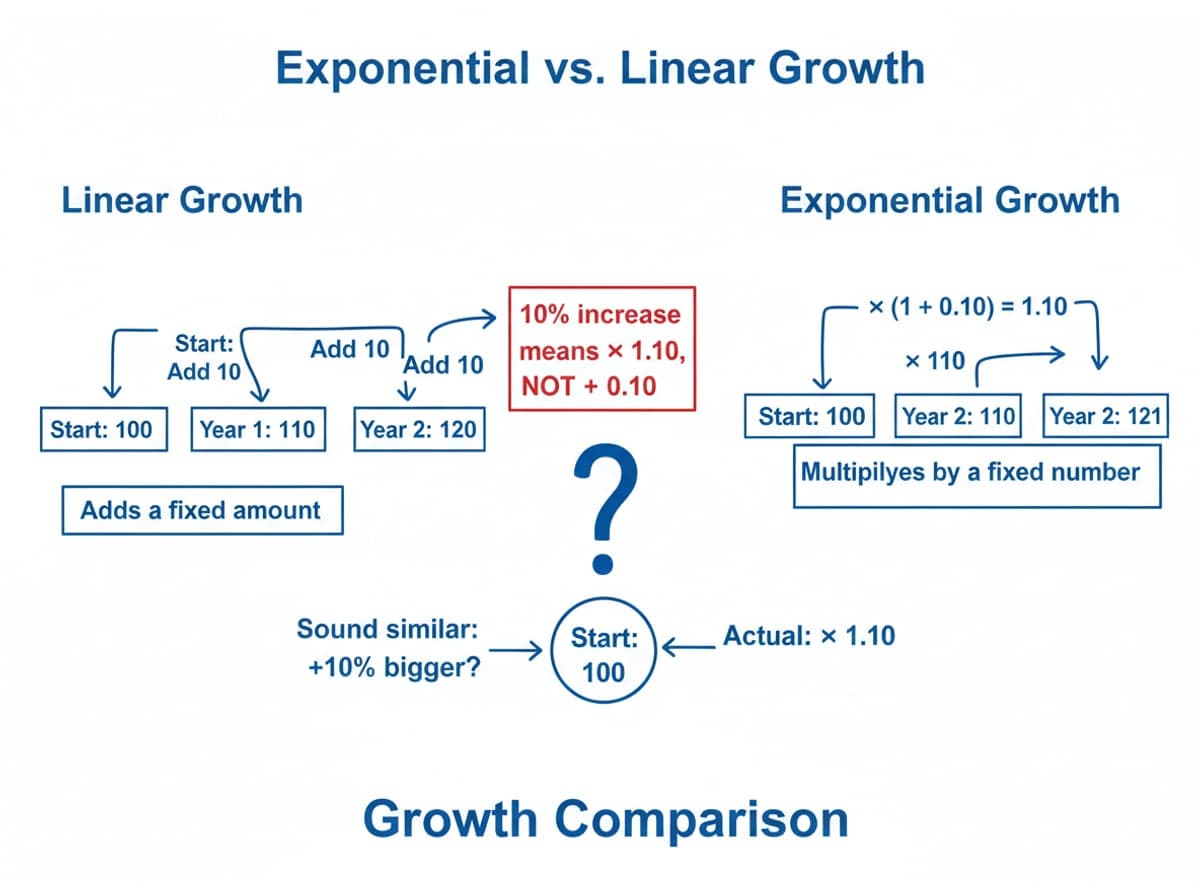
A 10% increase does not mean adding 10. It means keeping the whole 100% and adding 10% on top: an annual multiplier of 1.10. After one year, 100 becomes 110. After two years, the 110 is multiplied by 1.10 again, becoming 121. The second year's growth is 11 dollars, not 10, because the interest itself earned interest.
Linear thinking would give 100 + 10 + 10 = 120, treating every year as a copy of the first. The yearly addition is the same, but the amount it applies to is not. In exponential growth the base widens every period, which is why compounding beats simple repeated addition even when the rate looks small.
The multiplier route is the reliable one. Decide the rate, write 1 plus the rate, raise it to the number of periods, and multiply by the original amount. For 100 at 10% for two years: 100 * (1.1)^2 = 121. For other starting amounts, only the first number changes.
Keep this idea
Percent growth multiplies by 1 + r each period. Compare with the linear add-the-same-amount rule and the gap grows every period.
The practice checks apply only to the displayed examples. Follow your teacher’s guidance for your own assignments.
Get help with your own questionA practice lesson each week.
A short practice lesson for your inbox. Free, with a one-click unsubscribe.
Search all 106 free lessons for “Exponential vs. linear growth”