Fractions, decimals and percents
One small step at a time. Ask for a clue whenever you need one.
Ask about your own question- Step 1
- Step 2
- Step 3
- New question
Write 3/5 as a percent.
Common mix-up
In this example, a student wrote 3/5 = 0.6%.
Nia converted 3/5 to 0.6 correctly and then wrote 0.6% as her answer. She treated the decimal as a whole number and lost the two-place shift.
Guided example. Your answers aren’t saved or sent.
See why this works
Why is 3/5 the same as 60%?
Three names for the same amount, and one short chain that gets you between them. The confusion is rarely the arithmetic — it is which direction you are going.
A fraction is a division, a decimal is the answer to that division, and a percent is the decimal multiplied by 100.
A fraction is an unfinished division, so the first step is to finish it. Three fifths means 3 ÷ 5, which is 0.6. That gives you the decimal form for free, and the decimal is the most useful of the three because it can be compared and calculated with directly.
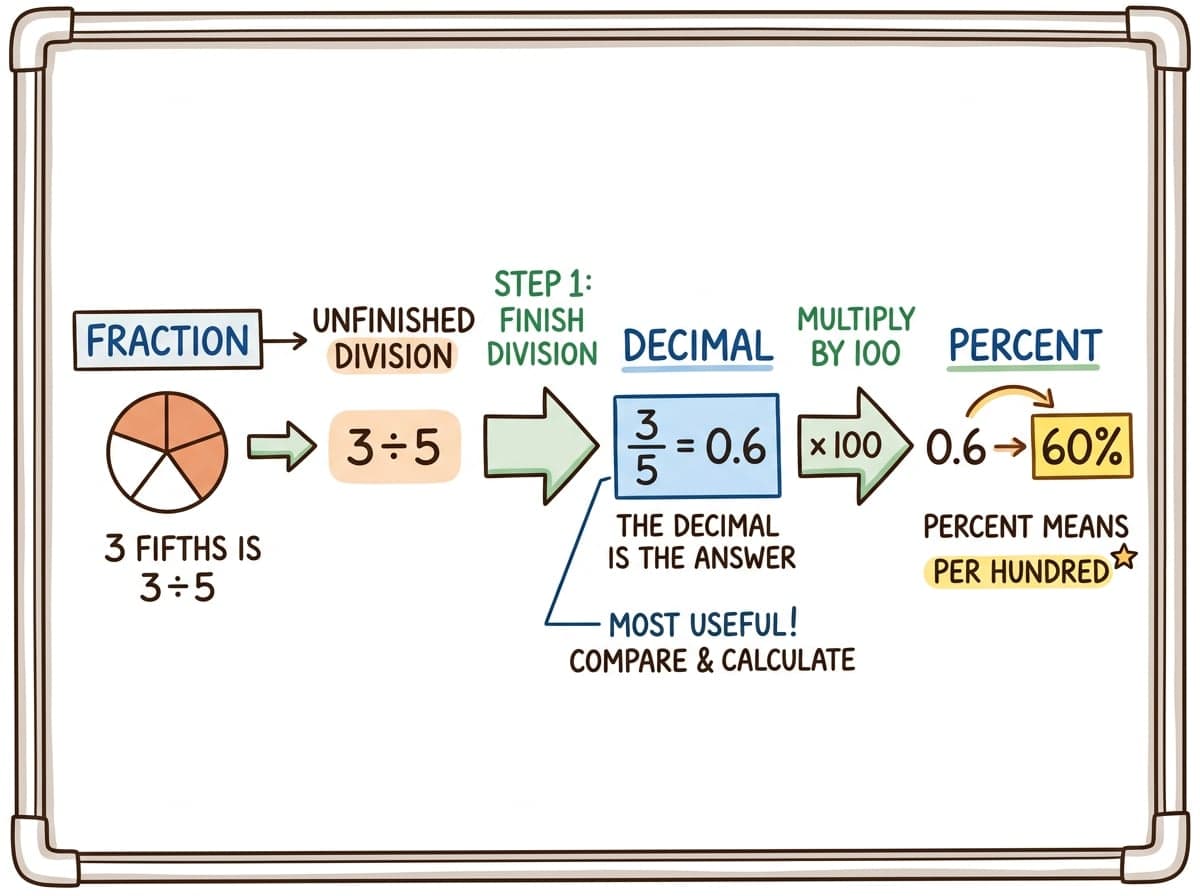
Percent means per hundred, which is where the name comes from. Moving from decimal to percent is therefore a change of scale, not a change of value: 0.6 as a percent is 60 per hundred, or 60%. Multiply by 100 and attach the sign. Going the other way, divide by 100, which moves the point two places to the left.
Going from percent to a fraction is the same journey backwards, and it usually needs simplifying. 60% is 60 out of 100, which is 60/100, which simplifies to 3/5 by dividing both parts by 20. If you started at 3/5, you are back where you began, which is the check that tells you the conversion went right.
Some conversions are worth knowing without working them out, because they come up constantly: a half is 0.5 and 50%, a quarter is 0.25 and 25%, a fifth is 0.2 and 20%, an eighth is 0.125 and 12.5%. Recognising these on sight saves time in a test, and it also gives you a benchmark for the ones that are unfamiliar — if you are told 35% of something, knowing that a third is about 33% tells you immediately whether an answer is in the right region.
Keep this idea
Fraction to decimal is the division, decimal to percent is multiplying by 100, and percent to fraction is putting it over 100 and simplifying. Convert it back to check, and learn the handful of common ones by sight.
The practice checks apply only to the displayed examples. Follow your teacher’s guidance for your own assignments.
Get help with your own questionA practice lesson each week.
A short practice lesson for your inbox. Free, with a one-click unsubscribe.
Search all 106 free lessons for “Fractions, decimals and percents”