
Gravity and orbits
One small step at a time. Ask for a clue whenever you need one.
Ask about your own question- Step 1
- Step 2
- Step 3
- New question
The Moon races along at about 1 km every second. Why doesn't it fly away from Earth in a straight line?
Common mix-up
In this example, a student wrote Because there is no gravity in space..
Orbiters are always falling toward Earth; their forward motion keeps them from hitting it. Gravity is strong in space.
Guided example. Your answers aren’t saved or sent.
See why this works
Why doesn't the Moon fall down to Earth?
You said there is no gravity in space, so astronauts float. The space station is falling around Earth the whole time.
An orbit is a continuous fall: gravity bends the path inward while the object's forward motion keeps carrying it past the planet.
Gravity is the pull between any two objects that have mass. It is universal and it never turns off. Earth's gravity reaches the Moon nearly 400,000 km away and holds it in orbit. The same gravity reaches satellites only a few hundred kilometers up, at nearly the same strength as on the ground. Distance weakens gravity by a little; it never turns it to nothing.
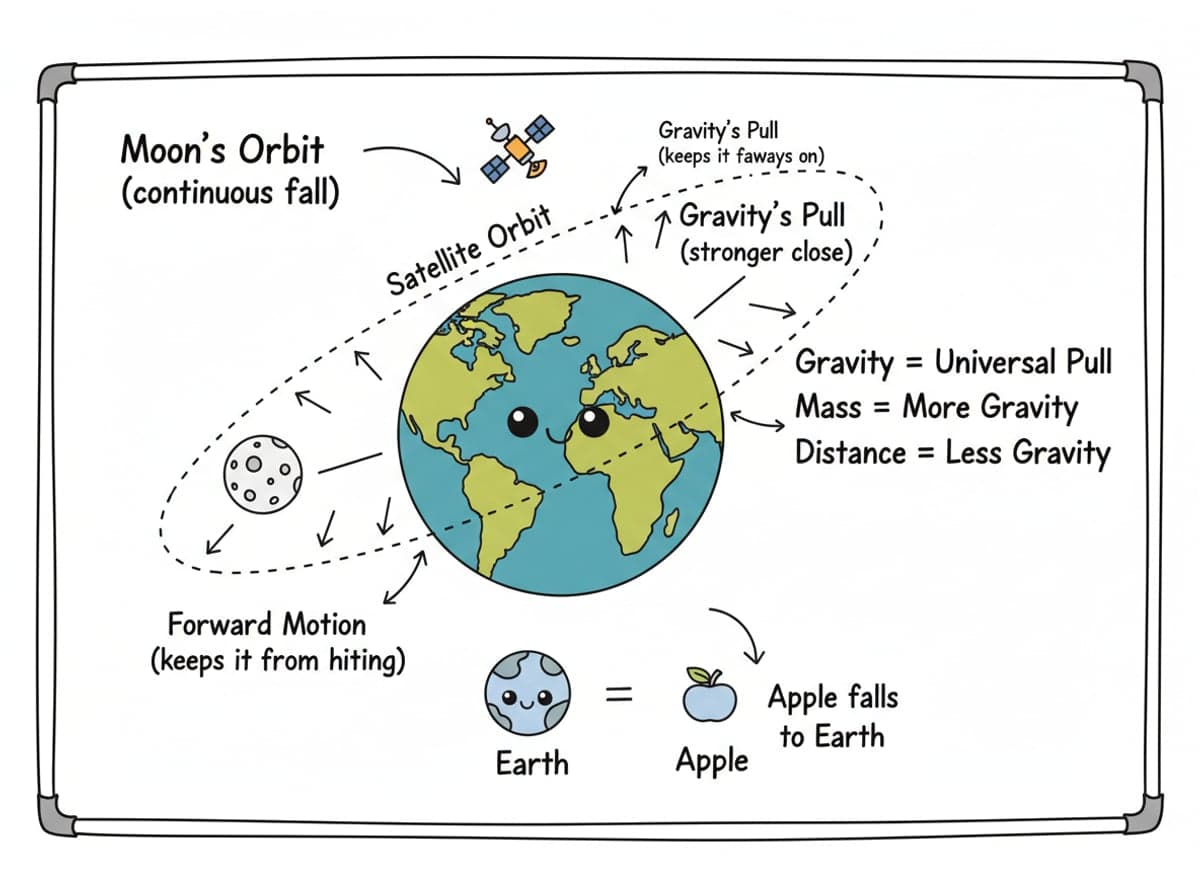
So why do astronauts float? Not because there is no gravity. The station and its crew are in the same orbit, pulled by the same gravity, and they fall together. Nothing pushes back, so nothing feels like weight. Weight is what you feel when a floor pushes your feet up; it is not gravity itself. A falling elevator drops its weight feel too, which is why this state is called free fall.
And why doesn't the Moon fall down? Because it is moving. Newton's insight: an apple drops straight down, but throw one sideways fast enough and the ground curves away beneath it as it falls. The Moon falls toward Earth every single second and moves forward about one kilometer every second, so it keeps missing. An orbit is a fall that never lands.
The same law rules everything human-made up there. A satellite gets an initial sideways shove, then coasts while gravity steers it. The Moon and the planets obey the same rule as the satellites above you right now. Changing orbital speed changes the orbit: faster means a bigger orbit, slower a smaller one. Gravity supplies the one thing an orbit cannot do without, a constant pull inward.
Keep this idea
Gravity holds every orbit: the object falls around the planet while its forward motion keeps it perpetually missing the ground.
The practice checks apply only to the displayed examples. Follow your teacher’s guidance for your own assignments.
Get help with your own questionA practice lesson each week.
A short practice lesson for your inbox. Free, with a one-click unsubscribe.