
Mixed numbers and improper fractions
One small step at a time. Ask for a clue whenever you need one.
Ask about your own question- Step 1
- Step 2
- Step 3
- New question
Write 7/4 as a mixed number.
Common mix-up
In this example, a student wrote 7/4 = 1.
Ava wrote 7 ÷ 4 = 1.75 as her final answer. The arithmetic was right, but the question asked for the amount as a mixed number, and she lost the three quarters that were left over.
Guided example. Your answers aren’t saved or sent.
See why this works
Why write 7/4 as 1 and 3/4?
Both forms describe exactly the same amount. One is better for seeing how much it is, and the other is better for calculating with it.
A fraction whose top is bigger than its bottom is more than one whole; count the wholes and keep the remainder.
Seven quarters means seven pieces, each one quarter of a whole. Four of those pieces make one whole, so you can group four of them and have one whole with three quarters left over: 1 and 3/4. Nothing was added or thrown away, the same seven pieces were just grouped. That is why the two forms are always equal.
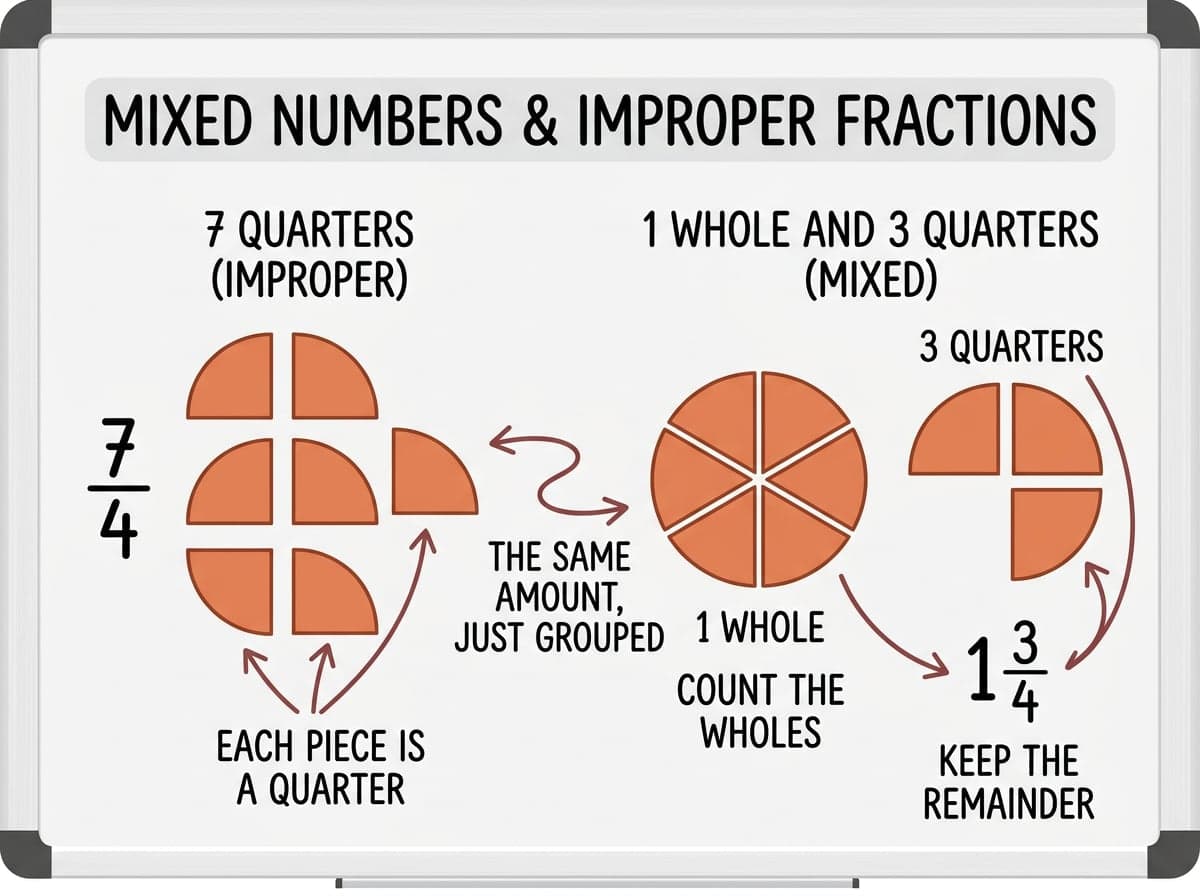
The top of a fraction being larger than the bottom is not an error, it is a signal that the amount is more than one. Reading 7/4 as a mixed number tells you how much it is at a glance, which is why recipes, measurements and answers are usually written that way. The improper form is easier to calculate with, because there is only one number to multiply or divide rather than a whole and a fraction to keep track of.
Going the other way is multiplication and addition. For 2 and 3/5, multiply the whole number by the bottom and add the top: 2 × 5 + 3 = 13, so it is 13/5. What you are really doing is rewriting the two wholes as ten fifths, then adding the three fifths you already had. Check it by turning 13/5 back: 13 ÷ 5 is 2 remainder 3, which is 2 and 3/5.
The reason this matters most is subtraction. To work out 3 and 1/4 minus 1 and 3/4 you cannot simply take 3/4 from 1/4. Rename one of the wholes in 3 and 1/4 as four quarters, so it reads 2 and 5/4, and now the bottom numbers match and the subtraction is straightforward. This renaming is the step that most often goes missing, and it is the same borrowing you already do in whole-number subtraction.
Keep this idea
An improper fraction is just a group of pieces, so count the wholes and keep the remainder. Multiply the whole by the bottom and add the top to go back, and rename a whole before subtracting fractions with different denominators.
The practice checks apply only to the displayed examples. Follow your teacher’s guidance for your own assignments.
Get help with your own questionA practice lesson each week.
A short practice lesson for your inbox. Free, with a one-click unsubscribe.
Search all 106 free lessons for “Mixed numbers and improper fractions”