
Moon phases
One small step at a time. Ask for a clue whenever you need one.
Ask about your own question- Step 1
- Step 2
- Step 3
- New question
One week after a new moon, half of the Moon is lit. What is this phase called, and why does the Moon show it?
Common mix-up
In this example, a student wrote It is a shadow of Earth covering part of the Moon..
Phases are the changing amount of the Moon's sunlit half we see as it orbits. Only a lunar eclipse involves Earth's shadow.
Guided example. Your answers aren’t saved or sent.
See why this works
Why does the Moon change shape?
You said Earth's shadow covers the Moon to make phases. A phase is only how much of the Moon's sunlit half is facing us.
The Moon orbits Earth, so we see different amounts of its sunlit half. Earth's shadow matters only during a lunar eclipse.
The Moon is not a lamp; it shines by reflecting the Sun's light. Half of the Moon is always lit and half is always dark, just like a ball in sunlight. As the Moon orbits Earth, we see that sunlit half from a different angle each day. Sometimes we face most of the lit side and sometimes mostly the dark side. That shifting view makes the cycle of shapes we call phases.
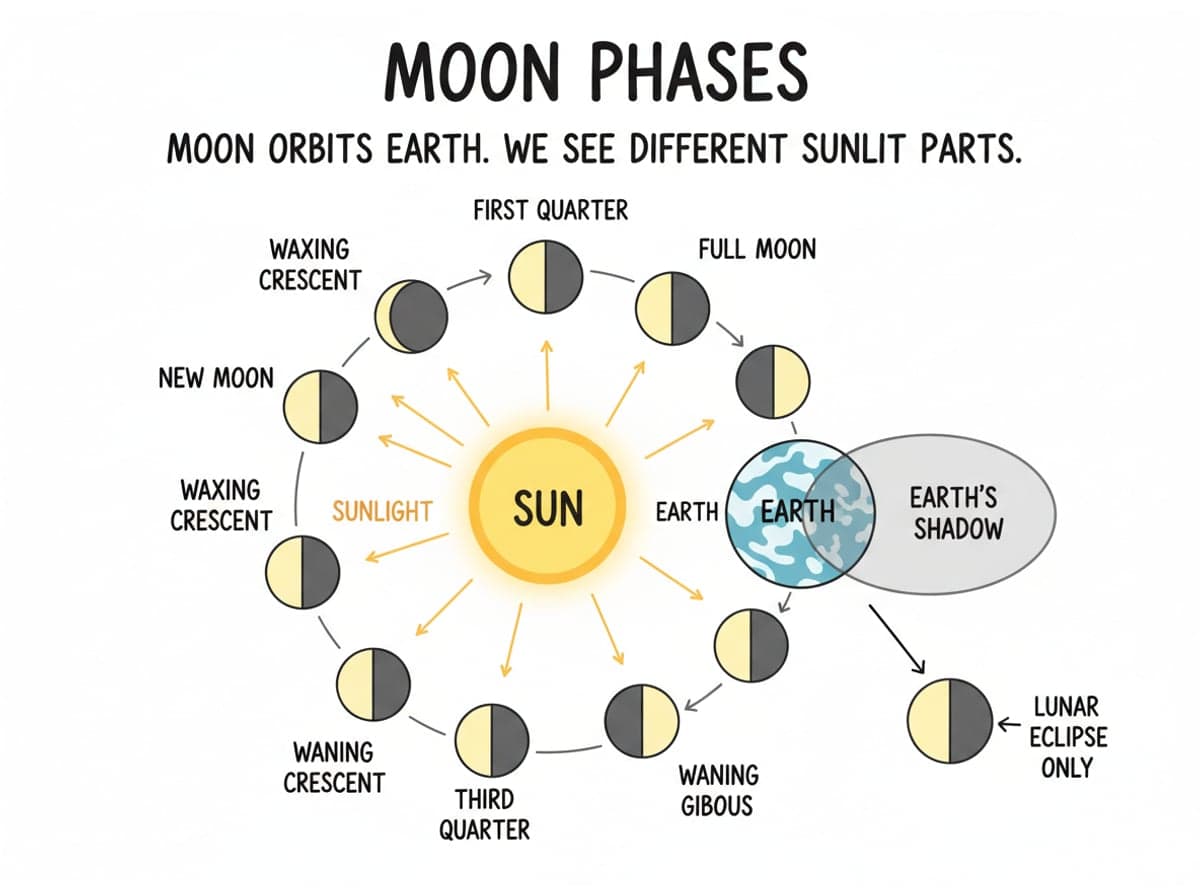
New moon comes when the Moon sits between the Sun and Earth, with its lit half turned away from us. As it moves along its orbit, a growing sliver appears: waxing crescent, then first quarter, then waxing gibbous, until full moon, when the Moon stands opposite the Sun and its whole lit face points at us. Then the shapes repeat in reverse, shrinking through waning gibbous and last quarter to a waning crescent.
The whole cycle takes about 29.5 days, which is why a lunar month is a month. The Moon rises about 50 minutes later each night because it moves along its orbit while Earth spins. In the Northern Hemisphere, a waxing crescent is lit on its right side and a waning crescent on its left. Phase names describe what we see from Earth, and they never require anything to cover the Moon.
Earth's shadow does land on the Moon sometimes, during a lunar eclipse, but that is rare and lasts under two hours, and the Moon turns a dull coppery red. The monthly phases are not an eclipse. You can recreate every phase in a dark room with a flashlight, a ball and your head: walk the ball around your head and the same geometry, with no shadow at all, reproduces the whole month.
Keep this idea
The Moon's phases are the changing view of its sunlit half as it orbits Earth, waxing through full and then waning. Earth's shadow makes only the rare eclipse.
The practice checks apply only to the displayed examples. Follow your teacher’s guidance for your own assignments.
Get help with your own questionA practice lesson each week.
A short practice lesson for your inbox. Free, with a one-click unsubscribe.