Newton's first law of motion
One small step at a time. Ask for a clue whenever you need one.
Ask about your own question- Step 1
- Step 2
- Step 3
- New question
When a bus brakes hard, why do the riders lurch forward?
Common mix-up
In this example, a student wrote The stopping force of the bus pushed them forward..
Motion does not need a force to continue; only a change in motion does. Inertia kept the riders moving forward when the bus stopped.
Guided example. Your answers aren’t saved or sent.
See why this works
Why does your head jerk forward when the bus stops?
You said a moving ball slows down in space without a push. Nothing pushes or pulls it there, so Newton's first law says it keeps going.
An object keeps its current motion unless an unbalanced force changes it. Changes in motion need a force; plain motion does not.
Newton's first law is also called the law of inertia: an object at rest stays at rest, and an object moving in a straight line keeps moving at constant speed, unless unbalanced forces act on it. The surprising part is the second half. A puck gliding across the ice does not want to stop; it is stopped by friction with the surface, not by running out of push.
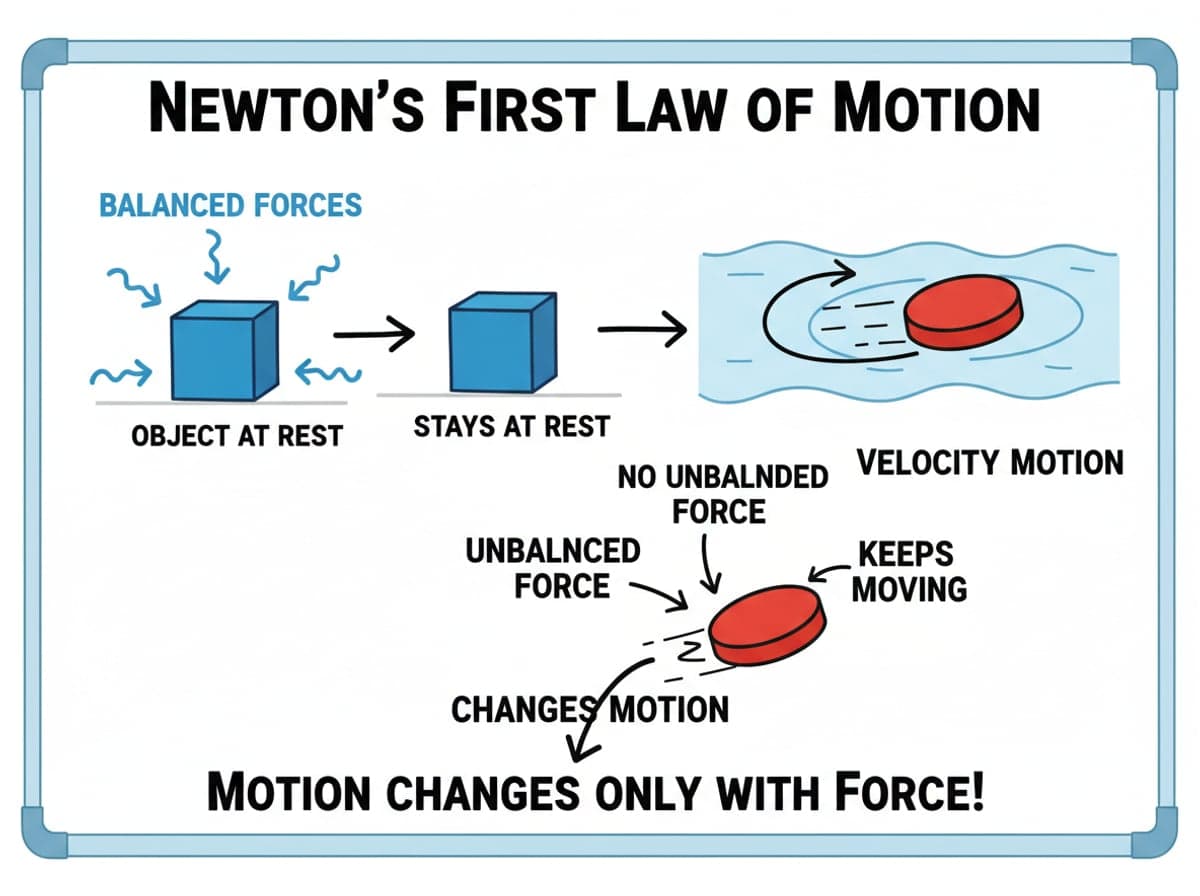
Everyday motion hides this law because friction is everywhere. A rolling ball slows, a car needs to stay in the gas on a highway, and a sled stops in the snow. Remove the friction and the picture reveals itself: a puck on near-frictionless ice glides almost forever, and a wrench thrown in empty space travels at constant speed until something touches it. Ice and vacuum are the clearest places to see the law.
Now the bus. It brakes, and your body keeps going forward. No force threw you forward; nothing had stopped you yet. The bus decelerates while your body keeps moving until a belt, the floor or a seat supplies the stopping force. The lurch feels like a push only because your muscles are fighting to change a motion that the bus has already changed.
The law also resolves a classic confusion: a force is needed to change motion, not to keep it. A drone hovering in empty space burns no fuel to stay put. A hockey player gliding at constant velocity needs no push at all. More mass means more inertia, so a truck takes a bigger force to change its motion than a bike. Newton's first law is the baseline every other force story has to start from.
Keep this idea
Objects keep their motion until a force changes it. Friction hides this in daily life, and the forward jerk in a stopping bus is inertia, not a forward force.
The practice checks apply only to the displayed examples. Follow your teacher’s guidance for your own assignments.
Get help with your own questionA practice lesson each week.
A short practice lesson for your inbox. Free, with a one-click unsubscribe.
Search all 106 free lessons for “Newton's first law of motion”