
Osmosis and diffusion
One small step at a time. Ask for a clue whenever you need one.
Ask about your own question- Step 1
- Step 2
- Step 3
- New question
A freshwater cell is dropped into saltwater, which is much saltier than the cell's inside. Which way does the water move?
Common mix-up
In this example, a student wrote Water moves into the cell to keep it from drying out..
The cell's needs do not decide the direction. Water spreads toward the saltier solution, and osmosis needs no energy.
Guided example. Your answers aren’t saved or sent.
See why this works
Which way does water move through a cell membrane?
You said water rushes into the cell because the cell needs it. Water does not choose sides; it simply spreads toward the saltier solution.
Diffusion moves particles from high to low concentration; osmosis is water diffusing across a membrane toward the saltier side.
Particles in a liquid or gas are always jiggling. Over time their random motion spreads them out, so they drift from crowded regions into empty ones. That spreading is diffusion: open a bottle of perfume in one corner of a room and soon you smell it everywhere. No pump and no energy are involved; the jiggling alone does the work. Cells use this natural spreading to bring in oxygen and send out waste.
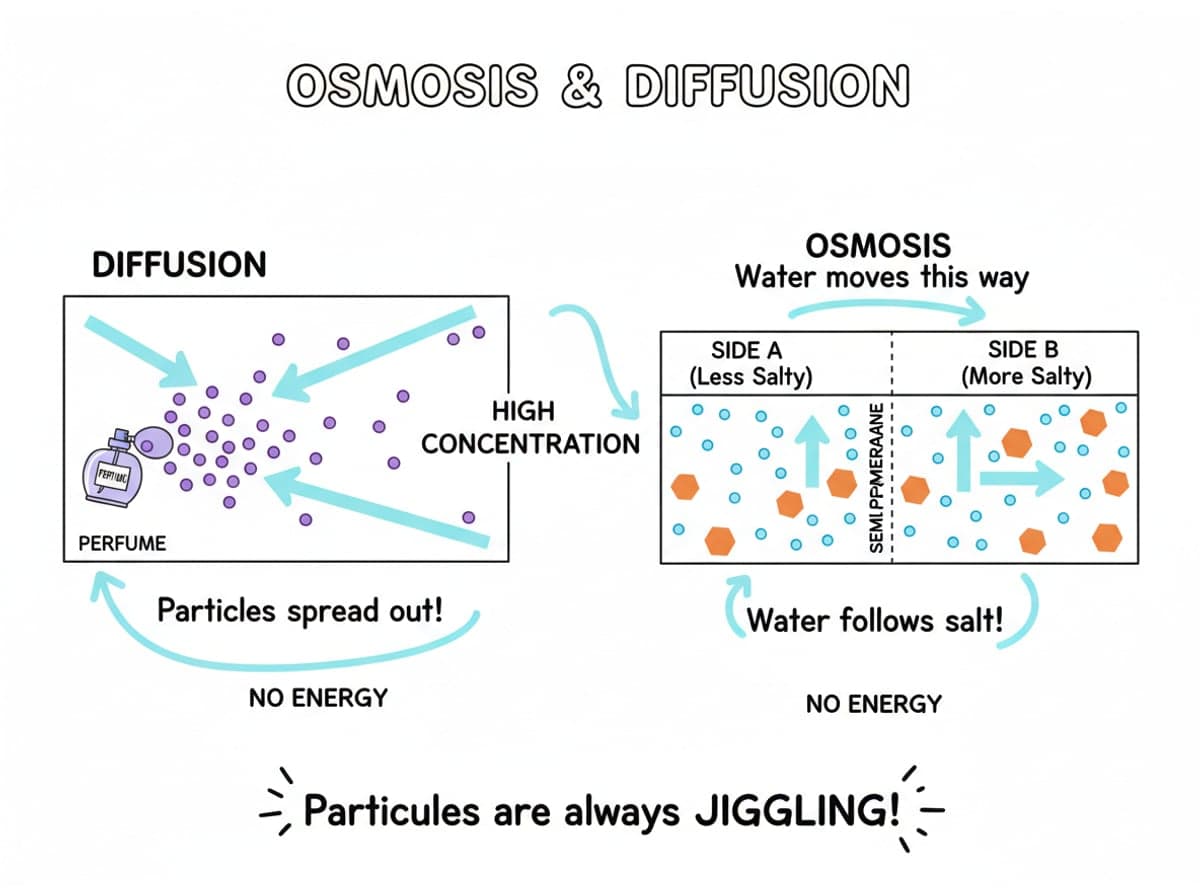
Osmosis is a special kind of diffusion. It happens only with water crossing a selectively permeable membrane: one that lets water through but blocks dissolved particles. Water moves from the side with more free water and less solute toward the side with less free water and more solute. The membrane is the gatekeeper that decides what may pass. The result is a simple rule: water always drifts toward the saltier side.
Imagine a cell floating in saltwater. The saltwater outside holds more dissolved solute than the cell's inside. Water diffuses out through the membrane, toward that saltier solution, and the cell shrinks like a grape becoming a raisin. Float the same cell in pure water and water moves the other way, filling the cell. Cells in your body meet both kinds of surroundings, so this balance matters every single moment.
Neither diffusion nor osmosis needs energy; both are passive. Active transport is the opposite: it pumps particles against the concentration gradient and spends energy to do it. If you remember that particles spread away from crowding and water moves toward salt, you can predict what will happen to any cell in any salt solution. That one rule explains salted roads, ocean water, and raisins that plump up when soaked.
Keep this idea
Diffusion spreads particles from high to low concentration. Osmosis is water diffusing across a membrane, always toward the saltier side.
The practice checks apply only to the displayed examples. Follow your teacher’s guidance for your own assignments.
Get help with your own questionA practice lesson each week.
A short practice lesson for your inbox. Free, with a one-click unsubscribe.