Punnett squares
One small step at a time. Ask for a clue whenever you need one.
Ask about your own question- Step 1
- Step 2
- Step 3
- New question
Two parents each carry alleles B and b. How many different allele pairings can their offspring receive?
Common mix-up
In this example, a student wrote Two, because each parent has two alleles..
Each parent passes one allele per trait, not two. The grid pairs one allele from each parent in every combination.
Guided example. Your answers aren’t saved or sent.
See why this works
Why does a Punnett square have four boxes?
You said each parent donates both of its alleles. The two alleles separate, and each parent passes on just one for the trait.
A Punnett square pairs one allele from each parent, showing every possible combination and its probability.
A Punnett square is a small grid for predicting the allele combinations offspring can receive. Along the top go the alleles one parent can pass, and down one side go the alleles the other can pass. Each box holds one pairing, and each pairing is equally likely when the alleles shuffle randomly. Like all probability tools, it predicts the chances for many offspring, not the fate of one particular child.
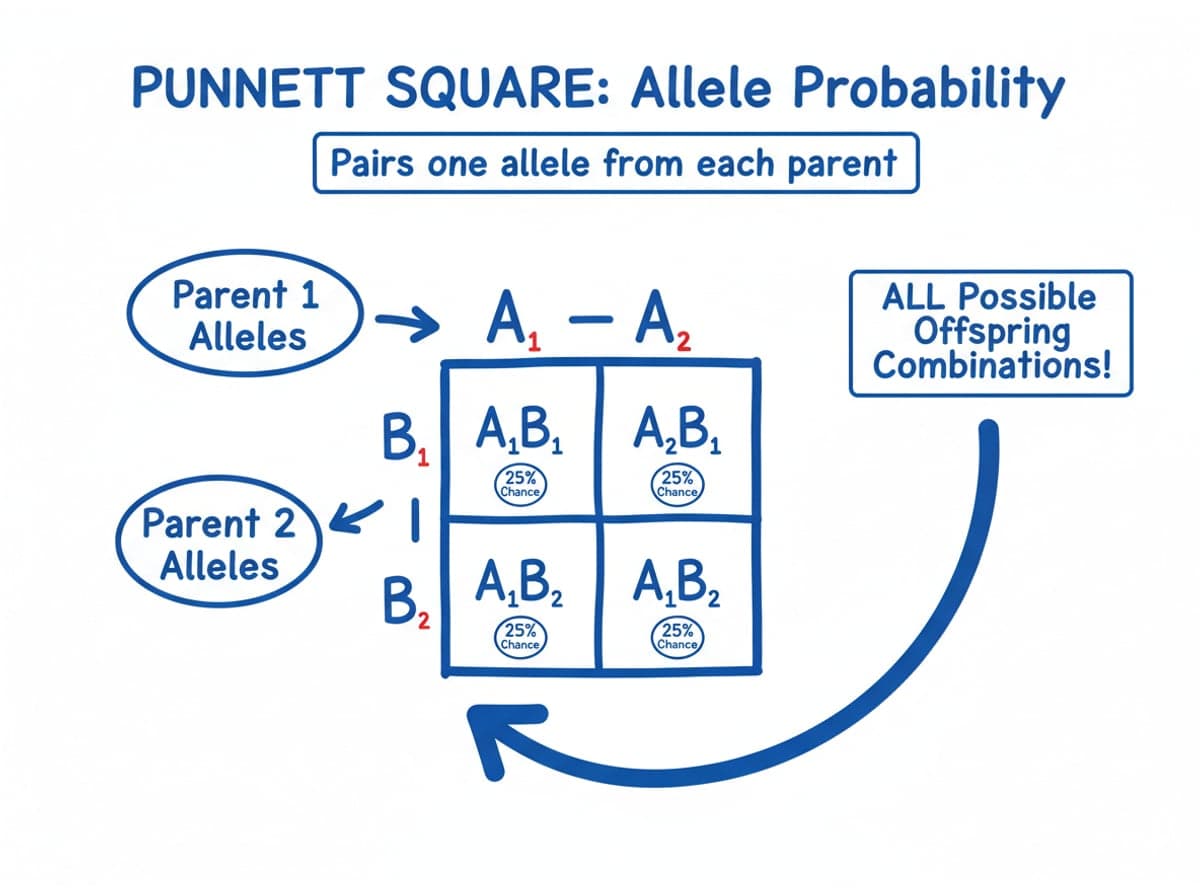
A key rule: each parent has two alleles for a trait, but passes on one of them per offspring. The parent's alleles separate during germ-cell formation, a separation called segregation. If a Bb parent can give B or b, and the other parent can also give B or b, the grid has 2 × 2 = 4 boxes: BB, Bb, bB and bb. Remember to count both orders, because each order is a different possible pairing.
B labels a dominant allele and b a recessive one. BB and Bb both show the dominant trait, and bb shows the recessive one, even though bB looks different in the grid. Counting the boxes gives the odds: a Bb × Bb cross produces about 3 dominant-looking offspring for every 1 recessive-looking one. The square works cleanly for one trait; two traits at once need a bigger grid.
How can two brown-eyed parents have a blue-eyed child? The parents showing the dominant trait can each carry the recessive allele hidden. The Punnett square shows that hidden allele sitting quietly in a box: Bb by Bb can make bb. A child cannot show a trait without the right alleles, but a hidden recessive can be passed for generations without ever being seen.
Keep this idea
A Punnett square pairs one allele from each parent in every possible combination: BB, Bb, bB and bb, and the box labels give the trait odds.
The practice checks apply only to the displayed examples. Follow your teacher’s guidance for your own assignments.
Get help with your own questionA practice lesson each week.
A short practice lesson for your inbox. Free, with a one-click unsubscribe.