
The quadratic formula
One small step at a time. Ask for a clue whenever you need one.
Ask about your own question- Step 1
- Step 2
- Step 3
- New question
Solve x^2 - 2x - 4 = 0 using the quadratic formula.
Common mix-up
In this example, a student wrote x = (2 + sqrt(-12))/2.
The student read c as positive 4, computed the discriminant as -12, and stopped, never simplifying the radical or dividing the numerator.
Guided example. Your answers aren’t saved or sent.
See why this works
What is x when x^2 - 2x - 4 = 0?
Not every quadratic factors over the integers. The quadratic formula works for all of them, and it only asks you for three careful numbers.
For ax^2 + bx + c = 0, x = (-b +/- sqrt(b^2 - 4ac)) / 2a.
The quadratic formula solves any equation of the form ax^2 + bx + c = 0 in one routine. For x^2 - 2x - 4 = 0, the matching numbers are a = 1, b = -2, and c = -4. The sign carries with each number: b is negative two, not two. Copying the signs wrongly is the most common first slip.
The discriminant inside the square root is b^2 - 4ac. With these values, that is (-2)^2 - 4(1)(-4) = 4 + 16 = 20. It comes out positive, so the equation has two real solutions and the formula will produce two of them, one for each sign of the plus or minus.
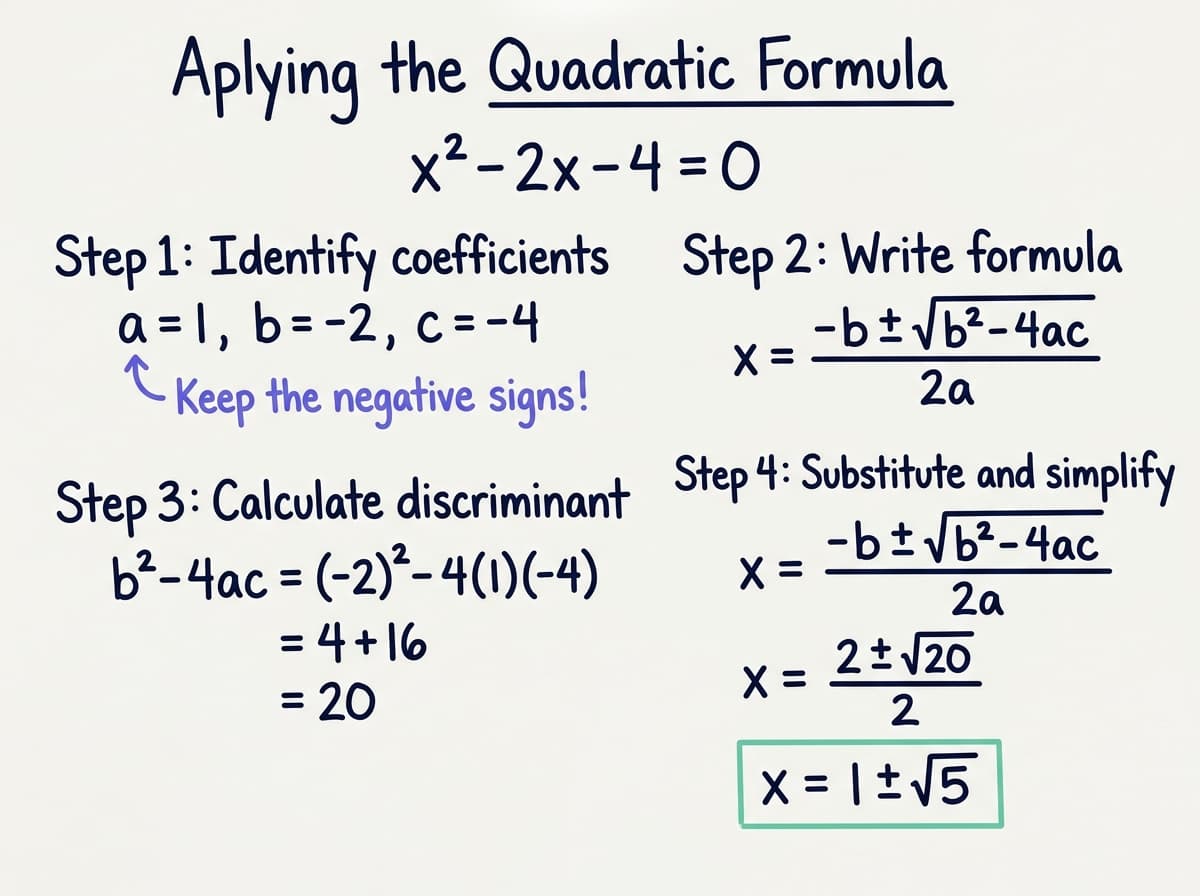
Now run the formula: x = (2 +/- sqrt(20)) / 2. Before dividing, simplify the radical: sqrt(20) = sqrt(4 * 5) = 2 * sqrt(5). Factor the numerator, divide out the 2 somewhere, and ends as x = 1 +/- sqrt(5). Simplifying the radical first keeps the division clean.
Check one solution by substituting. For x = 1 + sqrt(5), the square of x is 6 + 2*sqrt(5), then subtract 2x and 4: (6 + 2*sqrt(5)) - (2 + 2*sqrt(5)) - 4 = 0. The radical parts cancel and the whole expression collapses to zero, exactly as it should.
Keep this idea
Read a, b, c with their signs, work out b^2 - 4ac first, simplify the radical, then divide the whole numerator by 2a.
The practice checks apply only to the displayed examples. Follow your teacher’s guidance for your own assignments.
Get help with your own questionA practice lesson each week.
A short practice lesson for your inbox. Free, with a one-click unsubscribe.