Reaction rates and catalysts
One small step at a time. Ask for a clue whenever you need one.
Ask about your own question- Step 1
- Step 2
- Step 3
- New question
A catalyst is added to a reaction. What quantity does it lower? What happens to the catalyst itself? And what does higher temperature do to the rate?
Common mix-up
In this example, a student wrote The catalyst is used up to become the product, and it increases the amount of product..
The student said the catalyst is used up in the reaction and that it increases the amount of product formed.
Guided example. Your answers aren’t saved or sent.
See why this works
Is a catalyst used up, or does it just help?
A catalyst helps a reaction finish faster without being used up. Learn the one quantity it lowers, and what it never changes.
A catalyst speeds a reaction by lowering its activation energy, and it is not consumed; it changes the speed, not the yield.
Reactions happen when particles collide with enough energy to get over an energy hurdle called the activation energy. Anything that raises the collision rate or lowers that hurdle speeds up the reaction. A catalyst is a substance that lowers the activation energy by offering an alternative pathway with a smaller hurdle along the same overall journey. The collision, not the simple meeting, is what counts, and energy decides which collisions succeed.
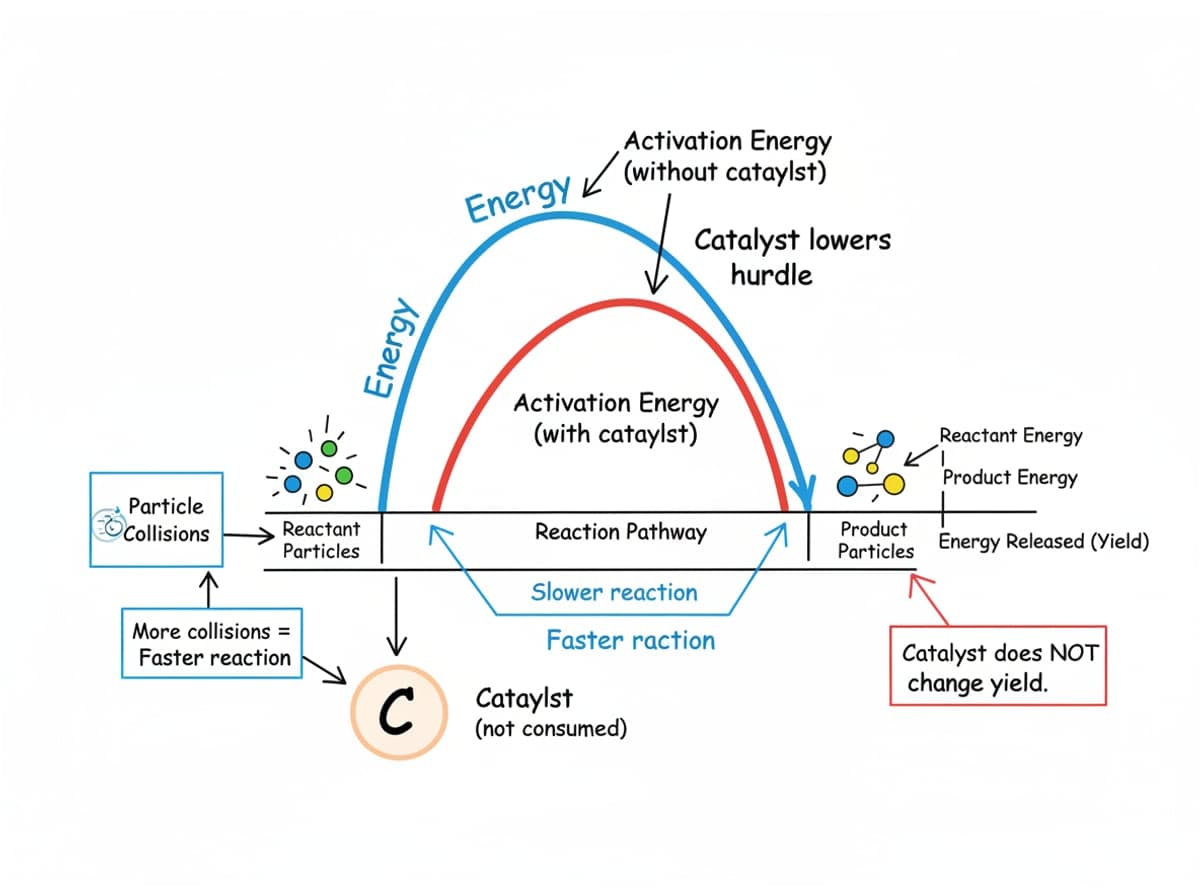
The catalytic pathway goes over a smaller hump, so a larger share of collisions succeeds at any moment. The same product forms; it just forms faster. The catalyst is not a reactant and is not consumed by the reaction, so a little of it can keep assisting across many reactions without ever being refilled. It offers a shortcut, then steps aside so the reaction can happen on its own.
The common mistake is treating a catalyst as something used up, or expecting it to create more product. A catalyst changes the speed, not the yield. The balanced equation is unchanged; only the route changes. The start point and end point of the reaction stay exactly where they were. The product amount is set by the reactants, and catalysts change only the timing.
Other rate factors fit the same collision picture. Higher temperature makes particles move faster, increasing collisions per second. Smaller pieces expose more surface area for collisions. Surface area, concentration, temperature, and catalysts are all knobs on the same collision rate. Each factor raises the chance that a reacting pair meets with enough energy, and the direction of the effect is easy to predict.
Keep this idea
A catalyst lowers activation energy and is unchanged at the end; it makes a reaction faster, not bigger.
The practice checks apply only to the displayed examples. Follow your teacher’s guidance for your own assignments.
Get help with your own questionA practice lesson each week.
A short practice lesson for your inbox. Free, with a one-click unsubscribe.
Search all 106 free lessons for “Reaction rates and catalysts”