
Why we have seasons
One small step at a time. Ask for a clue whenever you need one.
Ask about your own question- Step 1
- Step 2
- Step 3
- New question
In June, the Northern Hemisphere has summer while the Southern Hemisphere has winter. Both are the same distance from the Sun. Why?
Common mix-up
In this example, a student wrote Because the Southern Hemisphere is farther from the Sun in June..
Earth's distance from the Sun barely changes. The 23.5-degree tilt of the axis makes the seasons by changing the angle and hours of sunlight.
Guided example. Your answers aren’t saved or sent.
See why this works
Why is it hot in summer and cold in winter?
You said summer comes when Earth is near the Sun. Earth is closest to the Sun in early January, during northern winter. The tilt is the cause.
Earth's 23.5-degree tilt makes sunlight hit each hemisphere more directly and for more hours in its summer; distance from the Sun barely changes.
Earth spins on an axis tilted 23.5 degrees from the vertical. The axis points the same direction in space all year, toward the North Star, while Earth travels around the Sun. Because the axis keeps its direction, each hemisphere leans toward or away from the Sun as the year progresses. That steady lean, not any change in distance, is the entire engine of the seasons.
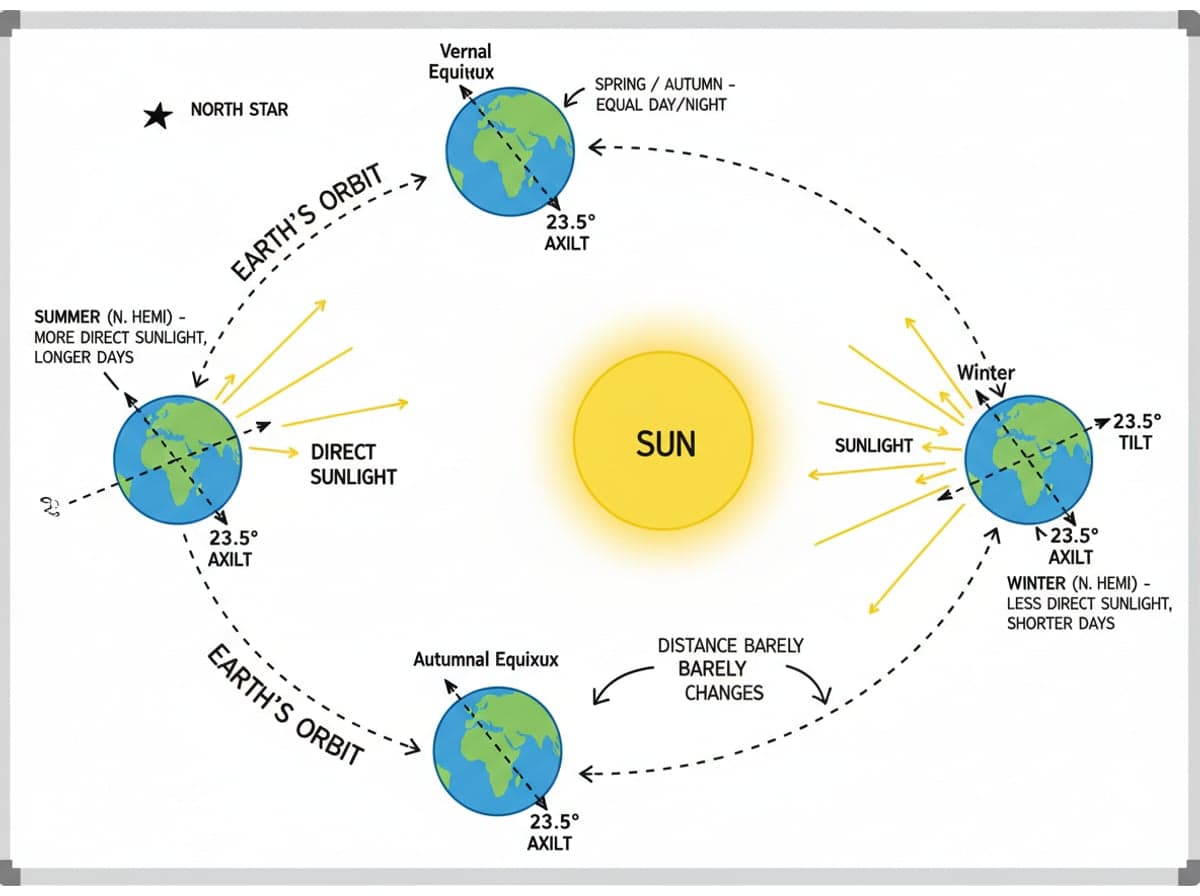
A tilt toward the Sun changes the energy budget in three ways. Sunlight arrives at a steeper, more direct angle, so the same patch of ground receives more energy. Days grow longer, so the Sun shines more hours. And the light passes through less air, losing less to scattering. More direct, longer and punchier sunlight is summer. Tilted away, all three reverse: the light is shallower, days shorten, and that is winter.
Distance from the Sun is almost irrelevant here. Earth's orbit is nearly circular, and its distance from the Sun changes by only about 3% across the year. In fact, Earth is nearest the Sun in early January, the middle of northern winter, and farthest in early July, the middle of northern summer. If distance caused the seasons, the whole planet would have summer in January, and it does not.
Because the axis points one way world-wide, the hemispheres get opposite seasons. When the Northern Hemisphere leans toward the Sun in June, it has summer while the Southern Hemisphere has winter; December flips them. Near the equator the effect weakens, so tropical regions have rainy and dry seasons instead of hot and cold ones. Near the poles the swing is largest, with days and nights months long.
Keep this idea
Earth's 23.5-degree tilt makes each hemisphere face the Sun more directly and for more hours in its summer, and gives the two halves opposite seasons.
The practice checks apply only to the displayed examples. Follow your teacher’s guidance for your own assignments.
Get help with your own questionA practice lesson each week.
A short practice lesson for your inbox. Free, with a one-click unsubscribe.