
Wave properties
One small step at a time. Ask for a clue whenever you need one.
Ask about your own question- Step 1
- Step 2
- Step 3
- New question
A buoy bobs up and down as ocean waves roll past. What is actually traveling from the storm to the shore?
Common mix-up
In this example, a student wrote The water itself, carried all the way to the beach..
Waves move energy through a medium while the medium only oscillates in place; the water does not travel with the wave.
Guided example. Your answers aren’t saved or sent.
See why this works
What really travels along an ocean wave?
You said the water rides along with the wave to the beach. Watch a cork bob: it stays, and only the energy travels.
Waves transfer energy through a medium without transporting the medium; wavelength, amplitude and frequency describe the wave.
A wave is a traveling disturbance that carries energy. Water waves, sound waves and light waves all do one job: move energy from one place to another without moving the stuff they pass through. A cork on the sea bobs up and down and drifts hardly at all while wave after wave rolls past it. The cork wiggles in place; the wave's energy travels all the way to the shore.
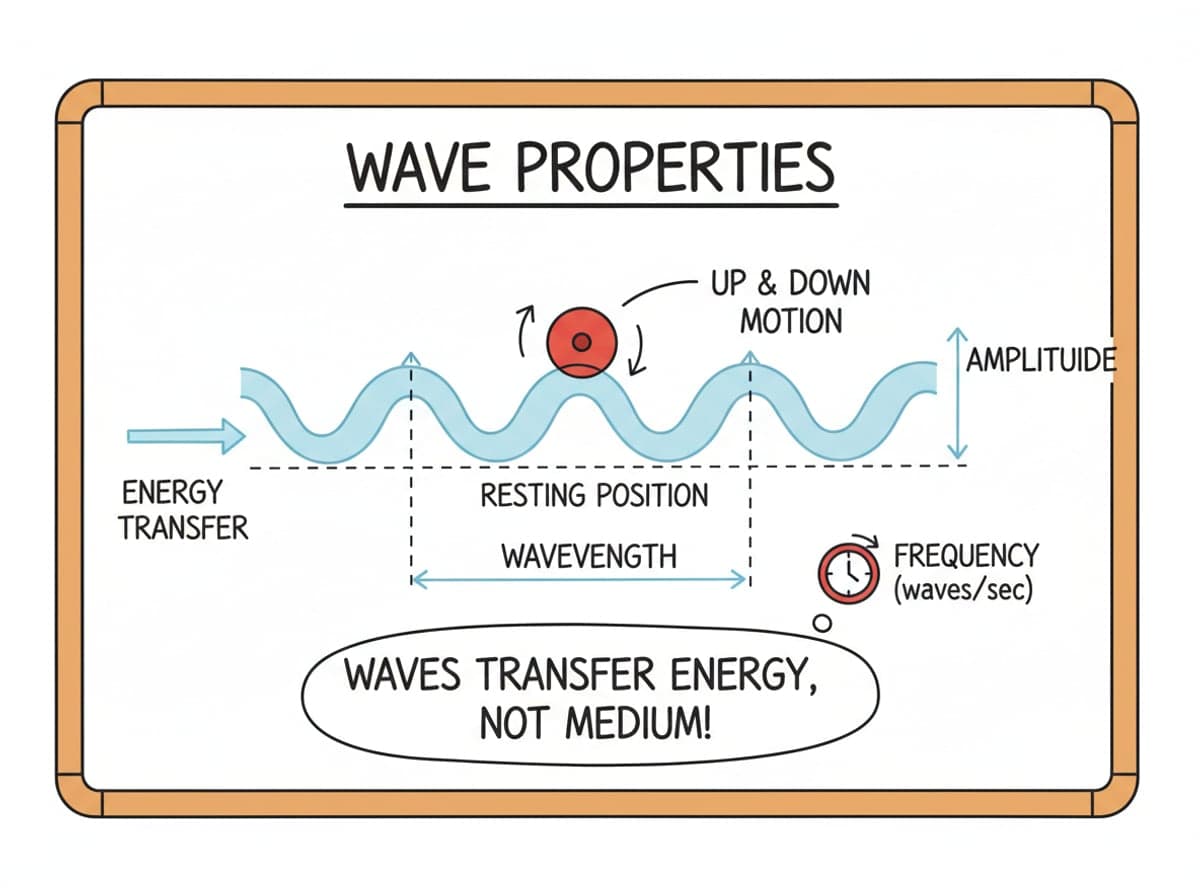
The three numbers that describe a wave are amplitude, wavelength and frequency. Amplitude is the height from the rest position to a crest, and it carries the energy: a big wave moves more than a rippling one. Wavelength is the distance from one crest to the next crest. Frequency is the number of waves that pass a fixed point each second, measured in hertz. Two waves per second is a frequency of two hertz.
Sound is a wave too, but it needs a medium: air, water or a solid. Hit a drum head and its vibration pushes neighboring air molecules, which push their neighbors, and the disturbance travels across the room. The molecules themselves only wiggle a tiny distance while the sound travels many meters. Remove the medium and there is no sound at all, which is why deep space is silent.
Waves carry energy, and bigger waves carry more. A heavy surf can throw a thousand kilograms of water onto the shore, delivering energy from a storm that began far away. The rules work together: frequency counts cycles each second, amplitude is the crest height, and wavelength is the crest-to-crest distance. Name the three and you can describe any wave and predict what a bigger or faster one will do.
Keep this idea
Waves transfer energy, not matter. Amplitude and wavelength describe size, frequency counts cycles each second, and bigger amplitude means more energy.
The practice checks apply only to the displayed examples. Follow your teacher’s guidance for your own assignments.
Get help with your own questionA practice lesson each week.
A short practice lesson for your inbox. Free, with a one-click unsubscribe.