
Z-scores
One small step at a time. Ask for a clue whenever you need one.
Ask about your own question- Step 1
- Step 2
- New question
A test has a mean of 80 and a standard deviation of 5. A student scored 85. What is the z-score?
Common mix-up
In this example, a student wrote z = 17.
The student divided the score by the standard deviation first, computing 85 / 5 = 17, instead of subtracting the mean first.
Guided example. Your answers aren’t saved or sent.
See why this works
What is the z-score of a test score of 85 when the mean is 80?
A z-score measures a data point in standard deviation units: how far it sits from the mean, and in which direction.
z = (x - mean) / standard deviation.
A raw score by itself is hard to interpret. An 85 on a test means something different in a class with a mean of 80 than in a class with a mean of 90, so statisticians standardize scores. A z-score converts any data point into a distance from the mean measured in standard deviations.
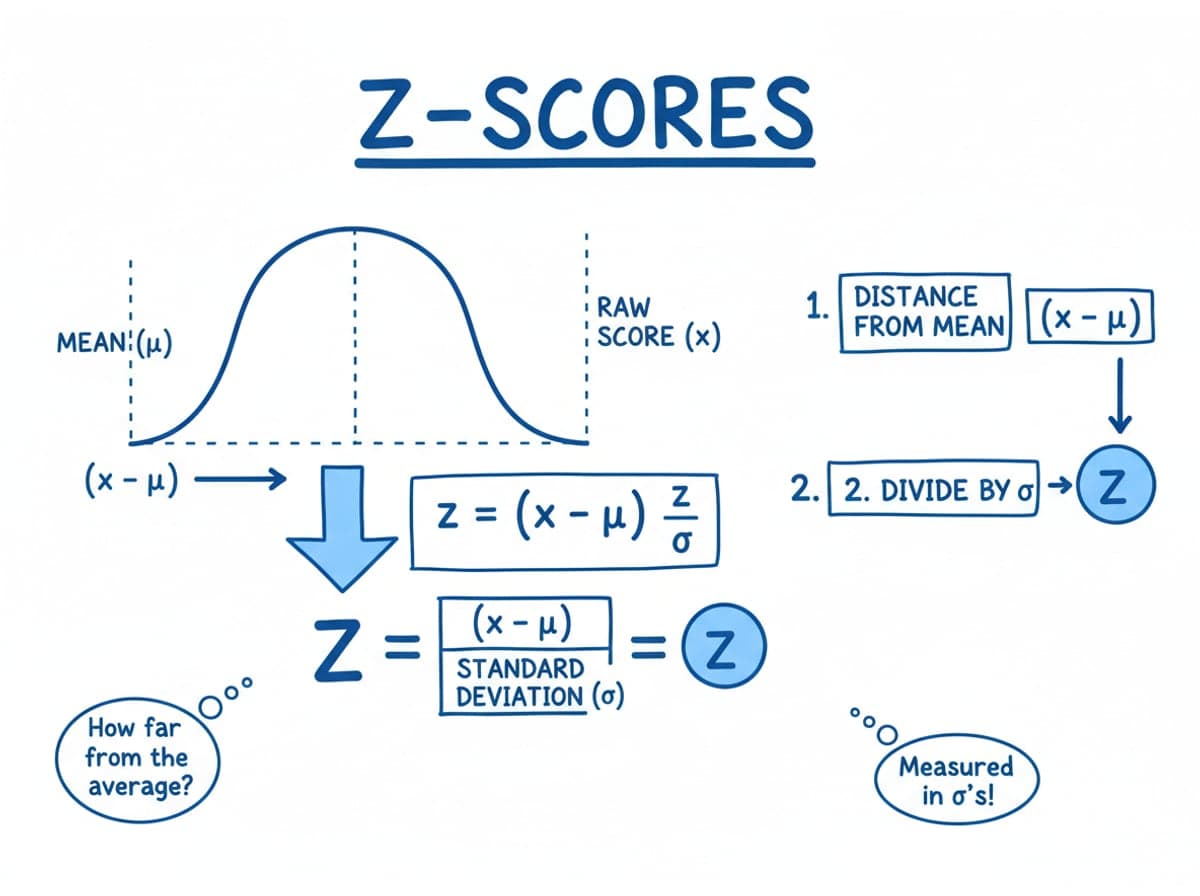
The formula has two steps, and the order matters. First subtract the mean from the score to find the deviation: 85 - 80 = 5. Then divide that deviation by the standard deviation: 5 / 5 = 1. The score sits one standard deviation above the mean. The common slip is dividing first, like 85/5, or multiplying the deviation by the standard deviation.
The z-score tells direction and size. A positive z means the value is above the mean, negative means below, and zero means exactly at the mean. The size tells how many standard deviations away, so scores with different units become directly comparable. An 86 in a class with mean 70 and standard deviation 8 gives z = 2: a much more unusual score than it first appears.
Z-scores are also how normal distribution tables work. With a mean of 0 and standard deviation 1, the z-score marks a place on the standard bell curve, and the area under the curve up to that place is the probability. Get the deviation first, and the rest of statistics has a common ruler.
Keep this idea
A z-score is a distance in standard deviation units: (x - mean)/sd. Subtract first, then divide, and keep the direction in the sign.
The practice checks apply only to the displayed examples. Follow your teacher’s guidance for your own assignments.
Get help with your own questionA practice lesson each week.
A short practice lesson for your inbox. Free, with a one-click unsubscribe.